Daredevil: End of Days

Ok, I swear this is the last one. I aim for variety and even this is getting ridiculous. If I could count the number of times I’ve ripped into Brian Bendis this on my hands I’d resemble something out of a Goosebumps novel.

It seems Bendis is returning to his roots somewhat by delving into the street-level superhero that really made his bones at Marvel back in the early 2000s. Utilising an end-of-an-era feel that’s strongly reminiscent of Batman’s The Dark Knight Returns, Bendis gives us End of Days – the bland, overhyped and overly-colourful conclusion to a superhero saga that renders the entirety of what came before it completely meaningless and-

Wait. Hold on. You mean, it’s not bland? It actually has a story?

And it treats the characters and mythos with respect? And it’s a call-back to the glory days of Bendis’ writing style by focussing on a narrative that doesn’t involve a galaxy-level threat and tons of Wolverine fanservice? And it uses writers and artists from previous Daredevil runs as a kind of last hurrah for some of the character’s most seminal books?

HOLY CRAP BENDIS, MAKE UP YOUR MIND.

Seriously, either stick to doing schlocky, overblown pieces of garbage or keep writing fantastic, thought-provoking and memorable instant classics that focus on narratives that kick ass. You can’t have it both ways.
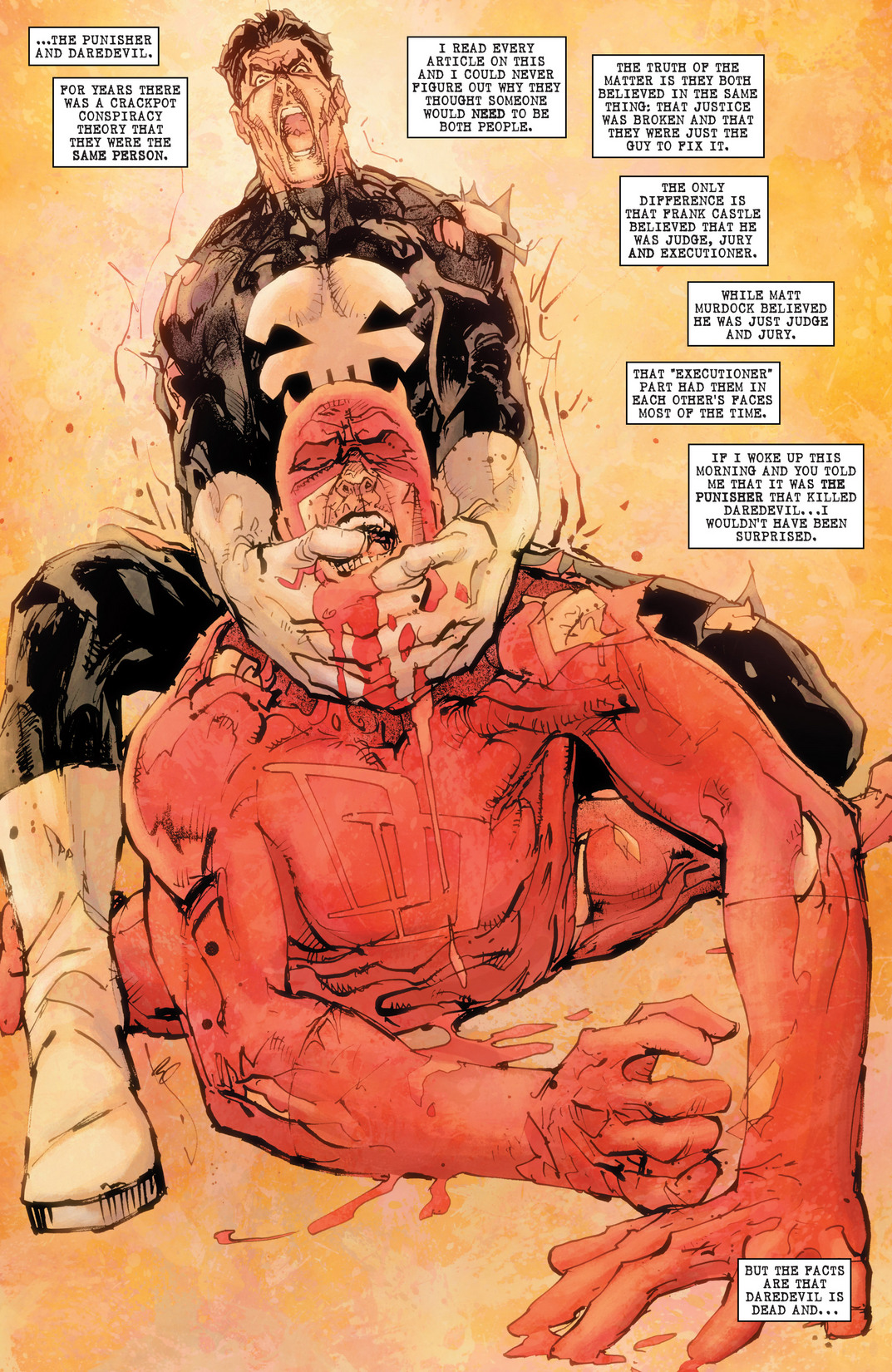
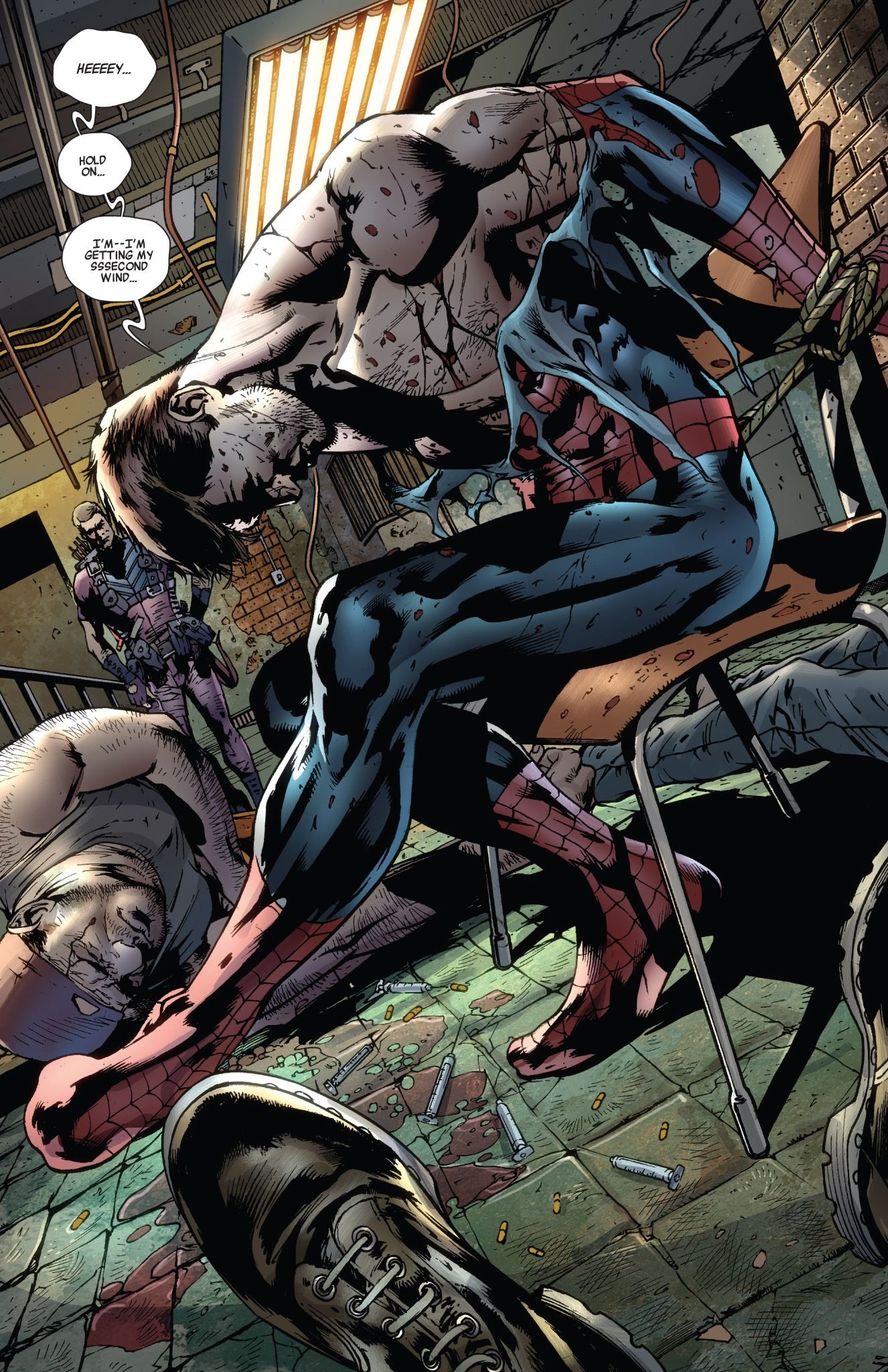
daredevil end of days 5Brian Bendis’ writing can best be described as like the American Congress, with crappy stories to the Right and truly excellent yarns to the Left. End of Days falls squarely into the latter category; after Daredevil dies in a climactic confrontation with a villain who doesn’t have a lousy name that reflects the old comic school of thought from the 80s that works as hard as it can to rip off Batman at every turn, intrepid reporter Ben Urich takes it upon himself to investigate his death and the enigma of his last words. The story that follows is a continuity cavalcade featuring appearances from almost anyone who graced the pages of Daredevil’s series, and the book itself is built by Bendis and a slew of old writers and artists from the Hornhead’s prior runs.

I will say this review is a tad biased because it’s Bendis writing Daredevil again. I haven’t really done a review on his run before but suffice it to say that the three Ultimate Collections of his run are so, so worth the money. Bendis took the character to hitherto unseen places and pushed the envelope in ways not seen since Frank Miller’s Daredevil: Born Again back in the 80s. It was subversive, gut-wrenching, harrowing story with very little light at the end of its tunnel but with a solid premise and excellent character work throughout. Go read it. Seriously, I know I keep saying that about books I happen to be partial to, but the original Brian Bendis Daredevil run is worthy of your attention.

As is End of Days. Bendis fully abandons the bravado and Buck Rogers qualities of his recent works such as Age of Ultron and All-New X-Men and goes back to the grounded, gunmetal feel of a life-on-the-street superhero and the sins he commits in the name of daredevil end of days 2security. Urich, too, works well as the book’s protagonist, and is still one of the best well-rounded journalistic characters I’ve seen in any medium since Will McAvoy took the desk in The Newsroom.
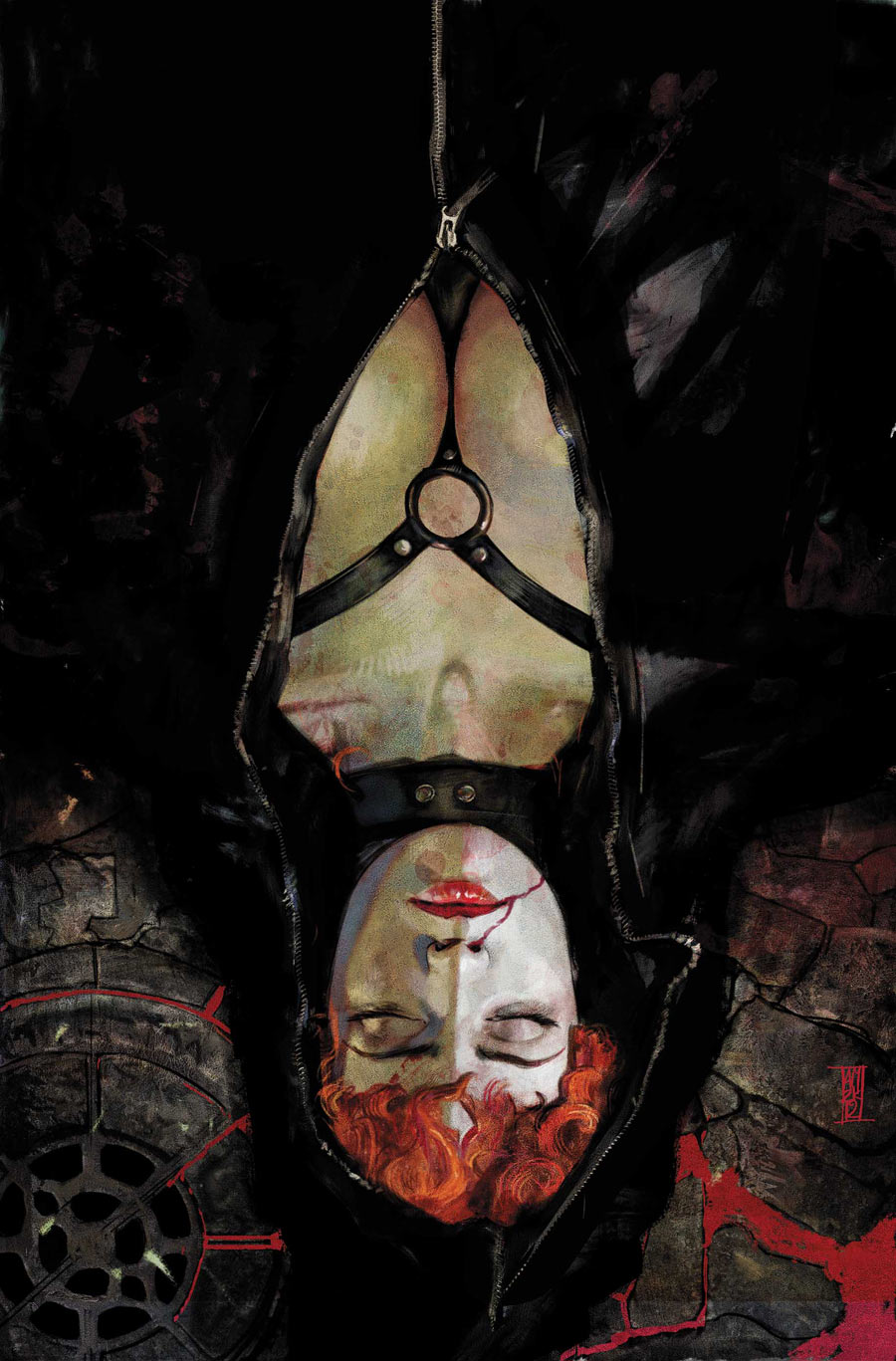
That said, this book is of no use to you if you’re not even a tad familiar with Daredevil’s curriculum vitae. Even people who’ve checked out Mark Waid’s recent run will get something out of it, albeit not as much as if you’ve read Miller, Bendis, Brubaker and Diggle in particular. This is a story written by and for devout fans, people who’ve experienced Daredevil’s trials and tribulations for the longest time. There’s quite a lot of reference to multiple past events that aren’t elaborated on for neophytes, so don’t pick this up expecting a gateway entry to Daredevil’s universe. I ‘spose the whole End of Days title is a bit of a giveaway that this isn’t a beginning.
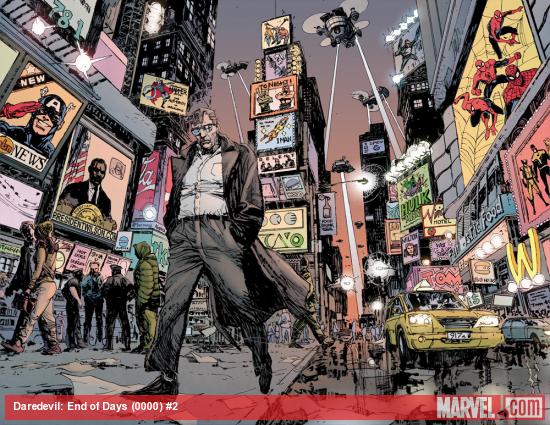
daredevil end of days 4

As I said, the story crips heavily off the themes and styles of The Dark Knight Returns, but manages a great balancing act between emulating that story and treading new ground of its own. It helps that the hero’s already dead, rather than Returns‘ use of a geriatric Batman as the narrative’s protagonist. By focussing on the aftermath, and on those caught in the blast radius of Daredevil’s death, End of Days gives us something with a very unique flavour and poses a bunch of questions that strike right at the heart of any superheroic pathos. I won’t give you the full rundown since most of my spartan readers probably aren’t interested in reading me pontificating for several thousand words, but suffice it to say the book manages to not only represent the truly excellent side of a superhero character, and the many great deeds they do which are seen as mighty when reflecting on their death, but also challenges the very nature of those characters. Little things like the tired nature of the Avengers as a brand, the many former villains and bystanders who question the hows and whys of characters like Daredevil, they all come together to really poke holes while flying the flag at full and glorious mast.
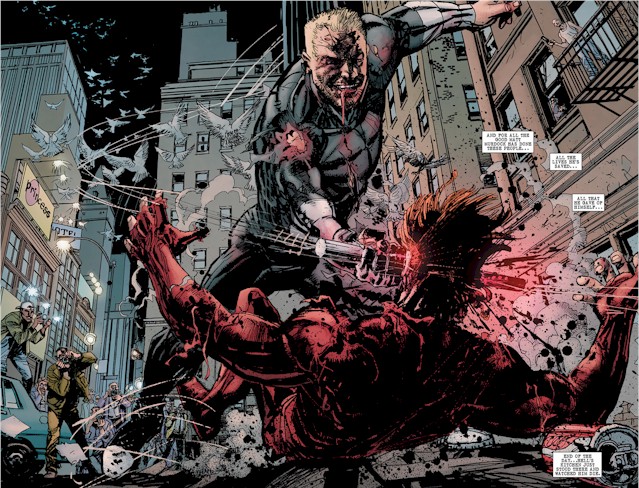
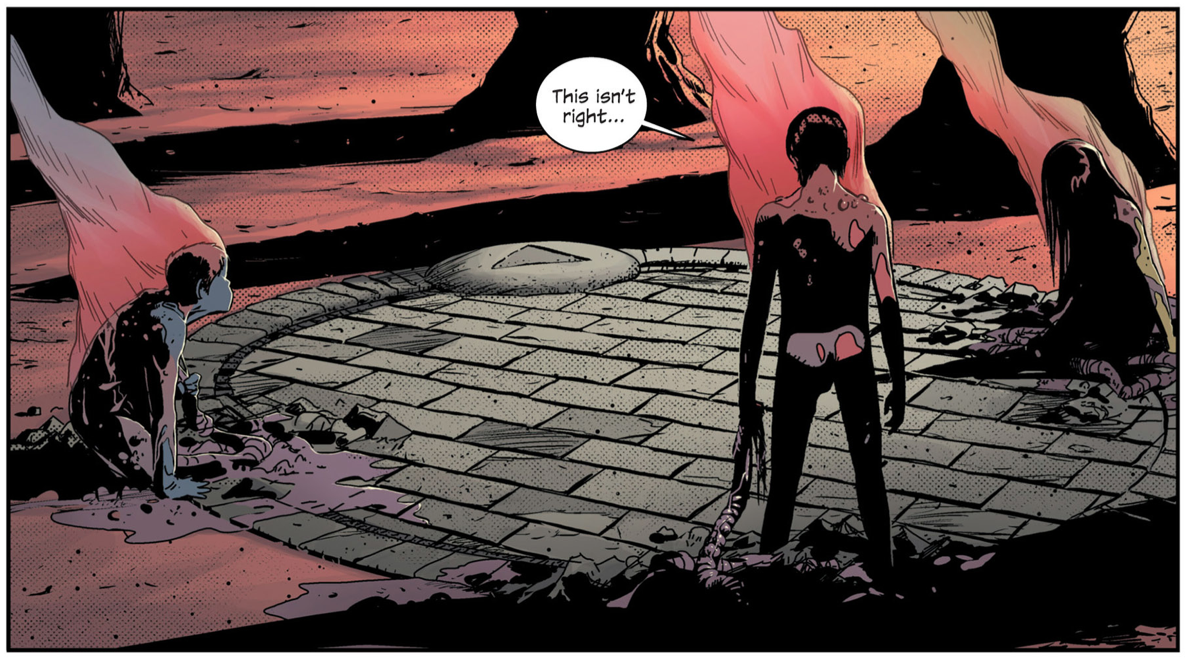
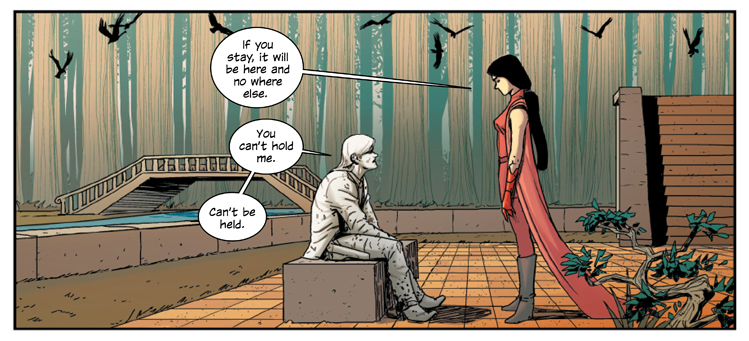
daredevil end of days 3Artwork is brilliant. I’ve got a soft spot for the grungy, dirty style of Alex Maleev and Klaus Janson, and with the abstract paints of David Mack and further assistance by Bill Sienkiewicz the story is brought vividly and darkly to life in a way that esoteric, full-lipped art just can’t match. I love some of the pop art styles being utilised in Waid’s current run by artists like Paolo Rivera and Chris Samnee, but sometimes it’s great to read a down-in-the-dirt story with some appropriately down-in-the-dirt artwork. It’s less a lovely bouquet of roses and more a punch in the teeth, and it’s the only time I wouldn’t mind being punched in the gut. Mostly since it doesn’t require a dentist’s tools afterwards.

Dialogue is not quite at the conversational, organic level Bendis achieved in the oft-referenced examples like Dark Avengers and Siege, but it’s still decent. The dynamic between Urich and his son is well-written, and the references and explorations of past events through Urich’s interviews with Daredevil’s old cohorts is written in a style that seems true to the characters. As I said, a lot of it is going to fly over the head of anyone not the least bit familiar with Daredevil canon, but for those of us who’ve been in the long haul there’s a bunch of tiny and well-chosen eater eggs peppered throughout.

End of Days may not end up being the perfect end to Daredevil’s career, and I’m sure there are those in the fan community who hate Bendis for concretely spelling out Matt Murdock’s final fate (since he has claimed, emphatically, that this book is indeed canon). It’s not sunshine and flowers in the end, but that’s never what Daredevil’s been about. His end is fitting, a death on the street in defence of innocents, and his legacy ensures that the implicit mission he started in Hell’s Kitchen will never be left without someone to finish it. I loved End of Days not just because it got the old writer/artist team of Bendis/Maleev together again, but also because it was a fitting cap to a superhero career that’s ebbed and flowed in terms of Murdock’s victories and defeats. It’s reflective, introspective and, ultimately, a little hopeful.

Sorry, got a bit too serious there. Coming next week: Chris reviews a Superman book through hilarious interpretive dance!
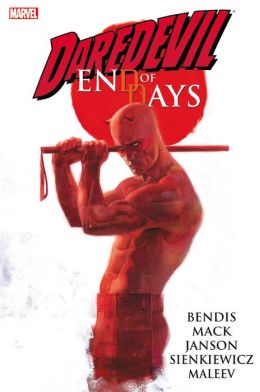
daredevil end of days cover

PUBLISHER: MARVEL COMICS

STORY: 4/5

ARTWORK: 5/5

DIALOGUE: 3.5/5

OVERALL: 12.5/15

BEST QUOTE: “You made a deal with the feds. You made no deal with me.” – Daredevil
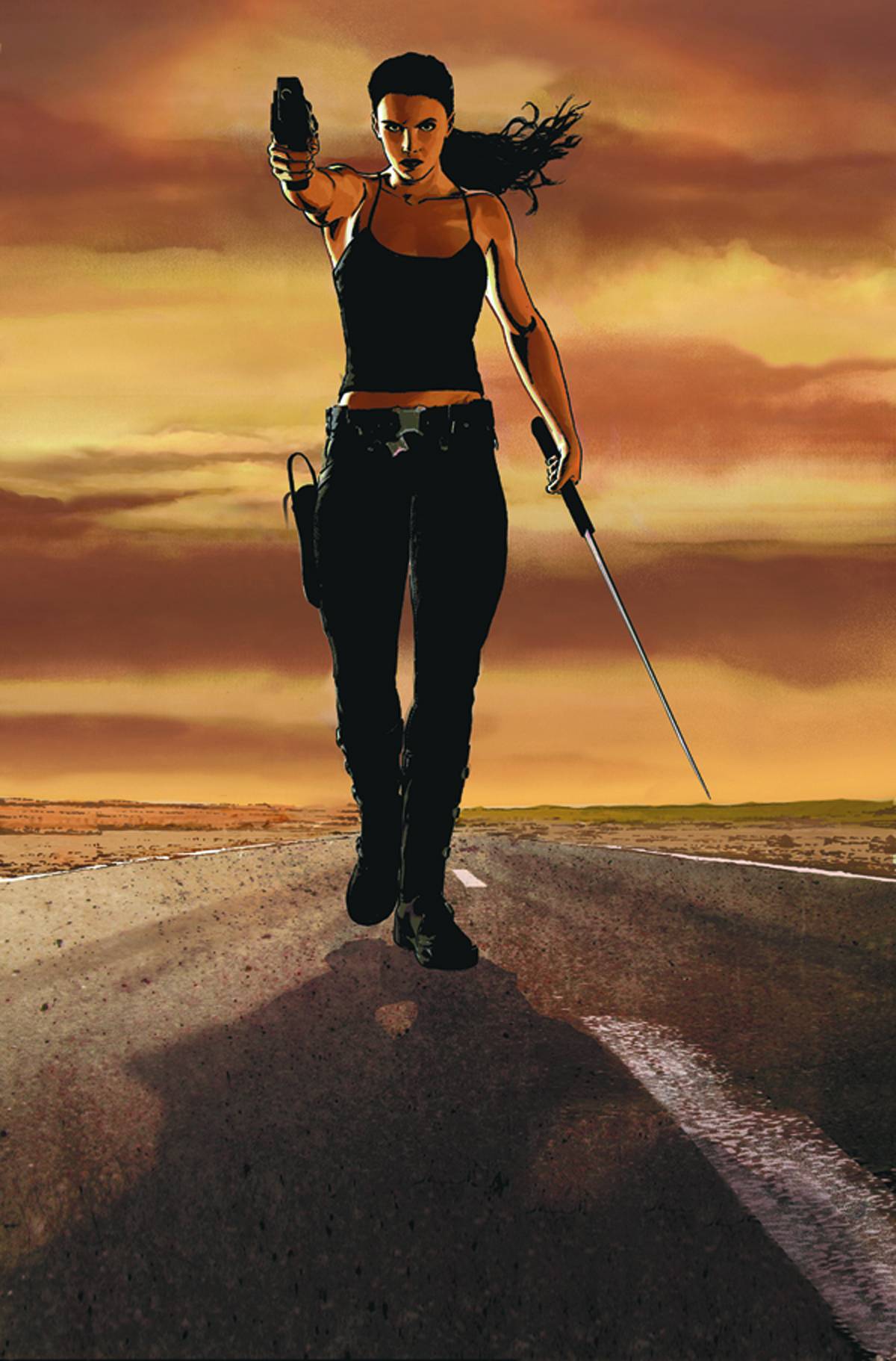
Lazarus, Volume 1

Despite Marvel making leaps and bounds with tying their IPs to successful big screen ventures, television shows and perfectly-handled comic book retools, a lot of their stuff can be classed as “samey”. DC might be making it big by slapping a Bat emblem on anything vaguely popular and provoking irate fanboys with unexpected motion picture casting choices, but quite a bit of their output slides into “second verse, same as the first” territory.

As I may have possibly intimated once or twice last year to people who only pretend to read my work, the real innovative gems in the comic book world are to be found in the indie stuff. If Twitter hype is to be believed, books like Lazarus are fast becoming the narrative of choice for those of us whose visual and textual taste buds range beyond a simple mish-mash of spandex-clad wrestlers flying around cities and invoking the ire of insurance companies by causing more civic damage than a tornadyphoon.

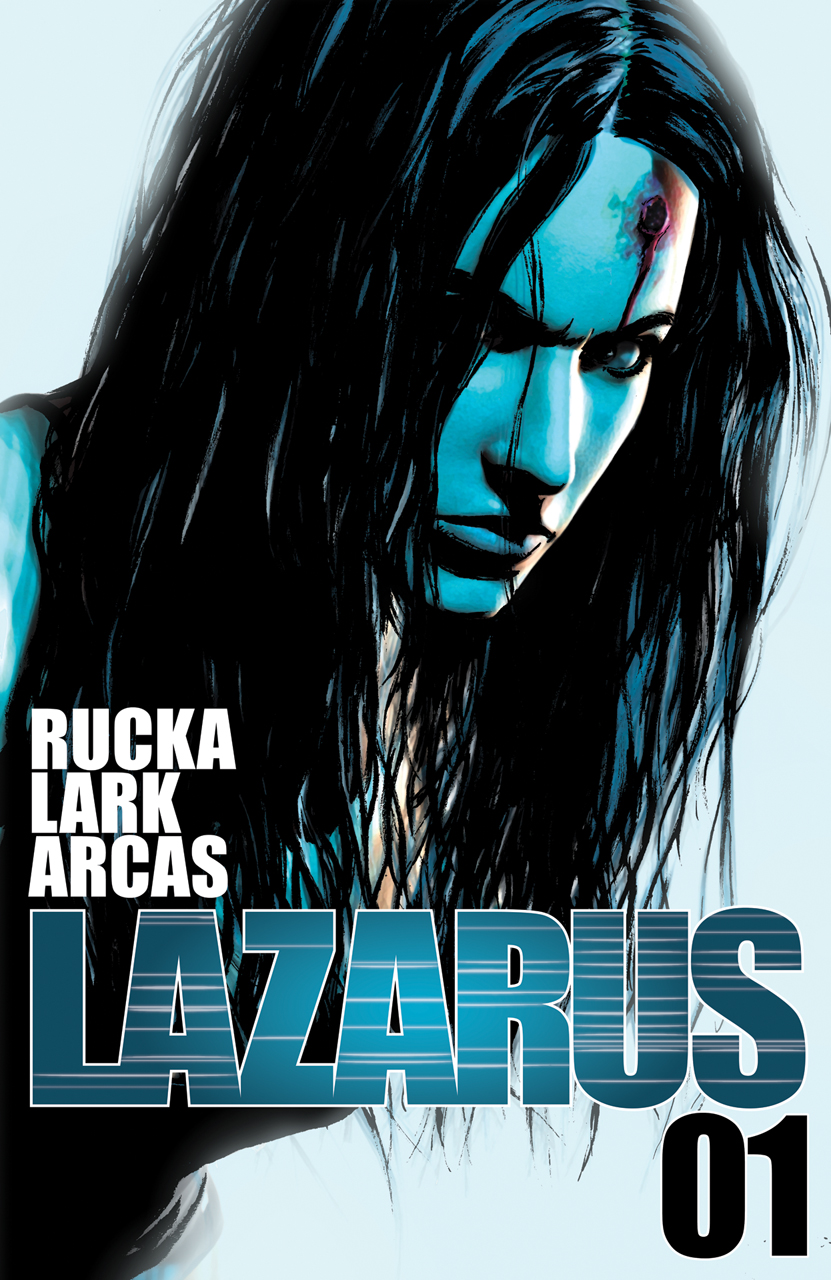
lazarus 1I’m actually not going to review the first volume of Lazarus in my normal fashion this week – suffice it to say it’s a well-crafted, intriguing little epic springboarding from the creative mind of Greg Rucka (responsible for starting Batwoman’s well-received retool back in 2010) and the artistic talents of Michael Lark and Santi Arcas. It’s a dry, post-apocalyptic grunge-fest with a story about high-class families having risen to national power in the wake of some kind of catastrophic Facebook friend-culling that Mother Nature decided to enact in real life. There are vibes of Game of Thrones and Revolution poking through, with the merest dash of Dollhouse added for good measure. It’s an engaging, intriguing first entry to a neat little story that is well worth your time to read, even if it does follow East of West in terms of having a first volume that’s less a story in itself and more of an expositional orientation to the weird and violent world of the Families. Definitely check it out, if only to help support an industry in dire need of more exposure.

On that final note, let’s get into what I really want to talk about this week; comics and cinema. For the purposes of this mini-digression, the term cinema encompasses both movies and television shows since more and more literary works appear to be being bastardised for the latter these days.

Now, I’m one of the first to trumpet the successes of adapted shows like ArrowAgents of SHIELD (not strictly an adaptation but obviously taking notes from the books in Marvel canon) and The Walking Dead, and it’s a credit to the writers and producers of those ventures that these works can match and, at times, surpass the quality of what they’re based on. Comics in particular seem to be being Shanghai’d onto our screens more and more, as anyone with a cinema subscription and a fetish for explosions can tell you. They’ve invaded the international market solidly for the last decade.  In addition to what we’ve already got in the superhero arena, future endeavours will involve adapting Locke and KeyMIND MGMT and Thief of Thieves, all indy titles that have been met with varying levels of success from comic readers. There seems to be a clear push towards carving new niches from the in-roads made by these books, in an effort to spice up otherwise bland network television predominantly in America.

With that in mind, it seems like a bunch of indy books these days are being written with a potential filmic adaptation in mind. Lazarus is one of them.

It sounds kind of like I’m mentioning this as a negative aspect, that seeing great and effective characters like Forever Carlyle and that immortal Mexican bloke whose name I forget on our screens is something to be avoided. In truth, I’m not. Lazarus is a greatlazarus 3 story, and I’m sure with the right direction it could potentially make it big on television (I’d advise against a film, since the book’s complex mythology is already being comprehensively laid out in the first volume and to cull that down to a two-hour film could only be to the detriment of the original work). My problem stems from the unresearched, unverified belief I have that Greg Rucka wrote Lazarus with a lean towards that kind of adaptation work.

I’m quite possibly making something out of nothing, and jumping to an illogical conclusion. It could just be complete coincidence that Lazarus is paced, illustrated and written like a movie, with several action set pieces, a few good fight scenes and a couple of extraneous characters who might as well wear their two-dimensional motives on their scalps as Celebrity Heads labels. The relative brevity of the book – four issues in all – even makes it seem like the kind of project that could potentially fit into that two-hour format even if they kept most of the deeper layers of the story. Or, heaven forbid, as the first of a summer action trilogy.

“But Chris,” I hear my five regular readers (not) cry out, “that’s just one example. Not all indy books are written like movies or TV, are they?” No, they’re not. Quite a lot of indy titles – most of them written by Jonathan Hickman, who has never allowed his works lazarus 4to be optioned for television – work better doing their own thing. Books like Chew and The Sandman would dilute the quality of the original work if someone ham-handedly tried to stick them in our living rooms, when they’re quite clearly written and nuanced for the medium upon which they’re published. Sometimes I even think Walking Dead would’ve done better off staying in comic form since the TV show’s immeasurable popularity leads to stupid decisions on the creative team, like keeping alive a villain who’s been set up to fall in the season finale because the actor draws viewers in with his haunting, macabre performance (and if you’re reading this, David Morrissey, please don’t take that as a swipe at you. I ❤ your Governor. Lots).

But then you have books like Revival, with its rural noir undead setting and characters quite clearly modelled off old soap opera stock. You’ve got The Massive, which tries to be a global warming documentary with a slight LOST bent. Most egregiously you’ve got Great Pacific, one of the most droll books I’ve ever read partly because every single issue feels like it was hastily written for an Aesop-heavy television series that’s as toothless and unchallenging as most of the shows that a station like FOX would air. These are books that, to my mind, despite those varying levels of quality, they have undoubtedly been crafted out of a desire to one day see them as colourful moving pictures. It’s done at the expense of proper comic book pacing, and made less as a great story on paper than as a possible future cash cow for moviegoing masses to shove milk into.

Like I said, it’s possible I’m pulling this supposition out of thin air. Lazarus could simply be the product of Greg Rucka’s excellently creative mind, and only resembles a movie out of crazy random happenstance. Whether it does or not it’s worth your time to lazarus 2read, and it’s definitely one of the more original titles in an indy market that seems more and more geared towards stories off the beaten superhero track. It’d be nice to know if books like Lazarus are written for comic books rather than for potential movies, since the former is a medium in dire need of more support as the tidal wave of motion pictures threatens to drown out the original blueprints. I hear a few upcoming books like Velvet and Pretty Deadly are shifting more towards reclaiming the medium a bit.

Whatever the case, don’t read Lazarus if you’re hoping to get on the ground floor of a fledgling movie fandom. Don’t go into the first volume expecting to say to future cinema audiences “Aww man, I was into this before it was cool!” Those are the kind of people I force-feed popcorn with a cattle prod.

lazarus cover

PUBLISHER: IMAGE COMICS

STORY: 4/5

ARTWORK: 4/5

DIALOGUE: 3.5/5

OVERALL: 11.5/15

BEST QUOTE: “[speaking about death being painless] I’m sorry. It isn’t. I speak from some experience.” – Forever Carlyle

Batman: Death of the Family

As a rule, if a comic I like happens to release two volumes within a year I’ll probably only review one unless there are massive differences between them. For example, despite the continued success of Jonathan Hickman’s Avengers, I’ve already covered a volume in 2013. Even though The Last White Event, Volume 2 of Hickman’s run, was awesome, it’d end up being more of me gushing about how great it is since they’re both in pretty similar veins. Since you’re probably reading this for some variety rather than me espousing the virtues of similar books week to week, I’ll hold off on giving you a second verse the same as the first.

That’s why I didn’t cover The City of Owls, Scott Snyder’s follow-up to 2012’s ass-kicking The Court of Owls and a core component of the Night of the Owls crossover hardcover earlier this year. Since the latter wasn’t technically a Snyder book in the same sense that City was, being a book composed entirely of Snyder’s story rather than from various other scribes, I figure that let’s me look at how he did writing the return of everyone’s favourite psychotic children’s entertainer.

Joker

To be honest, I was a little hesitant before diving into this one. The recent failure of Severed coupled with the sheer hype surrounding Death of the Family made me wary that it wouldn’t come anywhere close to meeting expectations. After all, to assume something will meet the standards set by rabid comic book consumers and internet trolls who’ve actually decided to try and enjoy something for a change is like believing a crowd of cultists who are telling you that no, really, that bucket of kool-aid is totally ok to drink because it’ll turn you into a dragon!

Sorry, that was a bit tortured. What I’m getting at is that it seemed a little unlikely to be as awesome as all involved said it was – but lo and behold, I of little faith have once again been proven tragically wrong.

death of the family 2Death of the Family picks up not longer after the members of the aforementioned Court of predatory night-birds either scurried off into the night or killed themselves (or both), and sees the Joker return to Gotham a full year after he had his face cut off by a two-dimensional villain. As a man with a plan for the Bat-clan, Joker sets about terrorising the city and making life extremely difficult for our flying-mammal-mascot hero and his fine feathered friends (and Jason Todd).

What sets this story apart from pretty much any other Joker-centric yarn I can remember reading is the brutal underpinning of logic that drives it. When he does finally explain his plan to Batman – or, rather, the reasons for his plan beyond mere psychosis – it’s a reasoning that actually makes a twisted, gut-wrenching sense. I might as well throw up a MILD SPOILER WARNING right now for anyone who doesn’t want to know that the Joker secretly intends to marry Batman.

That’s not it actually (though there is a rather squicky line implying that effect in the book’s middle). In reality, Joker’s gunning for Bats because he believes having allies like Nightwings and Robins and Batgirls around – the eponymous Family seemingly headed for Death – makes Batman weaker. He cares about these people, giving himself weaknesses that villains like Joker can exploit. He and his Family have become too good at their job and put all the big names in Arkham, meaning Batman never actually has to visit there like he once did. By killing off Batman’s allies, Joker believes he’s making him stronger and providing him with a chance to revisit the good old days where it just a man in a suit and a psychotic clown running the show.

While there are plenty of ways Joker’s new drive could be picked apart, I’ve got to say it’s kind of a compelling reason. There’s the usual cleverness brought on by his insanity apparently reaching some kind of singularity – which is the only reason I can think of for him being both at once dangerously intelligent and bats**t crazy (haha pun) – but it’s less random acts of terrorising violence and more targeted, thought-out conflicts that really do a number on the Bat-clan. This is in addition to the usual high quality with which Scott Snyder has written Batman and his internal monologuing, and it’s a nice change of focus to have one major entity of evil rather than the broader gang of hats that was the Court of Owls. It’s what we’ve come to expect from Snyder, but with enough difference to it to keep things fresh both for his run, Batman’s overall narrative and the Joker’s character specifically.

In addition, Greg Capullo keeps knocking it out of the park on artwork. Bats still looks terrifying, the colours are nicely juxtaposed by blacks and greys when needed, and Joker looks hideously deformed enough that it’s genuine nightmare fuel by death of the family 1story’s end. What particularly stood out for me was the opening sequence in the Gotham City Police Department with Joker’s return appearance, which is darkly lit enough in places and uses black panels to give a real slasher-horror-film-villain-entrance feel. It’s hella unnerving, and just one of the many reasons Capullo’s artwork fits the tone of the book beautifully. As well as that we have Jock, one of the sterling artists behind The Black Mirror, providing marvellously macabre illustrations for the back-up stories detailing Joker’s behind-the-scenes recruitment of Batman’s rogues gallery.

My one complaint (tis minor) is that, especially later on, the use of odd-dimensioned panels and copious amounts of black background makes visual elements a little jumbled. Capullo seems to rely really heavily on an almost exclusively-charcoal palette by story’s end, with a couple of coloured elements – such as Batman’s eyes and Joker’s purple coat – being the only things really standing out against the setting of the Batcave. The panels are also crazily-drawn to give the off-kilter holy-crap-what-the-hell’s-going-on feel that one expects in a Joker story (especially after characters inhale nitrous oxide, as they do here) and some of them almost seem out of order and hard to follow for the story progression. It’s a great technique done well, but Capullo kinda misses the mark a little here. Again, really minor complaint but still worth noting.

Dialogue – oh hell, you’ve read my other Snyder reviews. Just rehash the dialogue section from them and stick it here. Snyder is still up to snuff on every character he writes, giving them distinct flavours and remaining true to decades-worth of characterisations for most of them. I love his representation of lesser characters like Harvey Bullock, and the Bat-clan continue to be written with aces. Once again, a minor drawback are the scenes featuring Penguin with dialogue that feels awkward for the character, lacking his trademark bluster and self-assured vanity and makes him look more like a really passive figure. Granted, this is compensated by Joker’s scripting being immensely fantastic and blackly hilarious, so it’s all good.

death of the family 4

The dialogue also manages a hell of a thing by really invoking real voices; the way Joker’s written sounds almost like Mark Hamill is speaking his lines in your ear with a Heath Ledger inflection in parts, and Batman’s channelling a mashup of Kevin Conroy and Christian Bale something fierce. I know a lot of books are able to do that already – and certainly do when I read them – but this is a story that really makes the dialogue pop. There’s no other way for me to word it adequately, and even that’s not doing it justice. It’s like a sequel to The Dark KnightArkham City and The Killing Joke all at once, and speaks with voices we’ve heard before in a way that we haven’t experienced. Sorry if that doesn’t make a lot of sense, but it was kind of a rare experience for me to hear the characters’ voices so damn clearly in a book like this (either that or I’m just going insane – probably both).

I’m also sorry if it seems like too much of an obvious thing with me praising Snyder’s work to high heaven, but keep in mind that Severed has made me remember that even great writers can give you giraffe poo in a book sometimes. Death of the Family is a fresh take on several classic elements, and should no doubt be remembered one day as a seminal Joker story alongside The Killing Joke and The Clown at Midnight. It’ll certainly make the next few months of any Bat-title crossovers interesting, not least of all to see if the characters are able to stay in the same room as one another for periods of time.

If all else fails, and they really can’t, there’s always the ability to take on baddies while Skyping instead.

death of the family cover

PUBLISHER: DC COMICS

STORY: 5/5

ARTWORK: 4.5/5

DIALOGUE: 5/5

OVERALL: 14.5/15

BEST QUOTE: “[about Batman’s allies] If only you’d kept them close. *sigh* But you never do, do you? No, you send them off. You shut them out. You dangle them like bait. And that’s the point, Bats. The proclamation I made to you. Be as fast and smart as you want. But so long as they live, and you keep up this farce…you’ll always, always lose. Now, that leaves you with only one thing left to do…and that is, to accept your true role. To embrace it. And, in doing so, to take your rightful place…on your throne.” – The Joker

Avengers: Endless Wartime

Let’s talk about pacing.

Good movies – especially summer blockbusters (though not all of those are good) – use a sequences of flashpoints strung together by in-betweeny bits. Think about the majority of movies you like, and chances are they rely on a formula that utilises plot-altering scenes necklaced with dialogue and character moments as the glue that keeps it together.

There’s a risk run when writing those kinds of scenes; too little of the in-between moments and a lack of appropriate buildup sees the story become a series of vaguely-connected action scenes without any character grounding (see something like Transformers or Quantum of Solace). Too much of the indulgent character moments and big gaps in plot-moving scenes gives you a ploddy tortoise of an experience that’s either a completely pointless story or so far up its own butt that it’s in danger of choking on its own throat (see something like Cloud Atlas which, while being for me personally a fantastic film, does lean heavily on scenes that expand the characters at the expense of the plot).

Either framework can work if you’re into that, but I find the best visual narratives are ones that can strike a balance. Take something like Dredd; lots of bombastic action violence neatly juxtaposed against organic character development in both the protagonist and his helplessly-annoying tagalong kid. It’s a nice, neat ninety minutes of appropriate narrative ebbs and flows, connections between violent judgment of criminals and personal judgment of character motivation.

endless wartime 4

So when an OGN (Original Graphic Novel, for those not fluent in comic lingo) gets released that is made, for all intents and purposes, as a piece of literature designed to evoke the pacing and experience of watching a film – something made explicitly clear in the book’s Foreword – I’m immediately sceptical. For one it’s an Avengers book, meaning if they’re trying for a movie feel then it’s almost entirely an exercise in ripping off Joss Whedon’s excellent film. For two it implies adherence to one of the two aforementioned frameworks – either fast-paced action or plodding dialogue – since every other graphic novel I’ve read that’s been described or advertised as a filmic experience has ended up in one of those two camps. Both those implications can especially be a death sentence for a graphic novel when scribed by one of the generation’s most talented and award-winning writers in Warren Ellis, the mind behind Transmetropolitan and the book that inspired the plot of Iron Man 3.

I’ll be honest, I was a little hesitant to get stuck into Endless Wartime. The market’s quite saturated with Avengers-related stories right now so this was kind of like ripping open a block of Cadbury Sensations after a night spent in an inflatable pool full of melted endless wartime 5Toblerone (and now I’ve made myself hungry). In all fairness I probably would’ve waited for the paperback if it didn’t have Ellis’ name stamped on the front, since he’s a writer usually responsible for brilliant, subversive takes on things. I know it’s not good going into a work with expectations, but given Ellis’ resume I had the high hope it’d be a clever spin on something that seems to be dominating the comic market almost as much as Batman right now, for better or worse. I assumed that, because it was an Ellis book, it had to be great.

Well, you know what they say about one who’s assumed – it makes an ASS out of U and ME. Also there’s a D in there somewhere.

A Warren Ellis book comes with high marks in the three areas I grade a comic on – namely story, artwork and dialogue – and taking each part as a separate piece endless wartime 2of the whole, Endless Wartime falls flat. The story; the Avengers do some avenging. That’s it. There’s a biological weapon that looks like a cross between a Predator drone and a Mi-Go which is some unholy fusion of ancient Norse white whale and some World War II-era munitions tech, meaning Captain America and Thor have a bunch of flashbacks and lead a crusade to wipe them off the face of the Earth. The rest of the Avengers you know and love from seeing on the big screen show up to help, as well as a couple of sideliners in Captain Marvel and Wolverine – the latter of whom wins the prize for “Most Crowbarred-In Character to Serve the Plot” since Angela showed up at the end of Age of Ultron.

I’m really not generalising here; this is the plot, such as it is. It’s made clear early on that the actual quest to kill the Norse-Nazi weapons takes second place focus in favour of looking at the inner struggles of our favourite big screen Avengers, in particular endless wartime 6Cap’s assertion that combat for a soldier never ends (hence the incredibly clever title). The problem with this is that very little weight is given to examining those struggles. Cap and Thor get flashbacks, Iron Man ruminates for about a page on his past as a formerly immoral weapons manufacturer, Wolverine has some Uncanny X-Force-influenced dialogue regarding the need to kill, and Black Widow has her usual “red ledger speech”-inspired script taken almost wholesale from the movie. For a book trying to inspire feelings of sympathy in us, as well as taking inspiration from other existing sources of canon, it’s a very uninspired piece narrative-wise.

The story’s other big problem is its pacing. As Clark Gregg (who you may know as Agent Coulson) states in the book’s Foreword, this story is intended to act like a movie in your hands. It certainly starts that way with the cold open in a country clearly inspired by the real-world war in Afghanistan, which then segues into some opening chatter between our heroes before the narrative’s main conflict kicks in. Granted, quite a lot of the dialogue is written like someone would speak it normally and the threat is high-level enough that it could definitely work as a big screen battle.

Then, after a somewhat-carefully-paced first half, the book turns into a stop-and-start exercise that can’t decide whether to barrel through to another fight scene or linger on particular characters to flesh out their inner thoughts a bit more. The scenes out in theendless wartime 3 world have in-betweeny bits dealing with the Avengers going back to Stark Tower and musing for a few pages before going back out there to fight more baddies. Rinse and repeat. I swear there’s even a page of art with Black Widow getting ready for a mission at the Tower that’s copy-pasted at least twice at different points in the book – great for cost-cutting, not so much for great narrative flow. It’s not so much engaging as it is just there.

The same can be said of the artwork; compare Mike McKone’s art here – simple, blocky pastels with occasionally well-drawn battle scenes – with the art seen is some of Ellis’ other books, especially those of Darrick Robertson on Transmetropolitan and Simone Bianchi on Astonishing X-Men: Ghost Box. It’s far too simplistic, a little too accessible and, again, very uninspired. Even taken on its endless wartime 1own the illustrations are sub-par, not taking any risks and looking very safe. That said, there’s a great panel at the start where Captain Marvel’s space helmet retracts to show her luxuriously beautiful face underneath, and it’s spaced in such a way that would look great in a movie and looks really nice here (see the image above). If there’s one thing McKone can do well, it’s draw Captain Marvel (though I might look kindly on that because others have had a lot of trouble drawing her consistently in the past). Also, points awarded for having the characters in their Marvel NOW! costumes – consistency and a firm place in canon is always appreciated, which is a lesson Age of Ultron could’ve stood to learn.

Finally, there’s the dialogue. This is probably the most Ellis-y bit of the book, or at least the most competently strung-together. The conversations between Avengers feel like natural, real dialogue for the most part, and they’re certainly channeling the appropriate on-screen counterparts when they speak. As with the art though, it’s all very safe and comfortable. Ellis walks a line between giving away too little exposition through character dialogue and giving too much through introspection, and for the most part is feels like a reliable armchair one uses to unwind. Except if you sit in it for too long you have a restless, uninteresting sleep because it’s something you’ve done a million times before.

Endless Wartime is not a bad book, but it’s far from a great one. Even if I kill the expectation one would have from Ellis’ body of work, it just doesn’t do anything. It’s not a pop adventure in schlocktastic nostalgia, it’s not a gritty fight between heroes and villains, it’s not a layered and nuanced twist on an old framework the way books like Avengers World and The Court of Owls are. It just is; an adequate, untroubled piece that pushes no envelopes and moves no mountains. Might be considered a good gateway entry for newer fans, but even then I’d be hesitant.

One last note: someone at Marvel needs to set in concrete how the hell the Hulk is supposed to speak. Does he talk in complete sentences, does he use third person to describe himself, or does he just grunt and point? If Ellis had made him speak with sesquipedalian loquaciousness here, it might’ve earned him a few marks.

endless wartime cover

STORY: 2.5/5

ARTWORK: 2.5/5

DIALOGUE: 3.5/5

OVERALL: 8.5/15

BEST QUOTE: “Steve, this is Tony. Tell Jarvis to make sure he’s using the single-estate coffee from Guatemala, and the Starkia. It’s genetically tweaked Stevia sweetener, but Stevia’s a dumb name.” – Tony Stark

Age of Ultron

Not too long ago I was on holiday in England. While the weather could at times be charitably classed as less than ideal, it was still a fantastic experience and one that I would heartily recommend to anyone with an architecture fetish or immense and overwhelming love of bacon (seriously, English bacon is frikkin’ awesome). During my stay I visited the Forbidden Planet store in London, which is basically a semi-underground Shangri-La for comics and pop culture nerds like me.

After piling a number of books into a basket that would almost certainly eclipse my luggage weight limit for the flight home, I took them to the counter. The salesman unpacked them, scanned them…then stopped at a particular one.

“Look,” he said, “I don’t usually do this, but are you really sure you want to buy this book for £56?”

I blinked, confused. “Um, why?”

“It is the worst thing I’ve ever read in my life,” the salesman claimed. “Seriously, borrow it from a library or from a friend, but I would really recommend not wasting £56 on it here.”

My eyes widened in shock. “Seriously? It was worse than Avengers vs. X-Men?”

The salesman nodded sagely. “That’s the glory days compared to this piece of trash.”

I could hardly believe my ears. Putting aside for now the fact that a salesperson was actively and emphatically warning me off spending quite a bit of money on one of their products (which in itself has never happened to me before), this man was insisting that the book was the worst thing he’d read in his life. Further, that it was worse than AvX, considered by me to be one of the worst crossover events of recent memory and having earned a deserved spot on my worst books of 2012 list. I didn’t think there was much in the way of blockbuster superhero summer events that could eclipse the mediocre plot and complete letdown of Marvel’s top writing talent in such a method that AvX ended up doing. Clearly, this salesman believed otherwise.

So there was nothing else for it. I thought for a moment, then replied, “In that case, I have to read it.”

The salesman shook his head – out of bemusement or lamentation, I wasn’t sure – and put Age of Ultron in my shopping bag.

age of ultron 3This experience set the bar for my expectations going into the first of Marvel’s two blockbuster superhero summer events for 2013 (the other being the considerably more awesome-looking Infinity). Granted, those expectations were minimal to begin with; I’d read the first two issues during the initial release, and while they showed promise they weren’t good enough for me to consider sticking with them long-term. Wait until the hardcover’s out, I thought, then see if it lives up to the hype.

Well, perhaps “hype” is the wrong word. The path to the story has certainly been long and winding, set up during a one-off Avengers issue back in 2011 and being left mostly unregarded orage of ultron 1 mentioned since then. Despite his insistence that he was done with the Avengers and with big crossover events, Brian Bendis nonetheless returned this year to scribe the epic 10-issue series touted as an absolute and complete game-changer for the Marvel Universe in a way that seemed to evoke the DC groundbreakers of Crisis on Infinite Earths and Flashpoint. The story’s resolution was so secret that only half a dozen people in the whole world (including Bendis) knew what it was beforehand, and when the last issues were printed they came sealed and polybagged to avoid anyone spoiling the grand conclusion to Bendis’ epic (not that that did him any good, as it turned out that an intrepid internet user was able to leak the story a few days before release anyway. Curse you, denizens of the internet!).

With that in mind, I dived into Age of Ultron. Like AvX before it, the hardcover came with both the core story and a few ancillary issues as well that promised a diversity of writing talent and story focus. While I already knew the broad strokes of the ending I was curious to see if the road to that ending was well-paved and executed, and if the salesman’s dire warning to me would prove prophetic.

So in the end, does Age of Ultron meet the hype, exceed expectations and give us a crossover worth reading, or did the salesman have it right? Well… in short, it’s meh.

age of ultron 5

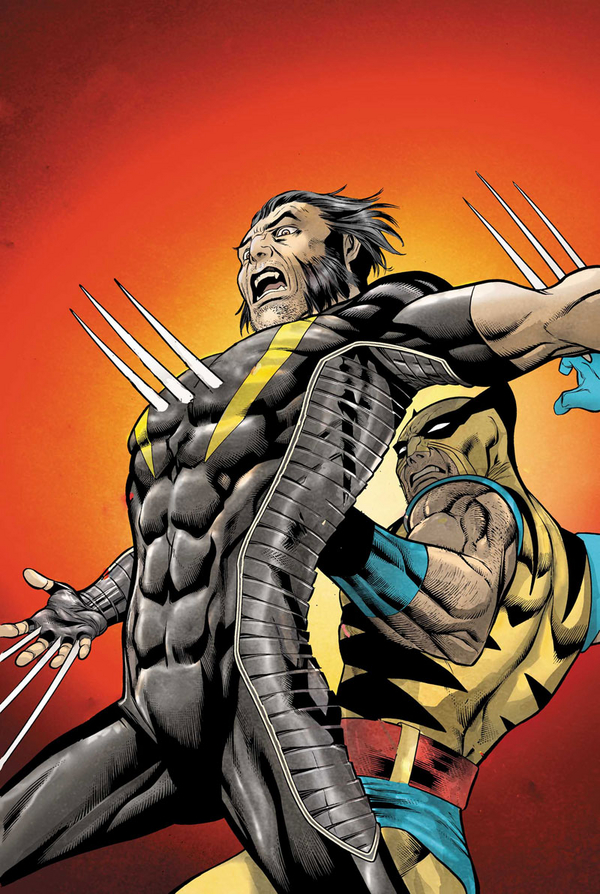
The story starts off pretty standard for an event comic; Ultron kicks Avengers ass, takes over the world and creates a superhero mortality rate that ensures some kind of reset button will get hit at the end. A world-beating idea is hit upon by those who remain to go back in time and kill Ultron’s creator, Hank Pym (aka as Ant-Man and a bunch of other goofy aliases). Wolverine steps up to the plate alongside Invisible Woman (whose presence in the story is never quite justified) and heads off to do the deed.

Then some stuff happens. Then the world resets. Then a character from Spawn appears.

Yeah.

What begins as a carefully paced, tonally-sharp piece very rapidly devolves into an over-the-top superhero spectacle that makes Fear Itself look tame in comparison. The entire middle chunk of the core story deals with Wolvie and Invisi-Lady killing Pym, then realising it wasn’t such a good idea, then convincing past selves it’s not a good idea, then Iron Man becomes Darth Vader, then Ultron disappears, then he’s back and takes over again, then Morgana Le Fey shows up, then Captain America dies-

UGH!

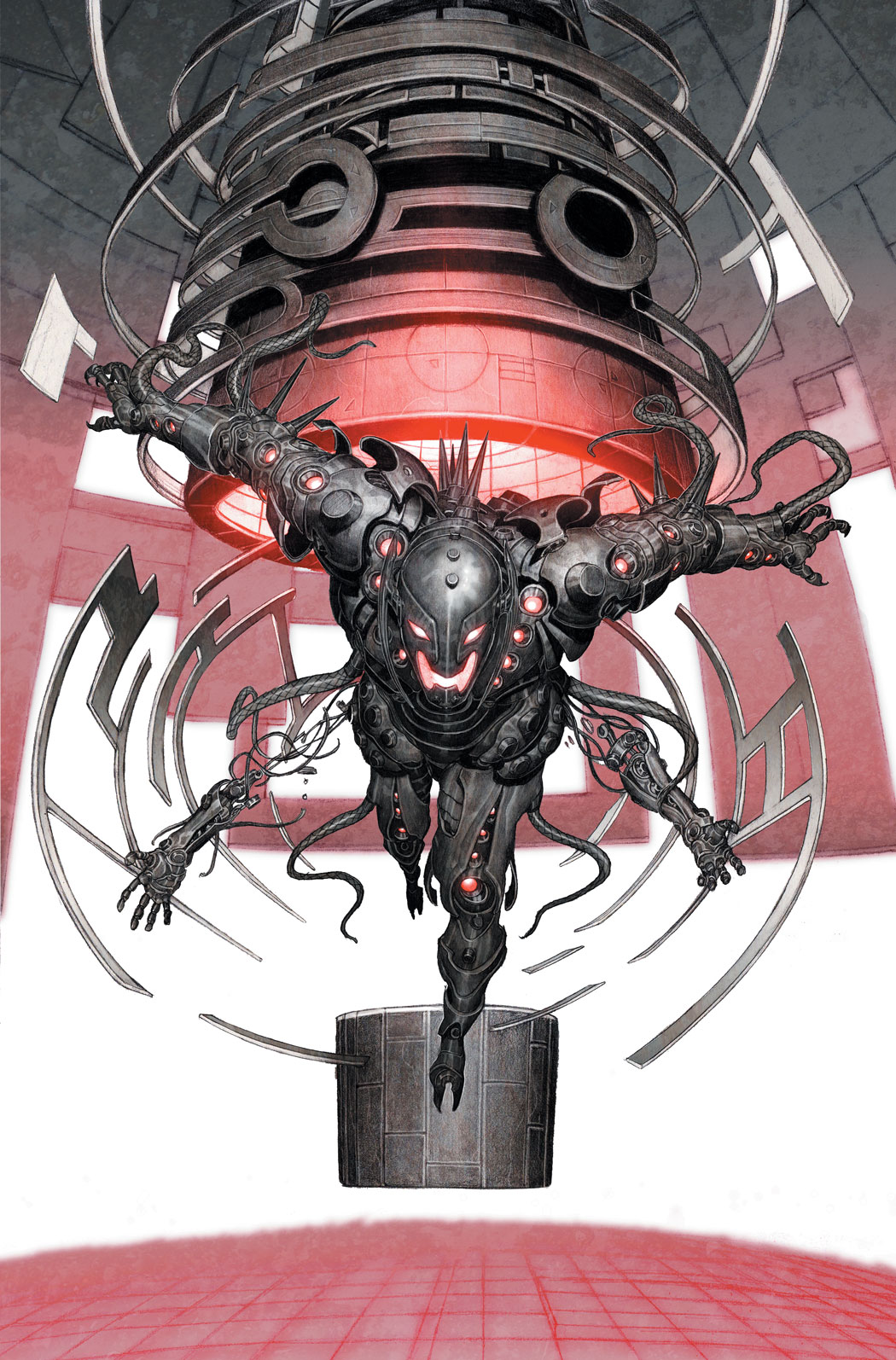
Ok, time out. Way too much stuff happens, yet at the same time not much is going on at all. The plot gets thin, with a lot of splash pages and minimal dialogue used to pad out the book’s pagecount, then suddenly it all wraps up again at the end. It’s kind of hard for me to describe; things happen, then they stop happening. Ultron’s around, then vanishes for most of the book before reappearing at the end for the predictable superheroic event-ending victory. If it didn’t say otherwise on the cover, I’d be convinced that Age of Ultron was the product of no less than seventeen different writers who took scraps of separate stories they’d envisioned and combined them into something with a vague narrative structure.

age of ultron 6And yet, I don’t hate it. Normally this is the kind of overblown, explosive superhero event book I’d steer clear from and recommend only as jailhouse wallpaper (as is the case with Avengers vs. X-Men). But I enjoyed it. It was stupid, its plot got very incoherent around the middle and the constant switching back-and-forth between artists was a little jarring, but I didn’t end up hugely disliking it. By the time I got to the ending I wasn’t as enthralled and energetic like I was when reading Siege, I didn’t feel equal parts satisfied and annoyed like in Batman’s Night of the Owls, and I didn’t despise and detest it the way I do The Children’s Crusade. It was just a good, fun, rolling superhero adventure with dumb plotting and some pretty decent artwork. What it lacked in cerebral material and narrative solidarity was made up by a few fun character moments, some great battle sequences and some truly excellent back-up stories in the issues accompanying the core series.

The two biggest problems that plague Age of Ultron go thus; first, its position in canon isage of ultron 4 dubious. It’s logical to assume the book takes place during Marvel’s NOW! relaunch (at least, before Wolverine turns into a gorier Doctor Who), but the issue there is that too much of the current Marvel world isn’t represented in the story. Many Avengers uniforms are either completely different to their normal attire or are the older, pre-relaunch outfits like Captain America’s fish-scale costume or Spider-Man’s blue and red getup rather than the Superior black and red duds he’s rocking these days (and on that note, if it weren’t for the Superior Spider-Man back-up issue it’d be damn near impossible to tell if the Spidey we’re reading here is our good ol’ pal Peter Parker, or that octopus guy who’s hijacked his body for a bit). There’s few references to many of the recent events that have happened in Marvel NOW, so the story could very easily have just taken place in some cosmic nether-reality where an author’s attempt at auteur writing co-exists with whatever readership Rob Liefeld reckons he gets.

age of ultron 7Second, for a book with the character’s name in the title there’s surprisingly little actual Ultron in it. He’s almost a book-end to the story, appearing at start and end and being almost entirely forgotten during the Avenger duo’s temporal road trip. Now while there’s no contractual obligation to have the big baddie appear in every issue of a giant summer crossover, it does help reinforce him as a villain if he’s present, y’know, at all. You could be forgiven for thinking that a more appropriate title would be Age of Ant-Man, since the book spends most of its time trying (and only partially succeeding) to paint Hank Pym as the real threat to the multiverse. I can imagine Ultron getting on the phone with his agent after this book and asking for an appearance in a DC book out of insult at his minimal casting. He’d fit right in with that Forever Evil series they’re doing at the moment, right?

age of ultron 2Despite these problems – and these are only the bigguns, mind, there’s plenty of other nails I could hammer into the coffin – I liked Age of Ultron. The dialogue isn’t as snappy as Bendis’ previous work on titles like Dark Avengers or Daredevil, the artwork by a veritable army of illustrators gets muddled and lacklustre here and there (though the art in some of the back-up stories is truly fantastic) and it is far, far from being anywhere near the best event comic you could hope to read. But I enjoyed it. Keeping in mind that I’m usually one to like things most others hate, take my opinion with a grain of salt. I would definitely say AvX still takes the cake as the worst event book I’ve read in the last five years, and were I to choose either that or Age of Ultron to read on a long plane flight it’s not even a competition. You’ll definitely get better mileage from other Elseworlds-styled series’ like Flashpoint or House of M, but take Age of Ultron for what it is – an event book, with lots of action and a marginal plot. You could definitely do worse.

One last note: the back-up stories are awesome. Ok, some of them (particularly Fearless Defenders) are forgettable, but I found the real character-based meat of Age of Ultron came in one-offs like Black Widow losing her eye, the Apocalypse Twins getting a life lesson from Kang the Conqueror or the truly excellent Mark Waid-written backstory and character study of Hank Pym in the book’s closing issue, which acts as a segue to the upcoming Avengers A.I. series. I would almost go so far as to say these issues are better than the core story, but on reflection they’re apples and oranges; Age of Ultron is the canvas, the back-ups are some well-chosen brushstrokes.

And yeah, maybe the Forbidden Planet salesman was right in saying that £56 (almost $100AUD) was a bit steep for this book. If I’d known then what I know now I might’ve waited for the paperback instead. But for a nice hardcover to add to the collection, sitting on your shelf for the occasional perusal, there are worse things you could shell out that much cash for. Or you could, y’know, go outside, enjoy the sunlight and have a picnic with attractive members of the opposite gender for roughly the same amount.

Whatever works.

age of ultron hardcover large

STORY: 2.5/5

ARTWORK: 3/5

DIALOGUE: 2.5/5

OVERALL: 8/15

BEST QUOTE: “Logan and I have gone back in time to stop Hank Pym from creating Ultron and destroying the world. And we carjacked Nick Fury’s vintage SHIELD flying car to do it. That alone should probably seem crazy. But once you’ve been to the Negative Zone and back nothing really shocks anymore.” – Sue Storm

Green Lantern: Rise of the Third Army

third army banner

Remember Batman’s Night of the Owls way back in February? Turns out it’s the first in a new trend for DC’s reboot books, being a graphic novel cobbled together from separate parts of each adjoining series and putting them all into one smooth, streamlined reading experience. At least it’s better than the old days, where if five ongoings crossed over then you needed to buy five separate books and a reading companion just to get the particular event all in one place.

But here, in one of their more intelligent moves, DC’s opting to have all the parts under one cover. Might mean you’ve got to buy twice as many books in order to have all the numbered volumes of your favourite titles too, but what are DC if not penny-pinchers?

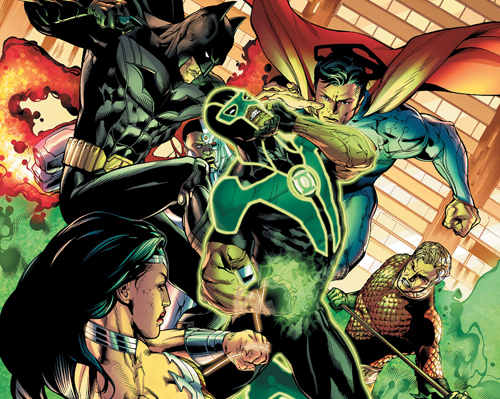
third army 4Anyway, Rise of the Third Army acts as the penultimate chapter for Geoff Johns’ amazing Green Lantern run, tying in parts from his story, Green Lantern Corps, Red Lanterns and Green Lantern: New Guardians just to make sure every colour on the spectrum of DC’s super-cops is represented equally. You’d be forgiven for thinking this’ll just be a giant superpowered smackdown, or that the Guardians are being possessed by an otherworldly force to be made the villains, or that the A-list cast of characters smooshed together in one book will lead only to a giant conflict that is easily resolved by a quick jab of the reset button afterwards.

You’d be wrong.

Following Hal Jordan and Sinestro’s disappearances at the conclusion of The Revenge of Black Hand, Earth’s Green Lantern protectorship falls to former Arabic car thief Simon Baz after a theft gone horribly wrong that leaves his brother comatose. While he adapts to his significantly altered new life, Earth’s surviving three green bug-zappers – Guy Gardner, John Stewart and Kyle Rayner – face problems of their own as the Guardians launch their Third Army, kind of a fusion between a golem and The Matrix‘s Agent Smith. Finally, seemingly separated from the main conflict, Atrocitus and his Red Lantern brood undergo changes that could very well have a profound impact on the rest of the universe.

Where Night of the Owls was more like a series of vignettes stitched together loosely under the broad umbrella of a 24-hour onslaught by Gotham’s Illuminati wannabes, Rise of the Third Army is a much more coherent, structured piece that manages a really rare balancing act with its content. This is a story, not a collection of short ones, and despite the shifts between charactersthird army 3 and plot points every now and then it all feels strongly connected. Simon Baz’s introduction to the world of Lanterns segways nicely into Guy Gardner’s excision from it, as he loses his ring and struggles to live life as a formerly-superheroic bystander (though, obviously, that one doesn’t last too long). The inner conflict in former GL saviour Kyle Rayner, as he struggles to wrangle the power of all seven major Corps into one amazing technicolour dream-spandex, ties into Red Lanterns lead character Atrocitus’ inner turmoil at possibly using the very weapons that killed his past as a means to safeguard his future. The Guardians’ overarching attack on everyone wearing a power ring comes full circle by story’s end, and the payoff at the book’s conclusion – leading to the final Johns-era book, Wrath of the First Lantern – is simply marvellous.

third army 2The pacing for Rise of the Third Army is spot on, effortlessly executed yet subtly and beautifully layered. Everything is relevant. Everything is connected. Disparate characters who we haven’t seen in a while (oh hello there, B’dg) come to the fore as heroes we hadn’t even imagined they could be. The real villainy behind it all carries a degree of understanding and, if it weren’t for the Borg-like Third Army zombies assimilating anything with two legs and a beating heart running around everywhere, can possibly be seen as not so much “villainous” as “misguided”. Granted, you’re definitely rooting for the rainbow Lantern brigade to kick their scrawny, wrinkled blue asses, but the fact that their actions are motivated by their own natural growth and realisation – rather than someone possessing or influencing them into being evil asshats – adds another satisfying layer of narrative assurance that no, it’s not going to be an easy fight against these guys because there’s no central power lording it over them. If the Lanterns defeat the Third Army it won’t just be a reversion to status quo – you’ll still have these immeasurably old midgets feeling grumpy and pissed off about the universe, and it’s a problem that can’t just be willed away by a wave of a magic power ring.

On a similar bend of goodness, the art’s pretty awesome too. As to be expected from a book with so many writers, artists and titles jostling for position, it can be a little eclectic but on the whole is fairly consistent. I find I like the illustration here more than I did the stuff in Revenge, but maybe that’s because every Lantern Corps is on display and I just like all the pretty colours. I’m simple that way.

Dialogue is decent, if at times a little too comicky. I get that Rise is supposed to be a grand space opera adventure with plenty of swashbuckling hero moments alongside the sheer dark terror of its eponymous villains, but the amount of wordiness going onthird army 1 gets a little overwhelming sometimes. Battle scenes in particular, such as the Gardner family machine-gunning zombies or the one which closes out the book, seem to have our heroes talking more than could be reasonably said in time that short. Unless the Third Army moves ponderously around and machine guns fire one bullet every three seconds, it’s a little unrealistic.

But who the hell am I to bitch about realism in a book like this? Rise of the Third Army is a grand, larger-than-life epic leading into another larger-than-life epic meant to close out a giant, years-spanning larger-than-life epic. It ascends above the quality we’ve expected of penultimate chapters – usually an exercise in setting the dinner table for the feast of a finale – and manages to be highly entertaining in its own right. The way every piece fits together beautifully makes it an event book worthy of your time.

Now if you’ll excuse me, I’ve got to go read Age of Ultron and hold it to the same benchmark. This could be fatal.

third army cover

STORY: 5/5

ARTWORK: 4/5

DIALOGUE: 3.5/5

OVERALL: 12.5/15

BEST QUOTE: “I think you blueholes have been given enough chances to keep screwing things up! You tried to destroy me, you tried to destroy my Corps–and that I will not abide! Been running from emotions all your lives–how about now? DO YA FINALLY FEEL SOMETHING NOW?!” – Guy Gardner

East of West: The Promise

During Rick Remender’s run on Uncanny X-Force (which, if you have any common sense, you’ll go read right now), there was a portion of the story that dealt with a reinterpretation of the Four Horsemen of the Apocalypse. You had War, a massive minotaur with an axe fetish, Famine was an old drummer soldier from the Confederate era, Pestilence was a geisha that spewed Japanese locusts, and Death came from a rich Persian family and just happened to be able to infest people with smallpox and bubonic plague with nothing but a laugh and an evil wink.

Ok, so they’re not a huge reinterpretation, but the idea’s there. The hallmarks of the original Horsemen are all there, just presented in a new way. They were engaging as baddies and as forces of nature, plucked from their respective veils and turned into arbiters of death by resident Marvel supervillain Apocalypse. They may not have all worn togas and ridden horses like this painting by ViKtor Vasnetsov, but they were still recognisable.

So what happens when you have three of these rapture-heralding equestrians as a trio of twelve-year-olds, whilst big brother outcast Death runs around as a pale-skinned, angle-faced cowboy with a white suit, terrifying smile and a pair of sidekicks who wouldn’t look out of place at the Hellfire Club? Well, what happens is that you get East of West.

east of west 4

The premise, devised by the weird and wacky Jonathan Hickman of current Avengers and Manhattan Projects fame, is straightforward at first blush. Death’s trying to collect some debts from those who’ve slighted him whilst staying one step ahead of his three newly-reborn siblings, who have anger management issues to make the Red Lanterns look well-adjusted. Along the way Death encounters a bartender with an anthropomorphic eye, a Mao-esque empire holding his former love interest captive, and a conniving and possibly completely evil Confederate town mayor with a penchant for naked young women and playing both sides of a conflict. The latter’s kind of like Littlefinger from Game of Thrones if he had a Confucius beard and a Southern twang.

east of west 2Beneath all this surface plot, though, is Hickman’s trademark complexity of character and moving cogs of the greater narrative machine hidden underneath the gloss. Granted, as a first volume there’s only so much The Promise can deliver in terms of character depth and explanation of the setting without devolving into telling rather than showing, but as with Manhattan Projects it seems like this is the setup for a next instalment where things move ahead at double the pace of the introductory chapters. There are plenty of plot teases laid out for Death and his supporting players, and while he’s not as potent or engrossing a character as others Hickman has started writing (particularly Oppenheimer in Manhattan and Black Panther in New Avengers) there’s definitely enough backstory and depth hinted at to make him a potentially great character.

The story does get a little misdirected and slows down around the middle with the plot concerning Death’s former love interest, the daughter of a Chinese communist overlord with a fortress to make the North Koreans weep, and while there’s a fairly significant development along that line which comes towards the end of the book (possibly setting up the larger conflict of the series) it comes almost as played for shock value. I won’t spoil it here but you’ll know it when you see it – I’d be interested to hear people’s thoughts on it. Remember my previous statement about Remender’s Horsemen being a different interpretation on the concept? I think The Promise‘s big development could tie into that a bit here.

Artwork by Nick Dragotta is gorgeous. It’s an antithesis to Nick Pitarra’s Manhattan Projects blocky, limited pallet and facial complexity artistic scheme. Here we’ve got a fleshed out Western setting juxtaposed nicely with cyberpunk and a bit of urbaneast of west 1 fantasy, and while the faces don’t have the lines of definition Pitarra gave them there’s still enough shape and difference in them to give them distinct appearances and features. It’s almost as good as the facial work Fiona Staples did for Saga, though thankfully we’re spared the ugly troll scrotum this time around.

Dialogue is a bit of a letdown. Hickman has this uncanny talent to convey lots and nothing at all with his words, giving his characters lines that hint at greater explanations of things and provide some clarity without going into anything expository in an almost Grant Morrison-esque way (read The Nightly News and Pax Romana for an idea of what I’m on about). Here, we get the smaller lines but less of the clarification, and there’s an over-reliance on assumption the reader knowing plot points and parts of the setting without them having been explained to us yet. The scenes with the aforementioned bartender with the living eye (which wins the prize for creepiest minimalist artwork of the year) rely on dialogue and terms that we haven’t heard yet, and a framework regarding the bartender’s true occupation that hasn’t been elucidated. It’s hardly a deal-breaker, and part of the book’s appeal does lie in not having everything laid out to us on a picnic blanket, but as Hickman’s dialogue works have gone so far this is a bit near the bottom. It still puts it head-and-shoulders above most other comics writing though – it’s like judging a low-rated Christopher Nolan film against any film by Uwe Boll.

east of west 3

As a beginning, The Promise does enough to get me interested in reading more of East of West. I’m more curious than engrossed at this stage, which isn’t a bad thing – it also happened to me with Manhattan Projects – and I’d be interested to see where we go next. It’s got just enough weird and unpredictability in its makeup that it could be an immensely fascinating story, and given its narrative and artistic heritage I would expect nothing less than a great read later down the track. If nothing else, it’s creative enough that it’ll help wash the taste of DC’s recent failings out of your mouth.

east of west cover

STORY: 4/5

ARTWORK: 4.5/5

DIALOGUE: 3/5

OVERALL: 11.5/15

BEST QUOTE: “You best be runnin’ back to Mao, tellin’ him the bad news. Tellin’ him…there will be no quarter. Go. Run for your life… run back to your city. The Great Wall is comin’ down… and my judgement will follow shortly.” – Death

Manhattan Projects: They Rule

God bless Jonathan Hickman.

As the auteur-driven creator behind post-modern odysseys like Pax RomanaRed Mass for Mars and The Nightly News, the man is a single-purpose writer. His goal: give you something that’s really off the beaten track.

manhattan 1While it’s true that his Marvel work is something different to the norm and well worth reading, his creator-owned pieces are another level entirely. A bunch of futuristic soldiers going back to Ancient Rome to change the course of future Christianity? An aesop regarding the follies of transhumanism that will lead to our race being subjugated by super-intelligent apes? A time-travel yarn about a dude fighting a war that started because time travel started a fight after time travel was started due to time travel starting before the other time travel began? Great stuff, even if it gives you a brain hemorrhage afterwards.

Ok, I’m not doing justice to the plot outlines above and they do sound like rip-offs of previously existing movies. It’s more what’s at the core of a Jonathan Hickman story that makes it unique. The art is usually gritty, abstract or both, the characters are anti-heroes at best and there’s rarely a completely happy ending – pyrrhic is the best you can hope for. More importantly, each issue has this tendency of building up joyous dread in you as you read, knowing that it can only go more downhill from here until you reach the end and it all spills out in a giant wave of anxious train-wreck tableau.

That’s a tendency that Volume 2 of Manhattan Projects runs with. Each new chapter of the alternate universe World War II all-star science brigade keeps building that awful, wonderful feeling in your gut that the protagonists are building towards a really, truly bad ending one day. It begins with a poor former Nazi getting his forehead cattle-branded with a swastika in a manner that’d make Aldo Raine proud, and after the guy shows he’s a lot more resentful of his Nazi-ness than most of the Third Reich he gets literally kicked in the face by his former superior, lied to repeatedly about receiving his freedom and has his brain hooked up to an energy vortex that can only be activated by sapping his life force over a period of years.

It only goes downhill from there. And it’s glorious.

I checked out Volume 1 of Manhattan Projects during my summer roundup of indie titles and found it jolly enjoyable, but it was missing a little bit of connective tissue to transform it into a story rather than a series of somewhat-related vignettes. This is a manhattan 3problem Volume 2 has kicked in the teeth; the story has a lot more cohesiveness overall, and peripheral elements that were given minor focus previously (such as the batsh*t crazy President Truman’s freemason orgies) come front and centre in the plot now, and with good reason. Every little lead the story’s set up before now comes together in marvellous fashion, proving that Hickman is playing a long game with the narrative. He knows what’s coming, which is a feeling that gradually builds in tandem with the foreboding “waiting for the shoe to drop” that readers are already getting.

The reason I say it’s glorious to watch as the snowball of unfortunate events grows ever larger is because most, if not all, of the main characters are complete asshats. Sure, it’s cool to root for the villain sometimes and watch as they plan world domination of all the hapless plebs crawling across the Earth, but when you’ve got protagonists including an alternate-universe axe crazy Albert Einstein, a vapid and self-obssessed representation of Richard Feynman and a multiple personality cannibal naming himself Oppenheimer then you’re not exactly in for a bunch of characters worth sympathising with.

manhattan 2

The thing Hickman does really well with Manhattan Projects is striking a balance between amoral thuggery and somewhat relatable anti-villainy when it comes to his protagonists, making them clearly on either the black or grey end of the scales but also giving them just enough of the other stuff for the reader to stay invested. That is, they’re not so evil that they’re off-putting as main characters. While it is satisfying to watch as things go exceedingly pear-shaped for everybody in the book’s second half, it’s equally great seeing the resolution to that in a way that’s not dissimilar to when someone like the Punisher (as bleak an anti-hero as you can get) securing a victory against someone like the Kingpin (even bleaker). The end result is a delicious nasty slice of anti-villain pie, bordering on a guilty pleasure as we unconsciously root for the bad guys to win. Or consciously, in my case, but then again I’m probably going to end up in an insane asylum before I’m thirty.

manhattan 4

The artwork by Nick Pitarra kicks ass, and not just in the part where the aforementioned kinda-nice Nazi is getting a foot planted in his tuchus. there’s quite a bit of definition in the facial work, with thick lines of articulation along the lines of Frank Quitely and Chris Burnham, and there’s fantastic use of single-colour shades used for flashback scenes and delineation between all of Oppenheimer’s psychotic alter egos. Whenever the book uses pages dipped almost entirely in blue or orange it’s usually not off-putting, although sometimes the block pastels used for those pages can get a bit samey. It’s not a deal-breaker, and for the most part Pitarra pulls it off really well. There’s a particularly gruesome page at the halfway point depicting one of President Truman’s orgies, which hits a balance between full illustration and hinting at deeper details to be truly unsettling without showing everything happening. Kinda makes you wonder why no-one likes the Freemasons anymore.

Dialogue is pretty good. Compared to other Hickman works it’s not quite as solid, and the introspective parts used during the final issue – a solely Oppenheimer-based affair – can get a little dry. Some of the characters do come across as a little cartoonishly villainous, which I guess is kinda the point, and sadly there aren’t as many laughs as last time for me. Still damn good, but not quite reaching the excellent levels of things like Transhuman and the first Manhattan Projects volume.

At the end of the day, They Rule is an excellent addition to the ongoing MP canon. It’s good to know that seemingly minor things have significance later on, and that it appears Hickman is definitely going about things with some kind of road map. The fact that the universe we’re experiencing could literally go in any direction, given its alternate nature, is equal parts exciting and horrifying. The former, because almost anything could – and probably will – happen.

The latter, because it means our villainous protagonists could push the limits beyond what they’ve already got going for them on their resume of bad. Who wants to make a bet that the series ends with Oppenheimer birthing babies and then immediately eating them?

Oh God, I think I’ve just given myself a new nightmare.

manhattan cover

PUBLISHER: IMAGE COMICS

STORY: 4.5/5

ARTWORK: 4/5

DIALOGUE: 3.5/5

OVERALL: 12/15

BEST QUOTE: “You have been a very bad computer, Mister President.” – Albert Einstein

Captain America: Castaway in Dimension Z, Book 1

I’m always one for innovation and difference when moving forward in a story, particular when a new writer comes aboard an existing franchise. After all, you’ve got two choices: either you establish your own take, your own particular flavour that’ll leave a mark on something long-lasting with enough other author marks to resemble Victor Zsasz after a particularly hectic night on the town, or you just ape the creativity of the guy before you, give a carbon copy of their much-beloved spin on things and end up living in the gutter alongside fellow creatively bankrupt sods like Michael Bay, P.C. Cast and the entirety of One Direction.

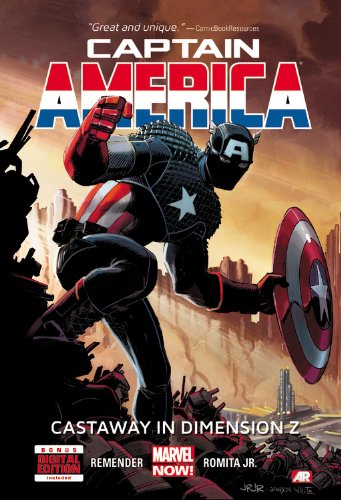
captain america 2Thankfully, coming on the heels of the intensely thrilling and award-winning spy story penned by sterling scribe Ed Brubaker, Rick Remender has managed to take the former option of the above two and create a pulpy, sci-fi-cum-fantasy spin for everyone’s favourite walking flag Captain America. Taking some of the previous run’s character elements and throwing them up against Jack Kirby-esque space demons and utilising time jumps as a plot device the same way most of us use toothpaste, Remender has well and truly given the Captain his own flavour. It’s just a pity the flavour is made up of nothing much more than batsh*t craziness and way too much of John Romita’s artwork.

Following the harrowing events of Avengers vs. X-Men and its assorted paraphernalia, America’s top cop Steve Rogers is dealing with what he sees as impending old age and possible obsolescence in the face of the country’s changing security nature. He’s on his way to a rendezvous with girlfriend Sharon Carter when he’s suddenly and inexplicably plucked from our reality and dumped in the eponymous Dimension Z, a nightmare realm of sci-fi villainy that’s somewhere between Labyrinth and Avatar in terms of its visual weirdness. It turns out Dimension Z is run by old nemesis Arnim Zola, now in a robot body following his stint in his last Captain America appearance and hell-bent on the Star-Spangled Man’s destruction. It’s up to Captain America to escape Dimension Z and reunite with the real world whilst accompanied by a strange little boy who turns out to be…

Well, I can’t really say much more than that without arriving at the armed border-patrolled gates of Spoiler Territory. There’s a lot going on in this book that, for the sake of your own narrative enjoyment, I can’t elaborate on. Suffice it to say that there’s weirdness, cyborgs, a face-stomach virus and a significant amount of in-story time that passes from the book’s beginning to end. Make no mistake, while it may be only a few issues of comic book goodness for us, it’s years for the Captain.

I get the feeling Rick Remender is writing a large, sweeping saga for Cap with the first of his entries, and given the “Book 1” title it presupposes that more will follow. The shedding of his easily-called Avengers co-workers and removal of almost all recognisable status quo gives Cap a harrowing, intensely personal journey that seems more like something The Walking Dead or Savage Wolverine would do, augmented in tone by the almost Lovecraftian landscape and nightmarish feel. The personal aspect is also backed up by frequent flashbacks to Steve Rogers’ past as a young boy in Brooklyn, which does quite a lot for fleshing out his character in ways Ed Brubaker didn’t touch upon. In fact, it’s an almost polar opposite to Brubaker’s political intrigue and expansive cast of supporting players in the previous run, and to the story’s credit there seems to be an awful lot of creative thinking going on as a way of pioneering a different story and tone for a character who’s been through many well-worn plotlines over the last few decades.

Quite, simply, its a new trick for a very old dog. It’s just a pity the trick leaves the dog panting and heaving as it struggles to catch up and move on to the next act in the repertoire.

There’s an awful lot of story fatigue going on that is juxtaposed by brevity; given the frequent use time jumps in the narrative, there’s little time to dwell on particular portions of the plot as they’re introduced to us. What could be status quo in Issue 2 is almost completely rendered moot by the start of Issue 3, and with the limited exposition that borders on almost Grant Morrison-levels of inexplicability it leaves the reader tired and trying furiously to follow everything that’s going on. By the time we get used to a circumstance, character development or plot point, in the short space of a few pages no less, it’s been whipped away from us and made into something else. It’s particularly egregious in the case of the aforementioned young boy following Cap who, without wishing to spoil, has his entire raison d’etre completely changed between issues right after we figured out who he originally was. It’s like figuring out a particularly complex mystery at the conclusion of an episode of LOST, then having one of the characters in the next episode go “No, actually the polar bear wasn’t put on the island by Dharma Initiative submarines, he was actually sent by Jesus and his intergalactic Christian biker gang.”

captain america 3

Not really helping is the distinct lack of dialogue, especially compared to other Remender-penned works like Uncanny X-Force. The book relies on the old Uncanny Avengers trick of having an insane amount of introspection and little thought boxes, but even those don’t do much to elucidate the craziness going on in Captain America’s head in a satisfying way. We’re given Classic Morrison snippets of half-lines and hints at what’s transpiring, but on the whole there’s a lot of explanation left out. Plus, in a rather ignoble move by Remender, what little three-dimensionality Arnim Zola had during the Brubaker run is almost completely removed in this book. He’s only a real head and a bottle of facial Rogaine away from being a literal moustache-twirling Saturday morning cartoon villain, and the link established between him and his young lady minion (which is, as with Cap and his little boy scout, a bit of a spoiler) doesn’t do anywhere near as much as it should to give the villain some depth.

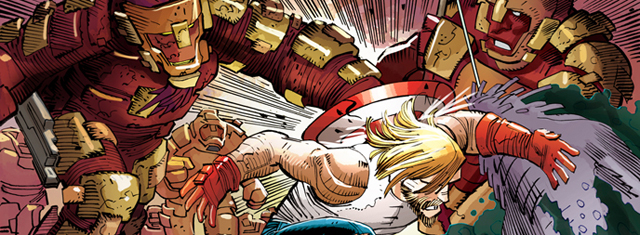
captain america 1Finally, the very worst aspect of this story is the artwork. John Romita Jr., as you’ll remember from my oft-referenced Avengers vs. X-Men review, is an artist I’ve never gotten into because his drawings are at once far too heavily layered and, at the same time, childishly simplistic. His work here brings all the worst aspects of his doings in AvX and Kick-Ass, where blood looks more like tomato soup and there are way too many goddamn motherpusbucket lines on thingsI know artistry is subjective to taste, but I just cannot get invested in almost any of his tableaus or scenes presented on page. The characters’ heads are boxy and rectangular, noses still look like an elongated symbol, and all the hair looks like it was scribbled on after the fact with a Sharpie. I know Romita’s a much-beloved artist, I know he’s won awards and I know he and his father are basically comic book art royalty, but I hate his artwork. With fiery, burning passion do I hate it.

What I don’t hate, though, is this book. Despite the above paragraphs of petulant whinging, I loved Castaway in Dimension Z. It had a tough act to follow after Brubaker, and while I never envisioned I’d praise it far above things like Winter Soldier and The Death of Captain America I didn’t think I’d like it as much as I did. Is it perfect? Of course not. Could the problems be enough to permanently harm the series if they’re continued later? Possibly. Is this worth reading? Abso-flaming-lutely. It’s different, challenging and not fully explained, and for that reason it’s an original twist on an old hero that behooves you to experience it.

captain america cover

PUBLISHER: MARVEL COMICS

STORY: 4/5

ARTWORK: 2/5

DIALOGUE: 3.5/5

OVERALL: 9.5/15

BEST QUOTE: “Where’s our breaking point? How many years will pass before we find some sign of hope? When will it become too much? The other way out…the other way out isn’t one you consider.” – Captain America

Cable & X-Force: Wanted

(Massive thanks to Thomas “Dac” Lee for writing this guest review)

Wait a minute, how did I end up with this gig?

Oh well.  Mysteries of life.

Cable & X-Force is one of Marvel’s two current titles with “X-Force” in the title, and the first of the two I’ve read.  It revolves around Cable, who founded the original X-Force a couple of decades ago, as he puts together a small group to take out future threats before they happen, which is Cable’s usual M.O. but has taken a bit of an odd turn here.  Also like the previous X-Force stories, this team is an unsanctioned, unapproved bunch who should (emphasis on ‘should’; remember that, it will be important) have no compunction about killing.  The ragtag bunch put together by Cable includes former flame and fellow Force friend Domino, disgraced powerhouse Colossus, nutjob tech wiz Forge, and…Dr Nemesis.  …your guess is as good as mine.

cable 1The first arc, Wanted, deals with, as most first arcs tend to do, bringing the team together and their first mission, which naturally ends disastrously.  The whole thing is written by Avengers Arena and X-Men Season One scribe Dennis Hopeless, whose name I refuse to make jokes about since the entire Internet has already done it to death, and illustrated by Salvador Larroca, of a few dozen X-titles and the under-read Newuniversal.  Bit of an odd blend but it should be OK, right?

A couple of things I feel I should point out before we get down to business: I didn’t read Avengers Vs. X-Men.  I took one look at that buffet table loaded with ominous servings and stayed away.  It’s not really fair of me to criticise the book without having read it, so I won’t do that.  I only really bring it up at all because, as with all the X-books, its repercussions are felt across Cable & X-Force.  How could they not?  Cable’s return in X-Sanction, also unread by me, kicked the whole escapade off, and as Havok angrily reminds Cable in the very first issue of this book, the Summers family name doesn’t need any more tarnishing after Cyclops’s, ahem, actions.  Also along for the ride is Hope Summers, Cable’s adopted daughter and saviour of AvX.  If you weren’t aware of that latter fact, don’t worry, this book reminds you at least three times.

In the wake of AvX, Cable comes to Forge to give him a little bit of help.  Having lost his techno-organics, his arm and eye are about as full of life as Chuck Austen’s writing career.  Forge, who spends a prologue issue getting his insanity cured after that whole Ghost Box thing in Astonishing X-Men, builds him a new arm and gives him an eyepatch, because if you’re going to be a rogue team, you may as well be led by a pirate.  Forge already has the whole pegleg thing, now that I think about it.  Anyway, Cable also recruits…

Oh wait.

Wait, wait, no, I’m going about this all wrong.

Sorry.

See, the first four issues of this series are non-linear.  I can see the appeal, put up a situation and explain how things led to it, constantly switching between the beginning and the middle and back again to do so.  When done right, it’s great.

This was not done right.

When the first issue opens, Cable and team are caught in a building surrounded by corpses of innocent humans by Havok and Captain America, and a whole press team.  Hence the chewing out by Havok I mentioned earlier.  Things look pretty bleak for the team, and they teleport away, where no one’s too thrilled about how it went down, least of all Colossus, whocable 3 nearly puts a fist through Cable’s face.  The arc then proceeds to describe how things got to this point: after getting his literal bodybuilding from Forge, Cable still has inexplicable migraines and gets Dr Nemesis to check his brain out.  At the same time, Hope goes AWOL from her foster home to go looking for daddy, and winds up forcing Domino to show her in.  After a somewhat touching reunion, Hope takes some of the heat from Cable’s migraines (Cable is telepathic and Hope can tap the powers of those around her.  Explaining that was remarkably easy) and they realise he’s getting visions of the future which they need to prevent.

OK, that’s a problem.  Cable trying to stop bad futures from happening has been part of his shtick ever since the future farted him back into the present, but the reason for that was, he was from the future.  He knew how things would happen because he studied them growing up.  Random telepathic flashes, which are never adequately explained but vaguely hinted someone may be doing it to him, just seems like a total cop-out.  Nonetheless, that’s the driving force here.  One of these flashes clues them in to what appears to be a scheme by a fast food corporate exec (no, really) to engender the usual anti-mutant bile, leading to Sentinels, camps, yadda yadda yadda.  Thankfully there’s more to it than that, and I’ll admit the fast food exec has more reason to dislike mutants than most, and it’s actually a nice breath of fresh air when it’s not personal, it’s business, so there’s positives and negatives.

So there’s a bit going on here.  Cable recruits team of morally-dubious figures, has to stop evil plots involving zesty breakfast burritos, has a troubled relationship with his kid and a few medical problems.  If that feels like a lot to cram into four issues, well, that’s because it is.  I haven’t even gotten started on Colossus’s intro yet (he’s trying to live a normal life and happens to be working in the same building the team needs to shut down.  Whoops) and there’s a whole beach rescue thing which is as irrelevant as it is forgettable.  As in, I forgot it until I was writing this paragraph and didn’t think it important enough to insert above.

The artwork is not the best you’ll ever see, but Salvador Larroca is one of those rare artists whose body of work, at least as far as I’ve seen, always falls between ‘excellent’ and ‘decent’.  If his name is on the cover of a book, you’ll get some nice images.  He certainly keeps the team looking interesting, although Dr Nemesis’s new goggles-mask-and-duster-coat looks inexplicably like Grifter from Wildcats, especially once he loses his hat.  Cable’s new look may take some getting used to, but I have to admit I respect the decision to consciously make him look different as a way of moving forward.  I just can’t help but think…eyepatch? Really?

The dialogue?  Well that’s a bit of a problem.  Part of it is the story’s fault; with such a rushed pacing, there’s a lot to cram in, and as such the characters don’t seem to take the time and really interact with each other.  Cable and Hope’s reunion is sweet, but unfortunately brief, and the most interesting conversations are, unsurprisingly, the ones not related to the maniacal plot; specifically the ones between Cable and Domino about his, ahem, medical condition.  Dr Nemesis’s vocabulary comes across as Fantomex, Deadpool and Beast getting tossed into a blender, and having the liquid spilled onto a Thesaurus, which I honestly did not want to like because it seemed to jar with the rest of the team, but by the end I couldn’t resist sniggering at his interjections.  Helps that, despite having read Nemesis in other books, I honestly still don’t know who the hell he is or what his deal is, so if this is off-character bingeing and purging for him, I didn’t even notice.  As mentioned before, the fast food exec has a lot of winning points behind her, which surprised me, so I was never bored when she turned up.  The true loser in the dialogue department is Colossus, who speaks very little while off-mission and his remarks on-mission tend to fall in the “RAAAAAAHH!  MUST SAVE THESE PEOPLE!” variety.  His intro scene was much more subtle and heartfelt, but it seemed to be all downhill from there.

So this was a poor start to the series, then?

cable 2

Well…

Those are the first four issues.  This volume contains five.  And honestly, that fifth issue?  Saved this book a LOT of grief.  Why?  Because it shows the team on downtime.  Do you know how many superhero titles take the time to show their heroes having downtime?  And I don’t mean one or two panels in an issue.  This is a whole issue solely devoted to the team catching a break.  After such a sandwiched first mission and the way it ended, power to them too.  It was a very good issue; Colossus and Domino sink a few and Colossus discusses why he was so pissed Cable had to kill the people in the building (oh, did I not mention he actually did do it?).  The discussion is one of the most genuine I’ve heard in a comic in some time, and given how poor Colossus’s dialogue was in the preceding issues, it stunned me all the more.  There’s Cable riding around on a motorbike, which was the issue’s weak point, before having an overdue heart-to-heart with Hope, and Forge and Nemesis playing video games against each other.  Having come to guiltily enjoy Nemesis’s non-sequitirs, it’s hard not to laugh when it turns into bravado about kicking Forge’s arse at Time Nuggets.  The adventure continues at the end as the team prepare to jetset off.

And thanks to that issue, I’m considering following their next adventure.

So at the end we have an arc that needed to take its time, pace itself out a bit, forego the utterly unnecessary non-linear device and give its characters more time to adjust to each other.  The hooks for the next arc were utterly blink-and-you’ll-miss-them; the cameo appearance of one of Remender’s Uncanny X-Force (or was it?) came out of nowhere and went back there moments later, not to be mentioned again until the downtime issue.  I cannot give the downtime issue enough credit for saving this arc; in fact I worry I may be overhyping it so anyone reading this may be disappointed.  If I can give you any advice on this series, it is this: take it with a grain of salt, but don’t be turned off completely.  It’s far from the greatest thing you’ll ever read, but far from the worst, too.

Oh, I better do this too.

cable cover

PUBLISHER: MARVEL COMICS

STORY: 2.5/5

ARTWORK: 3.5/5

DIALOGUE: 3/5

OVERALL: 9/15

BEST QUOTE: “This isn’t normal to me.  You raised me.  Bouncing around half a step in front of the gun, trying to save the future for a present that won’t ever appreciate it.  That’s what I want.  That’s my normal.” – Hope