[THE NEW 52] Batman – The Dark Knight: Knight Terrors

If comics were a whorehouse, Batman would now be the prostitute everyone wants to have a go with.

Of all the reinventions present since the New 52 hit, Batman’s had the most series that have spun out of them. The character himself stars in 4, with a further 5 being denoted as under the Bat-family label featuring appearances or allusions to the caped crusader, and it also doesn’t include featuring in Justice League, JLI and God knows where else right now. I’d half-expect him to be a supporting player in Voodoo or I, Vampire for Christ’s sake.

While I still love the character with every fibre of my being, I feel his core awesomeness is being abused somewhat. DC seem to have latched onto the fact that anything in the Bat brand is an instant license to print money, and thus he’s dominating the company’s merchandising efforts more than ever. I’m pretty sure the only reason he’s not running the Justice League is because the descendants of Jerry Siegel and Joe Shuster – Superman’s original creators – would sue DC for more money than they’re already owed.

Fortunately, not all of the Bat-books being thrown at us are bland and terrible. Only some of them. Like, half. Ish. Anyway, does Knight Terrors fit into the Snyder and Tomasi area of thought-provoking action-ness, or is it another Tony Daniel voyage into stupidity and self-aggrandisation that leaves you chugging a bottle of bleach?

First off, I was gratified to find out artist David Finch wasn’t the only writer this time around, since I’ve already covered how most artist-writer’s I’ve experienced in mainstream comics are about as engaging as a broken latch on a toilet cubicle. Plus, the last Batman – The Dark Knight book Finch worked on showcased his…lacking talents as a narrative scribe. No, this time he’s joined by Paul Jenkins (isn’t that the American newscaster from Team America?) and the two craft a solo book where the big bad Bat gets faced with some big bad baddies who bust out of Arkham, including a roided-up Two-Face and a scantily-clad woman wearing a white corset and bunny ears in a manner that wouldn’t be out of place in a Sin City story. The plot deals with Batman tracking down someone behind a toxin that makes anyone fearless and immune to pain, which leads to a rather hilarious moment where resident contract killer Deathstroke, infect by the toxin, slices up the Bat-plane with a whale-sized claymore. At that point I had to question whether or not Rob Liefeld had had any involvement, at least in this scene.

The story is pretty basic, but not in a bland and boring kind of way. Arkham escapes and supervillain performance enhancing drugs have popped up frequently in Batman’s world but innovation isn’t where the book excels, for excel it does indeed. It’s one of the rare Batman narratives I’ve read recently that features characters from outside the Bat-family, including a nice, if brief, team-up with the Flash and a house-destroying punch-up with Superman. It’s good, old-school superhero fun with a bit of a cerebral spine running throughout where Batman introspectively narrates his own battle with fear. While it doesn’t quite hit the same kind of character depth as The Dark Knight Returns or Hush, it’s still far better than Faces of Death at least.

The artwork is Finch-standard awesome, with nicely fleshed-out tones and great backgrounding. One thing I actually didn’t mind was the lack of the Batsuit’s recent line articulations for most of the story, presenting an outfit more in line with the pre-Flashpoint Batman’s appearances that further emphasised the slightly classic mood. The characters’ faces can look a bit deformed every now and then, and resident jerk Agent Forbes resembles Brad Pitt after too many botox injections. On the whole, pretty good stuff.

Dialogue is basic, with a few funny moments here and there that mostly include Alfred snarking. As I said, I wasn’t expecting Shakespearean levels of inspiration when I picked this book up, and as a piece of enjoyable, flashy pulp fiction it does the job. Batman thankfully doesn’t sound like a macho asshole the way he did in Faces, but doesn’t quite achieve the depth present in The Court of Owls.

Don’t go into Knight Terrors expecting anything huge or world-shattering, because all it aims to do is entertain with flashy colour, a half-interesting plot and a bunch of physical bust-ups. I’d almost go so far as to call it a Batman equivalent of The Expendables, except there’s no Sylvester Stallone with dialogue that sounds like he’s speaking out of his butt.

STORY: 3.5/5
ARTWORK: 4.5/5
DIALOGUE: 3/5

OVERALL: 11/15

BEST QUOTE:

Saga, Volume 1

It’s not often that I extricate myself from my superhero pigeonhole and explore the great wide world beyond, but when I do it usually results in me discovering some new gem to add to my reading catalogue – which doesn’t do my bank account any favours. For example, when I first got into The Walking Dead I had to technically start a second superannuation account to cover the cost of all those nice big hardcovers being taken straight out of my future spinster fund, and it didn’t make things easier when the end of every volume made me slather for the next one.

Mercifully I’m jumping on the Saga bandwagon at the early stages of its infancy, so my bank account can rest easy for a few more weeks in this instance. It’s a sci-fi romance fantasy epic that’s flown mostly under the radar for me, although I do recall seeing a news article about the first issue a few months back and feeling kinda intrigued about the notion of a comic book touted as a hybrid of Star Wars and Game of Thrones. Scribed by Y: The Last Man creator Brian K. Vaughan, the main characters are Marko and Alana, a pair of mismatched alien soldiers on opposite sides of a war who fall in love and, as the story opens, give birth to an alien hybrid named Hazel, who narrates the series. The two wayward militants are then pursued by a variety of aggressors, including a fornicating robot with a TV for a head, a half-naked spider-woman and a bald, cat-loving mercenary known only as The Will. It’s up to Marko and Alana to elude their would-be captors and find a place to raise their daughter safe and free from oppression.

Let’s not mince words – I friggin’ loved this book. It’s oddly simplistic but very subtly layered, and not an inch of the story feels wasted or unnecessary. The pacing is fast but not overwhelming, the characters are well-rounded in just a few pages of narrative each, the world-building is executed effectively and efficiently, and there are plenty of “holy s**t” moments to excite even the most devout Michael Bay fan. On top of that, to jump ahead a few sections, the dialogue is masterful. Every character has, at one point or another, enough wit and snark to make Red Dwarf look like a primary school pantomime. Even the British-voiced robots, who do decidedly organic things like take dumps and copulate, manage to get in some really great ripostes that are what I imagine Prince Charles says when the cameras are turned off and Camilla accidentally burns his evening roast again.

It’s one of those rare narratives, graphic or otherwise, that manages to execute a flawless balancing act between action, plot, character development and humour. I never found myself dreading a character’s appearance midway through another’s arc, like I do whenever Batgirl’s roommate shows up partway through her disability angsting. No, everyone here is enjoyable in different ways, heroic or villainous, and everyone’s appearances are welcome throughout. Even the bad guys – such as the aforesaid spider-lady – get some good moments, including a rather jilted conversation between two mercenaries who you’d swear were/are married, bickering about stealing each other’s kills the same way a wife reprimands a husband for using all the Baileys for body shots the night before.

The art by Fiona Staples is a marvelous fusion of abstract gorgeousness and slightly grungy shading, evoking a mashup of Alex Maleev and Michael Lark (ironically, two artists who both had noted Daredevil runs). The characters’ facial expressions are awesome, giving off subtle emotion and visual cues that most comic book artists can’t usually nail. While the horns and wings make Marko and Alana respectively look a tad surreal and not-quite-human, their faces are done in a way that looks like the way a real person would move and project emotion through facial expression. Coupled with the gorgeous panoramas popping up every now and then, fleshing out the galaxy and showing mismatched alien worlds complete with dragon trains and spaceships make of trees (no, seriously), the artwork is utterly sublime. It can get a little spartan here and there, with a couple of the fight scenes being a little confusing when one isn’t sure which of the six identical enemy soldiers just lost an appendage from a sword slash, and that’s the only reason the book isn’t getting a perfect score.

Seriously, Saga‘s first outing was brilliantly scripted, masterfully atmospheric, superbly illustrated and excellently captivating. I might sound a bit gushy about this, but I really wasn’t expecting a book of such understated awesomeness when I picked this up on a whim the other week. If you’re not reading Saga, shell out for Volume 1 (it’s only $10US or $13AUS) and check it out. I will bet dollars to donuts it can land more casual readers than a scary, continuity-bloated superhero comic could. Hell, my mother’d probably read it, once she stops her Fifty Shades of Grey re-read.

STORY: 5/5
ARTWORK: 4.5/5
DIALOGUE: 5/5

OVERALL: 14.5/15

BEST QUOTE: “I’ve interviewed every detainee on this rock, and the only thing I’m closer to catching is a staph infection.” – Prince Robot IV

[THE NEW 52] Batgirl: The Darkest Reflection

Wow, it’s been far too long. I really haven’t realised until now just how much I enjoy writing these reviews of scathing wit and appalling self-effacement. This must be how Jerry Springer feels.

The thesis took up a lot of my time towards the end, and in part it demanded my attention be taken away from actual comic books (ironic, considering what my thesis topic was). So while I was raring to get back into the swing of things after submission on October 4th, I found I was devoid of suitable material for a review – unless I do another classic review, which I think you’re all so sick of that the words “PLEASE BE CONTEMPORARY” are permanently etched into my letterbox with a sharpened stick.

So, let’s dive back in with a poor follow-up to a series I actually thought was great. What a way to bring myself back into the comic book fold.

I may have mentioned previously (somewhere on this blog or my other “serious” one) that one of the changes I found most reviling in the New 52 was the removal of former Spoiler Stephanie Brown as the current Batgirl, replacing her with old-hand Barbara Gordon. You may remember the latter as paraplegic superheroic icon Oracle, also know as the best Voice with an Internet Connection since Cortana from Halo (and, for the record, twice as sexy). Unfortunately, since there seems to be no shortage of creative bankruptcy in DC these days, Barbara’s been taken out of the wheelchair – with many of the unfortunate implications that creates – and thrown back into the retro suit of yellow and black armour with contemporary line articulations thrown in for good measure. After several months of physical therapy she’s tasked to take on the villainous Mirror, a dude who looks like a cross between Batman, Havok from X-Men and the Nightingales from Skyrim, who’s going around killing people who’ve been blessed by miracles (such as Barbara’s unexplained spinal recovery).

While I had a good inkling I wasn’t going to like this book, I wasn’t prepared for how annoying it is. It’s not Faces of Death but it’s still pretty bad. Obnoxious is probably the word I’d best use to describe it. The action is overwrought, even for a Batman title, the characterisation is sloppy and far too schizophrenic – with Babs switching between testosterone-chugging confidence and naive schoolgirl wallflower at the drop of a hat – and the story is paced like a malfunctioning escalator, stopping and starting all over the place. I know part of the New 52’s schtick was de-aging some of the characters to keep them contemporary and not the brittle-boned octogenarians they would be if they were real today, but they seem to have turned Barbara Gordon’s dial on the Way-Back Machine just a bit too much. She reminds me – especially in dialogue – of Stephanie Brown in all but name.

Wait, hold on, I should give some context here for those of you who aren’t predisposed towards watching teenage girls in tight bodysuits fight supervillains.

The Stephanie Brown run in Batgirl – back when Bruce Wayne was dead and continuity still mattered to the writers – was written by Bryan Q Miller. It was a fun, rollicking adventure with Barbara as the Obi-Wan and Steph as the slightly precocious yet very enthusiastic inheritor of the BG mantle after her predecessor ran off to join the army. The angst was set to minimum, the characters were well-rounded, the story was impressively paced and the dialogue was somewhere between Joss Whedon and Mark Waid in terms of enjoyable-ness. I friggin’ loved it, and the unnecessary change to Batgirl‘s winning formula post-reboot made me extremely hesitant to check it out. The fact that Gail “High-Horse” Simone was writing it didn’t help.

This must be how fans of Knight Rider and Charlie’s Angels feel after comparing their beloved 80’s schlock against the 2000’s reboots of the past few years that performed as well as a Dalek doing a trapeze act. I was severely let down by The Darkest Reflection and not because I figured I’d dislike it. I try to go into these new books as unbiased as possible – look no further than Superboy – but I just found it a bit difficult in this instance. The dialogue alternates between cringeworthy and just plain boring, and very much reinforces the notion that Gail Simone skinned Stephanie Brown, put a Babs lookalike’s appearance over the top, then brainwashed her into having pretend psychological issues about her former lack of mobility. I get the sense Barbara’s not so much an adult woman (as she was during her Oracle tenure) but rather a just-out-of-high-school teen who is a set of braces and a sleepover party away from being Katy Perry in Last Friday Night.

As with Faces of Death, the biggest points go to the artwork. Ardian Syaf is to be congratulated for taking a lackluster, underwhelming piece and really buffing it up in the art department. There’s full colour, fleshed-out tones and no shortage of really gorgeous panoramic panels, even if he does make the sky purple a few too many times. While some of the aforementioned articulation lines are a bit unnecessary, it’s still damn pretty. If we could set the Way-Back Machine to September last year and have Bryan Q Miller as writer, replace Babs with Steph and keep Mr Syaf as lead artist, we’d have a superior book that could rival some of my current contenders for best graphic novel of the year.

As it stands we’re left with a slow-moving, dialogue-heavy cringefest that carries the same narrative weight as an episode of Jersey Shore. There is some good character development during a brief interlude in the middle with Nightwing (including the worst use of a ballet metaphor I’ve ever read) but apart from that it’s boring, poorly executed and unengaging. If I wanted teen angst peppered with the odd punchup, I’d read Twilight.

STORY: 1.5/5
ARTWORK: 4.5/5
DIALOGUE: 2/5

OVERALL: 7/15

BEST QUOTE: “Isn’t it a little weird to be talking to your bike?” – Nightwing

Uncanny Avengers #1

WARNING: PLOT AND/OR ENDING SPOILERS FOR AVENGERS VS. X-MEN FOLLOW.

As I mentioned back in my Batman Incorporated review, I’m not big on buying single issues of comic books since I usually end up buying the collected versions anyway. While that title was until now the only exception to that rule, it’s now joined by another.

Over on my other meaningless site for pointless, nerd-fueled drivel, I expounded upon the annoyance I felt surrounding Marvel’s upcoming reboot and stated it was unnecessary and merely a “follow the leader” move after DC’s New 52 last year. I’d like to take a moment to break out a fork and gobble down some humble pie by saying I’d like to retract that statement – partially.

As it turned out, “reboot” was entirely the wrong word to describe Marvel NOW (which I still hold is a ridiculous title more aimed at kids and ADD sufferers) since it’s more of a refresh than a complete retcon of every event over the last eight decades that bruises continuity so badly it continuously urinates red. While it did mean the end of titanic super-runs like Ed Brubaker’s Captain America and Matt Fraction’s Invincible Iron Man, it also killed off stagnant old-hands like Daniel Way’s Deadpool and Kieron Gillen’s lackluster X-Men arc. This allows almost every Marvel title to start a new series without removing continuity and creating a mindless mess of mediocre money-making. The only possible exception is Mark Waid’s Daredevil, but seriously, that run is freakin’ sweet and no refresh is needed – its recent Eisner Award wins are testament to that, illustrating Marvel does indeed know what not to start from scratch.

It’s for this latter reason, and the start of Uncanny Avengers, that I firmly believe Marvel NOW is going to ultimately be better than DC’s New 52. Don’t get me wrong, I’ve loved a lot of DC’s newer stuff – especially the series’ I wouldn’t have tried beforehand – but they’ve really handled their continuity poorly in the twelve months since all their Flashpoint retcons took place. Instead of half-assedly cramming eighty years worth of story into a five-year timespan, whilst being incredibly flippant and vague over what actually happened and what was just a surreal superhero hallucination, they should’ve either really started with a clean slate or just refreshed their lines like what Marvel’s doing right now. Either option would mean a significant decrease in the level of flame warring going on right now.

Five paragraphs in and I’ve barely spoken about the actual review topic, so let’s get down to it. Uncanny Avengers is the new Marvel flagship title combining the eponymous superhero team, still riding the popularity wave after April’s film outing, with some mutant mainstays from the X-Men. If you can get past the slightly awkward title (and really, I still don’t get what makes the mutants Uncanny anyway – are they in-universe doppelgangers of celebrities or something?) it’s a book that seems to be developing a slightly lighter and fluffier equivalent of writer Rick Remender’s previous titanic super-run, Uncanny X-Force.

In the wake of AvX‘s game-changing finale, with the death of Charles Xavier and the decimation of the Phoenix Force, Captain America sets about creating an Avengers team blending superheroes and mutants into one big, happy gang of extraterrestrial and supernatural battle dudes. Among the chosen few are Thor, who apparently like lattes, Wolverine, who doesn’t seem to have aged a day since Joss Whedon’s run, Scarlet Witch, covering herself in red fabric almost as much as the chick from Goldfinger was covered in paint, Rogue, whose accent is still just annoying written as it was spoken by Anna Paquin, and Havok, erstwhile brother of egotist Cyclops. The team’s mission is…er, we’re not really sure yet, but since this is only one issue it’s likely we’ll find out next month.

It may not exactly be an entirely original concept, but I really loved the debut of Uncanny Avengers. Instead of starting with a massive battle and the team assembled without any prior backstory, we’re given the group’s first building blocks that highlight it ain’t gonna be easy getting everyone in the same room together. The choice of Red Skull as the first main villain might seem odd, especially if he thinks he’s a threat for Thor and let alone anyone else, but rest assured that by the end of the issue it’s abundantly clear why they’ve picked him and how they’re going to elevate him to a Big Bad status to rival Kang or Ultron – if the issue’s cliffhanger pays off the way I hope it will.

John Cassaday returning as an artist at Marvel really brings the book to life, and amps up the story with a synthesis between narrative and visuals in a way few artists can manage. To use a rather paltry term, it pops. God I hate that context. On top of that, Rick Remender’s dialogue is strongly reminiscent of Uncanny X-Force and is at once engaging and realistic. Both author and writer really seem to be in sync, and it makes me excited to see where this story is headed.

It’s also a perfect gateway entry for any new reader, since what backstory is required gets doled out at the start and the continuity isn’t so overwhelming that newbies would feel better off reading a Mills and Boon novel instead. So if you’ve ever wanted to break into the Avengers world with what looks to be an intriguing narrative and near-flawless artistry, this is the title for you (unless you’re trying out Bendis – read his stuff first).

I don’t know if I’ll review every issue as it’s released, but as something different I’ll consider it an option. If it convinces people to read the comic simultaneously, so much the better! We could start a book club and trade views on the story each month!

*crickets*

Hmph. Fine then.

UNCANNY AVENGERS – ISSUE 1
BEST QUOTE: “The place we go also makes lattes, if you prefer…I do.” – Thor

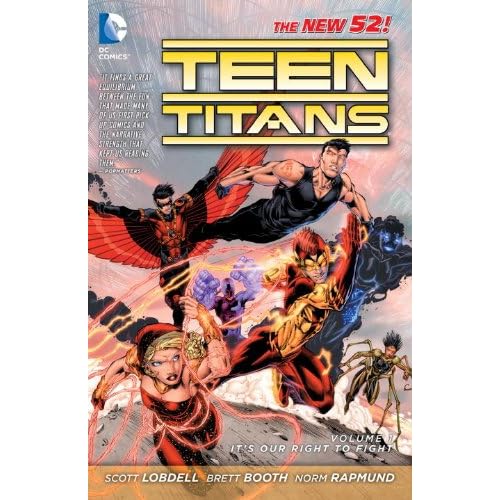
[THE NEW 52] Teen Titans: It’s Our Right to Fight

It’s a mark of a good story, in my mind, if I’m one to like it when everyone else hates it.

Well, maybe good is too strong a word – look at something like Alien vs. Predator. Schlocky, brainless action-fun with the only decent acting coming from that guy from Millennium. I love it (mostly for the Predator bits) while almost every other human being I know over the age of 18 thinks it’s crap.

I tend to be a bit of a magnet for storylines and people that most of my companions would rather live without, which has now tended to be the case with the works of Scott Lobdell. As I’ve previously covered I was quite surprised by how much I loved Superboy but was surprised to find most people online hated the pants off it. Apparently the reinterpretation of a goody-two-shoes Superman ripoff into a cynical, jaded youth (with minimum angst) who can blow up trains with a flick of his finger is something to be feared and ridiculed. From what I understand Lobdell’s taken many, many hits about Red Hood and the Outlaws‘s overt sexism and female proportions on par with a six-foot hourglass with basketballs mounted on the top, and the vitriol seems to be flowing thick and fast for his current Teen Titans run.

Now, if you cast your mind way, way back into the mists of Sunday Dash prehistory, back when I was still a penniless Facebook reviewer with a penchant for annoyingly tagging people in posts they didn’t want to read, you’ll see I checked out a Blackest Night tie-in involving the Titans; I’m guessing they dropped the Teen from the title so as not to provide fuel for pedophiles. I did enjoy the experience, and found the miniseries to be one of the better of the crossover event over others like Superman (no surprise) and Batman (lots of surprise).

This iteration is so far away from the original formula it’s evolved almost into its own lifeform, as far as I can understand it with limited knowledge of the Titans beforehand. It kind of evokes Season 9 of Stargate SG-1 with a dude (in this case, former Batman protege Tim Drake) assembling a team of like-minded individuals to take on baddies who are coming after emerging metahuman teens. On the roster for this gathering is Cassie Sandsmark (don’t call her Wonder Girl), a dude named Bunker (who takes the prize for most awkward dialogue), an out-of-time Kid Flash (who may or may not be a murderer/thief/political activist/botany enthusiast) and two other randoms named Solstice and Skitter.

The plot also crosses over with Superboy a lot, and it really casts the former Boy of Steel in a rather antagonistic light. Obviously we all know he’ll turn good and join the team at some point, but for now if this was a high school drama then Superboy would be the hot senior who beats up nerds and cheats on Emma Stone’s character with a blow-up doll.

I really cannot understand why so many fans are outspokenly against this title. It’s not the greatest piece of graphic literature ever devised, but it’s fun! Seriously, who can’t see the appeal in a bunch of superhuman teens (and Red Robin) wrecking up an aircraft carrier or messing with Time Square during New Year’s? And why can’t people see the enjoyment in a teen book that doesn’t have Chernobyl-level angst radiation going on? You’d think being as depressing and whiney as a malfunctioning jackhammer was something of a prerequisite whenever teenagers are involved in a story.

The artwork by Brett Booth is pretty good, even though the faces get a little weird every now and then and make them all look like they’ve had botox recently. Shading can get a little excessive, but on the whole it’s fleshed-out and visually appealing.

Dialogue is a bit clunky here and there (including an absolutely awful admission of homosexuality by the aforementioned Bunker that I believe was meant to come off as casual but ending up sounding shoe-horned in) but overall is fairly good. As I said there’s very little angst (apart from a bit of Superboy-introspection that comes and goes quicker than a lit match in a snowstorm) and it makes for a refreshing change to the regular teen-story affair. Of particular note is Kid Flash, whose every line of dialogue made me giggle.

I really should find a more masculine version of “giggle” to use in these reviews.

Something my father taught me is that you can’t fully condemn something unless you know the thing. You can’t knock Fifty Shades of Grey until you read it, and you can’t say a political party’s bad news unless you’ve really looked at their policies, people and the number of times their leader has stood out in public wearing Speedos. Having now experienced Teen Titans: It’s Our Right to Fight, I can safely say that it really is good. It’s not William Shakespeare, but it’s not Stephenie Meyer. It’s got charm, wit, an appealing story and some great artwork.

And at the end of the day, what more can you ask for?

STORY: 3.5/5
ARTWORK: 3.5/5
DIALOGUE: 3/5

OVERALL: 10/15

BEST QUOTE: “My name is Tim Drake. Also known as Red Robin – I used to be Batman’s “Boy Wonder”. No, I didn’t come up with the name.” – Red Robin

Avengers: X-Sanction

Today’s one of those rare days where I have time to squeeze in some recreational writing alongside the washing, sweeping and genocide gaming I usually have to get done, and so I figure it’s time to take a brief look at one last prologue to the upcoming Avengers vs. X-Men hardcover.

“Dash!” I hear you all yell, “You’ve already covered three prologues already, what’s with there being another one?”

Well, I’d reply, it’s because apparently there’s a lot of ancillary material one needs to explore before getting into the meat of the crossover…which, when you think about it, isn’t a point in its favour. If there’s that much required reading beforehand, would that not alienate readers and make them fearful of the long-winding continuity cavalcade that needs to be explored, which is an indication of the stigma superhero comics suffer on a regular basis?

Sorry, too deep. Let’s back up and talk about a dude beating the Avengers up.

X-Sanction marks the return of comics veteran Jeph Loeb into the spotlight as he revives longtime X-Men ally Cable, fresh from his “death” in Second Coming, who then embarks on a mission to maim, bludgeon and kill any Avengers within spitting distance to protect future mutant messiah Hope. Over the course of the short, tight storyline Cable makes mincemeat of Captain America, Iron Man, the Falcon, Red Hulk and a slew of other related heroes.

That’s it. That’s really all there is to the story. It’s not incredibly deep – although there are some good pages where Cable’s motivations are explained, ish – and consists mainly of superhero smackdowns that smack strongly of the style used in AvX VS, where two heroes spend an entire issue beating the crap out of each other. It’s not a bad thing in this case, and it’s actually kinda fun to see Cable beat seven shades of piss out of some of Marvel’s most beloved roster. It’s also refreshing to see someone flensing heroes alive with a motivation that doesn’t involve brainwashing, an evil clone or extraterrestrial possession, since Marvel have a tendency to flog that dead horse with such regularity the whip now resembles a garrote wire.

Artwork’s pretty good – I hadn’t checked out Ed McGuinness before, but what I saw wasn’t too bad. It does get a little chalky at times, and Cable’s absurd muscle proportions can be a bit – ahem – distracting on some pages, but overall it’s pretty well-handled.

Dialogue is…a bit lacking. It’s not really notable for atrociousness or standout soliloquyising, but it’s passable. Hush was better, but then again this is a different kettle of fish.

So yeah, brief review for a brief book. It’s worth checking out (if you can ignore the absurd price you pay for the hardcover) and, if nothing else, does a great job of showing that superhero comics can give good narratives without particular depth. It’s just shallow enough to be enjoyable – not quite Attack of the Clones, but definitely above The Clone Wars.

STORY: 3.5/5
ARTWORK: 3.5/5
DIALOGUE: 3/5

OVERALL: 10/15

BEST QUOTE: “The Avengers. I’m coming for every single one of you.” – Cable

[THE NEW 52] Aquaman: The Trench

Hype can be a terrible thing sometimes when it comes to mass media, as fans of Peter Molyneux can probably already tell you. While it does usually lead to greater turnouts, profits and first-day collections whenever a big movie or TV show comes out, more often than not it can end up going on to dashed hopes, unfulfilled expectations and the innate desire to throw rocks at the creators’ cars. Look at The Last Airbender – advertised and hyped up the wind-twiddling butt, and yet turned out to not only be a major disappointment to fans but also signposted the moment when M. Night Shyamallama finally jumped that bloated, nadir shark.

Comic books are no less a victim to the same hype syndrome, and it’s entirely possible even for characters like Batman to suffer the same fate as a Michael Bay movie. So it was with what some might say was trepidatious enthusiasm that I approached Aquaman: The Trench after enjoying the underwater adventurer’s exploits in Brightest Day, being under the impression that it might live up to its status as a new Geoff Johns treasure to sit beside his acclaimed runs on Green Lantern and The Flash.

Unfortunately, what we end up with is a meandering, rather abruptly-ending narrative that starts off a new arc-based story in the vein of Swamp Thing and Animal Man, yet doesn’t have any of the grand, epic scale of the former or the smaller, interpersonal nature of the latter.

Aquaman as a character has received a lot of stick for his rather lacklustre powers, appalling characterisation and a slew of hilariously awful quotes, mostly ripped from Superfriends, and it seems the inhabitants of DC’s new universe are fully aware of this. Throughout The Trench the eponymous hero gets a lot of “help” from local law enforcement who really just like taking the piss out of him, even when he’s bleeding after beating the everloving crap out of a bunch of underwater fish-people with a trident large enough to make even a Viagra addict go floppy in shame. While it is nice to see a bit of a meta-example of sticking real world dispositions in the comic book world, it does get a bit tiring when all we see is either Aquaman killing things or people telling Aquaman he sucks before he goes off to kill more things. If it weren’t for the established reputation as a Justice League member, you could easily confuse him for a befuddled serial killer.

The plot, such as it is, deals with recent landowner Aquaman and his wife Mera (do not call her Aquawoman) taking on a bunch of aforementioned fish-people who emerge from the eponymous Trench, an area deep under the ocean. Once that’s all sorted (which happens alarmingly fast) there’s a bit of an interlude where Aquaman gets lost in a desert and Mera buys dog food – then there’s a haphazard link between the end of this book and the start of the next title, which promises an arc to answer the question of who sank Atlantis.

I’ll be up-front – I was left disappointed by this book. It’s not because Aquaman’s a useless, schmaltzy hero – if anything, his recent outing in Justice League showed he’s more than capable of being a badass – or because we like to take the mickey out of him. It’s because there’s almost nothing relatable about his character, besides some quick slivers of backstory about his human dad that are inserted as a smoothly into the narrative as an obese man in a swimming pool, and because the plot goes in a bunch of different directions without settling on anything interesting or coherent. The enemies from the Trench don’t seem like that much of a threat – especially given the alarming ease with which they are dispatched – and are about as complexly layered as a cockroach. On top of that, almost every human character is presented as a quasi-racist asshole whenever the underwater superheroes are around, as if to highlight how put upon Aquaman and Mera really are.

This isn’t helped by art that really misses the mark visually and stylistically – the veteran team of Ivan Reis and Joe Prado do some good visuals here and there, but for the most part it’s pretty uniform. Where it majorly falls down is in the underwater scenes; almost every one of them is confusing, poorly drawn and muddled. The final confrontation between Aquaman and the Trench-people was a messed-up, incoherent blob of black and blue that more closely resembled the hair of that girl from The Grudge with bits of orange dandruff thrown in for good measure. Also, everyone in this story has really, really weird eyes – especially Mera, who wouldn’t look out of place in a Roswell conspiracy theory piece.

As the final nail in the coffin, the dialogue is plain – not great, not awful, just plain. There’s none of the really dry wit that pervaded Johns’ runs on Flash and Lantern, and as stated previously none of the characters have relatability the way those heroes did. Aquaman and Mera always seem wistful and two-dimensional while the humans are one thinly-veiled insult away from seeming like Klan members. There were one or two moments here and there that made me giggle, but on the whole it’s nothing special.

So in the end, I’m left wanting more. If there’s one thing the New 52 has done really well, it’s reinvigorate older heroes or teams and make them more interesting – like the Teen Titans, but I’ll get to that later – so I was expecting, especially with Johns at the helm, that I’d get something great here for the sea-dwelling superhero. Instead, Aquaman: The Trench just goes for a plain, bland, unappealing setting with boorish characters and a flimsily-written plot.

But hey, at least it’s not a Tony Daniel book.

STORY: 3/5
ARTWORK: 2.5/5
DIALOGUE: 2.5/5

OVERALL: 8/15

BEST QUOTE: “Bad food.” – Trench-person.

[DASH’S TOP FIVE] 1 – Batman: Hush

I’m pretty sure every man and their dog knows my opinion on Hush by now, but for the sake of rounding out this little self-indulgent exploration – and since the thesis has left me bereft of the ability to consume new comics this week – I’ll clarify my thoughts thusly.

Hush is pretty much the first major comic book I ever read from start to finish. I can’t remember if Watchmen came before, and there is a good chance it did, but Hush is at the very least the first Batman book I ever read. Coming on the heels of The Dark Knight I was in something of a Batman fever, and Hush was the cure to all my ills.


God that wordplay was awful. If I ever use a medical metaphor in this blog again, feel free to sue.


By today’s standards the story is actually kinda basic; it’s essentially a massive beat-em-up between Batman and almost every member of his Rogues Gallery, all while a mysterious puppetmaster (the eponymous Hush) orchestrates things from behind the scenes. There are moments of cerebral, thought-provoking character development – predominantly in terms of Batman’s growing relationship with Catwoman and the memories stirred with his reunion by childhood friend Tommy Elliott – but on the whole it’s good ol’ popcorn fun from start to finish with some dark undertones throughout.


Admittedly I am quite biased when it comes to Hush, seeing as it was my first real look into the Bat-mythos and one of my first real experiences with graphic novels, but it really is a greatly accessible, enjoyable read. I love it because you can pick it up as a first-time reader and get what’s going on without too much knowledge of backstory. I love it because there’s appearances – big and little – of almost every major character in Batman’s pantheon. I love it because Catwoman is actually decently proportioned without looking like Hugh Hefner’s Fetish Bunny. And also – it’s really, really pretty.


As some of you may remember I’ve got a bit of a thing for the artwork of creative duo Jim Lee and Scott Williams. This was the first time I’d seen their art and by Fishchrist it was beautiful. The colours, the layering, the background details, the lines of articulation…it was absolutely sublime. Even Superman didn’t look too bad – and for a time when I wasn’t open to new ideas, that’s saying a lot.


The dialogue was quite well written, and didn’t swing towards either the Grant Morrison method of telling you nothing or the Tony Daniel gameplan of telling you bugger all. It was a nice, Goldilocks-zone of wording with some great snark on behalf of resident deadpanners Robin and Nightwing. Admittedly Batman did get a little self-indulgent here and there, with some lines bordering on Frank Miller-esque ego-stroking about how kickass he is, but in a story like this – especially as a gateway entry to the mythos as a whole – it actually work really well.


While this is my favourite Bat-book in the whole of ever, there are others that can surpass it in both creativity and storyline, and to the veteran fan it might be a great read but not necessarily top of the list. Despite all the books I’ve read since – and trust me, when it comes to Batman there’s been a lot of them – Hush is still, and probably always will be, my favourite Bat-story of all time, and by extension my favourite graphic novel (at least at time of writing). It’s a solid, durable, engaging, action-packed, deeply character-based story that new fans can enjoy from scratch and old fans will almost certainly get a kick out of anyway.


So that’s the end of my Top 5, for the few of you who decided to join me on this little odyssey of self-indulgence. It’s quite probable that in years to come the list will change, replaced by newer, bigger, darker stories as we move further into the post-9/11 cynical age of global security and lack of social justice. But hey, if we’re all still around in twenty years time – after the nuclear winter ends and the US declares war on parts of itself – let’s get back together here and update the list, yeah?


TOP 5 ENTRY NO. 1 – BATMAN: HUSH


BEST QUOTE: “Criminals, by nature, are a cowardly and superstitious lot. To instill fear into their hearts, I became a bat. A monster in the night. And in doing so, have I become the very thing that all monsters become – alone?” – Batman

.

[THE NEW 52] Swamp Thing: Raise Them Bones

It seems the corner of DC’s new universe collectively known as “The Dark” is really producing some quality work, which is refreshing; whilst I do find superhero comics enjoyable, I do get a bit weary when it’s all I read for a few months. Comic books, much like Australian political parties, need variety every now and then.

As such, I’ve been enjoying what’s come out of The Dark so far; Animal Man back in May was not only an engrossing and well-illustrated tale of supernatural horror, but also a great juxtaposition against the flash and popcorn fun of Justice League. A few months later, Swamp Thing stands as a similar tale of gothic floral nightmare against the airy-fairy wish-wash of…something that’s airy-fairy wish-wash. I dunno, New 52 releases have been kinda ok this month.

But anyway, Swamp Thing: for those of you (like me) who never read Alan Moore’s seminal classic or any of the subsequent works that followed, Raise Them Bones does give a very good recap throughout of how put-upon botanist Alec Holland went from being dead, to being Swamp Thing, to being not-Swamp Thing, to being a postman…oh, wait. There’s quite a bit of expository dialogue that makes me think this book is trying to in some way act as a bandaid for the continuity that’s been as all over the place as an epileptic jaguar driving a sports car, but without prior knowledge of the mythos I can’t really comment – although I can say that I’m reasonably certain Moore wouldn’t have drawn Holland like a bodybuilder in the 80s, back when superheroic men didn’t have the proportions of a person made entirely out of protein shakes.

Holland discovers he’s at the centre of an ancient, supernatural plot by some dudes known as the Rot (whom you may remember from the aforementioned Animal Man title) and that he must once more become Swamp Thing in order to save the world and get out of that deadbeat carpentry job he’s got going on. Holland resists, meets a hot girl with a shotgun, fights an eight-year-old who can twist peoples neck 180 degrees and starts to really question whether or not he’s up to the task of turning into what might happen if Mr Potato Head and a Chia pet copulated.

The story is good, no doubt – come on, it’s Scott Snyder, of course it’s good – but I feel like it’s only really half a story. It’s presented as the start of a grand arc they way Animal Man was, but while Animal Man had a great character progression and ended on a satisfying cliffhanger that left me wanting the next one, Swamp Thing instead ends rather abruptly and leaves me with a sense of “Wait, that’s it?” It doesn’t help that the resolution to that ending won’t appear until April, so overall I’m left the same way the last two Harry Potter films left me – incomplete without the other half.

Don’t get me wrong, it’s still definitely worth a read; the artwork by Yannick Paquette is marvelously gothic and brutally gory, and while it can get a bit cluttered at times – especially during the aforementioned exposition – it really does evoke the same kind of dread that Animal Man did, which probably makes sense, since the two are headed for a crossover later. The similarities gave it a sense of familiarity for me, and made me double check no flies or dead pigs were anywhere near my house (it makes sense in context).

The dialogue is the usual Scott Snyder standard of excellent writing, although it does get a bit bogged down when the former Swamp Things are explaining stuff to Holland at length; the repetitious orange speech bubbles detract from the atmosphere a little, and the flow of the narrative does get broken up a bit during these parts, but on the whole it’s still pretty good.

On the whole, Raise Them Bones isn’t bad at all. There’s not a lot more I can say for fear of spoilers, but rest assured it does away with any negative connotations or impressions you might have of the character. If there’s one thing DC are doing quite well at the moment, it’s reinventing superheroes with shot reputations and making them awesome again.

Speaking of, next week on Sunday Comics – AQUAMAN!

STORY: 4/5
ARTWORK: 4/5
DIALOGUE: 3.5/5

OVERALL: 11.5/15

BEST QUOTE: “Now, Rot…I will show you war.” – Swamp Thing


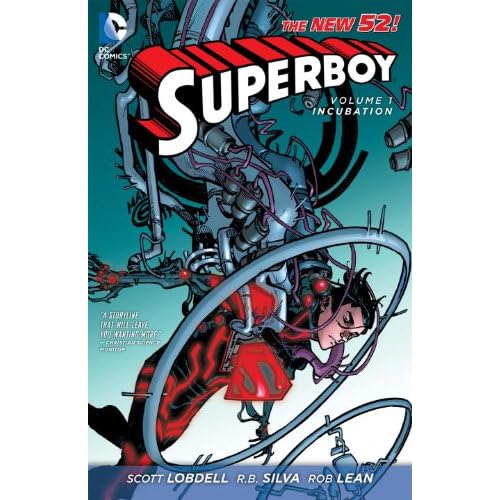
[THE NEW 52] Superboy: Incubation

I really seem to be pigging out on eaten-words right now.

After last week’s revelatory Superman review I figured it wouldn’t be a bad idea to maybe check out some other characters in the Super-mythos – I mean, hell, if one’s good there’s a chance the others might be too, right? So, of course, that meant an excursion into the unexplored waters of a prominent Teen Titan, half-clone of Superman and all-around angsty bastard with a rather uncanny resemblance to Shia LaBeouf after he’d gotten a few golf balls stuck in his throat.

Thankfully, none of that’s involved in Connor Kent’s mythos this time around. Instead we’re witness to the birth of the eponymous Superboy as he emerges, rather explosively, from a test tube in a facility run by super-secret-squirrel organisation N.O.W.H.E.R.E., the place of his birth. The genetically-engineered person-of-mass-destruction is then trained by N.O.W.H.E.R.E. to be an awesome killing machine, but over the course of the story he gradually gains an identity, personality and sense of ethics – even if he has to all-but flense the Teen Titans to do so.

One of the things that immediately jumps out at me with this book is the character development, because there’s a lot of it; the inner monologuing gives a clear sense of Superboy’s personality, struggles and internal debates, and really paints the portrait of a lonely, aimless lab experiment attempting to add some meaning to his life somehow. It’s almost tragic, the way he flits about from mission to mission trying to discover who he is as a person and what life he can possibly have outside the walls of his secret prison.

His captors are equally as fleshed out as he is; future Ravager and sword fetishist Rose Wilson comes across as a bit of a tragic villain through the struggles she has with her best friend, Dr Fairchild, who’s trying to come to grips with her treatment of Superboy as a lab rat who then deals with the machinations of Centrehall, leader of a clandestine organisation inside N.O.W.H.E.R.E. and a bit of a well-intentioned extremist who tries to coerce Superboy into stuff…

Ok, you get the picture; point is, almost every player is this super-opera is rounded to the point of being as developed in a few issues as other characters are over years of development. It’s also really refreshing to see Superboy as being both something different from Superman and his own pre-Flashpoint self, even if there is still a bit of angst going on.

One of my criteria for what constitutes a “good” comic book is its ability to hook me in for further installments – a great way to do that is drop a big cliffhanger that actually works for the story and makes me go “OMG WANT.” Superboy achieved this; without wishing to spoil, the ending is a WHAM moment that made me curse in frustration that I have to wait a whole frikkin’ year for the resolution for it. Might not be as impact-y to other readers (especially if you currently read Teen Titans) but to me it was a really solid effort.

So while the writing gets a big fat tick on the checklist, the artwork is where things stumble somewhat. Lean and Silva kinda make the book look a bit too cartoonish; the art is quite basic, with not a lot of fleshing out or intricate detail. While it’s certainly not the worst I’ve seen, it’s definitely not the best; and really, it’d be nice to see some actually properly-proportioned women in the New 52 at some point. Please, no more watermelons on telegraph poles.

Dialogue actually works surprisingly well, offering great introspection on the part of Superboy and explaining his motivations and evolution without diverging too much into drowning you in waves of chokey exposition. While the villain’s dialogue can be a bit hammy at times (lookin’ at you, Rose Wilson) Scott Lobdell does a really good job of writing the characters, on the whole, as engaging and interesting – including, surprisingly, Supergirl, who I’ve now added to my reading list for this year.

On the whole, I’m finding myself really surprised by the great range of flavours the Super-titles are offering right now. It strikes me as a very good move on DC’s part to actually try shaking up the status quo of one of their most beloved characters – beyond giving Wonder Woman pants for twenty seconds – and actually succeed at doing it. Incubation was an intriguing, heart-filled tale of a lost little boy with the power to blow up a city, and my only really big complaint is having to wait another bloody year before seeing the resolution to that cliffhanger.

And before you suggest it, no, I will not trawl Wikipedia to look for the answers. What am I, a scholar?

STORY: 5/5
ARTWORK: 3/5
DIALOGUE: 4.5/5

OVERALL: 12.5/15

BEST QUOTE: “I figured it out. I’ve spent a lot of the last week in the library (you might be surprised at how boring “freedom” can be). I’ve learnt about rum springa; it is a rite of passage in the Amish culture: as a teenager you are sent out into the “real world”, to make certain the life you choose is based on an informed choice. I’m pretty sure that’s what Centerhall did. Or maybe he’s just the angry parent who catches you smoking and makes you consume an entire carton of cigarettes. No, mysterious clandestine organisation – you choke on it.” – Superboy