Captain America: Loose Nuke

I’m going to assume most of the civilised world has taken two-and-a-half-hours out of their week at some point to see Captain America: The Winter Soldier. If you haven’t, might be time to turn off the soap operas and go for a walk.

The film does much what the original book (and its subsequent run) did to revitalise Cap in the modern world, presenting an old-world relic with time-appropriate values who gets introduced to the grimier setting of the present. Rather than abject patriotism and a recognisable threat, Cap now contends with murky politics and enemies both within and outside the country he wears as his sigil. I loved the film, based on a book that literally both got me interested in the character and helped form parts of my Honours thesis for my Bachelor’s degree, and it went a long way to reinforce my love of everyone’s favourite Star-Spangled Man.

But if Winter Soldier was many steps in the right direction, Loose Nuke takes most of them back, takes a few more, then leaps off the diving board into a pool of frozen disappointment.
loose nuke 4

Fresh from having returned after the harrowing events of Dimension Z, Cap once again finds himself the figurative “man out of time”; twelve years have passed for him in DmZ whilst only a few minutes elapsed for those in the real world. The grittier soldier Cap forged himself into within Dimension Z out of necessity is far removed from the (relatively) more peaceful setting of present-day New York. How can he go back to the life he had here, after already spending years getting over his time as a Capsicle following World War II, when everything seems so radically different after over a decade spent fighting?

Apparently the answer is to go Guy Fawkes by starting a bonfire made of your old possessions and try to start anew. If only all problems could be solved with such finality; I would imagine the night air would blaze with the smell of burning credit cards.

Believe it or not, the above summary only covers the first chapter of Loose Nuke; a story built around that concept could be an introspective interrogation of both Cap and his place in the world, potentially from a slightly new angle. I’d’ve been much happier with that than what I was slapped in the face with instead.
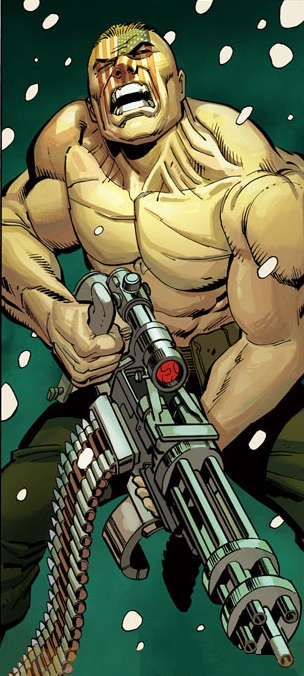
loose nuke 3Y’see, there’s a new enemy (or, rather, an old one, but I’ll get to that in a bit) running around Russia with the American flag tattooed on his face. He’s called Nuke, he has a best friend on his arm called Minigun who he never leaves the house without, and he’s fighting “for our boys”; that is, taking down them pesky Red commies because ‘MURICA, Y’ALL.

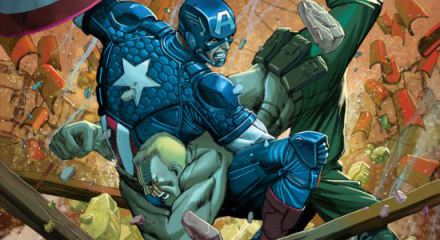
Ok, maybe I’m being a bit harsh. Loose Nuke isn’t a bad book the way Thunderbolts was a bad book, but it’s definitely several steps below the decent work writer Rick Remender did with the Dimension Z saga. Cap doesn’t even meet Nuke for nearly half of the book, and when he does their fight is ridiculously anticlimactic. The overblown robot vs. giant Cap fight in Captain America: Reborn wasn’t as BS as Cap vs. Nuke was. So there’s that.

My problem overall with the book is that it’s both treading old ground and going in a new direction, and both simultaneous actions are at odds with each other. As noted above Cap’s trying to adjust to life in a displaced world, which has practically been the character’s hallmark since he joined the Avengers in 1963, but he’s also surging forward with his own ideals and trumpeting his idealism as a standard we should look up to (the latter used egregiously during a final conversation with Nuke). He’s lamenting the loss of a loved one (Peggy Carter in ’63, Sharon Carter now) and also possibly moving forward with another (Sharon, now Jet Black Zola). All we need now is for him to meet his end on the steps of a courthouse after a civil war with Thor and we’ve got an almost perfect symmetry.
loose nuke 5

Loose Nuke‘s repetition syndrome also manifests in the titular antagonist; Nuke is a layover from the old Weapon Plus project that gave powers to Cap, Wolverine and a bunch of other killing machines. As such, he’s the pawn of a bigger bad guy that’s defrosted him with his old world values so they can point towards enemy and unleash hell. If you didn’t immediately recognise Nuke’s an old leftover from early American jingoism thanks to that bloody tattoo on his noggin, you probably don’t have a sore face of your own from the facepalming that caused me to undergo when reading it.

Old Weapon Plus and Captain America knock-offs returning in present day as murderous fish out of water has been done before. Ed Brubaker’s run did that a lot to great effect, ending with a final issue devoted to that ideal as something both romantic and loose nuke 1disastrous. Here, it seems Remender misses the nuanced way these old world relics can be brought back in a tragic manner, their diehard love of America juxtaposed with the complexities of the present day and how both are incongruous. Instead, Remender seems more concerned with heavy-handed, blatant dialogue conversely about how America is frikkin’ awesome (from Nuke) and how America is a wretched hive of scum and villainy (from Nuke’s Asian boss – which also seems quite on the nose). The politics of Loose Nuke are on full display, for better or worse.
On that subject, dialogue’s either awful or just there. I had a hard time finding a Best Quote for below, since most of what’s said is either too plain to stand out or far too terrible to warrant remembering. There’s no subtlety to any of this; Cap’s dialogue after going back to his apartment and Guy Fawkes’ing his memorabilia is overly maudlin and contemplative. Nuke’s the Team America theme song with steroids and tight trousers. His Asian master Iron Nail thinks the Yankees are capitalist dogs that deserve the needle (or a bomb, y’know, whatever works). Jet Black is adjusting to life on Earth after stepping from her murderous father’s shadow, but also she’s grumpy at everyone. Characterisations are consistent for the returning players, but the nuance is gone. It’s disappointing, especially since his run on Uncanny X-Force has shown me Remender is quite capable of saying a lot by saying a little, letting either lack of extensive dialogue or combination of the written with the visual tell the story more than overlong jingoist exposition ever could.

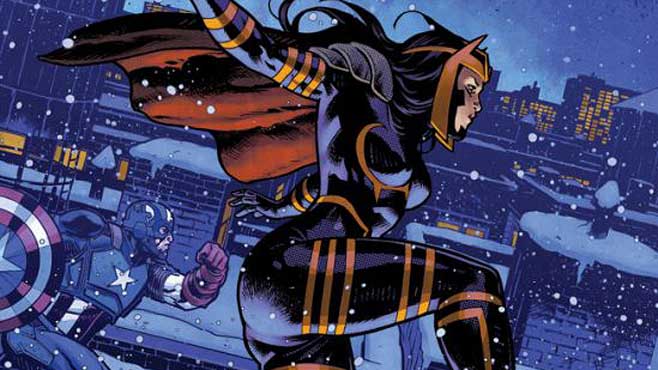
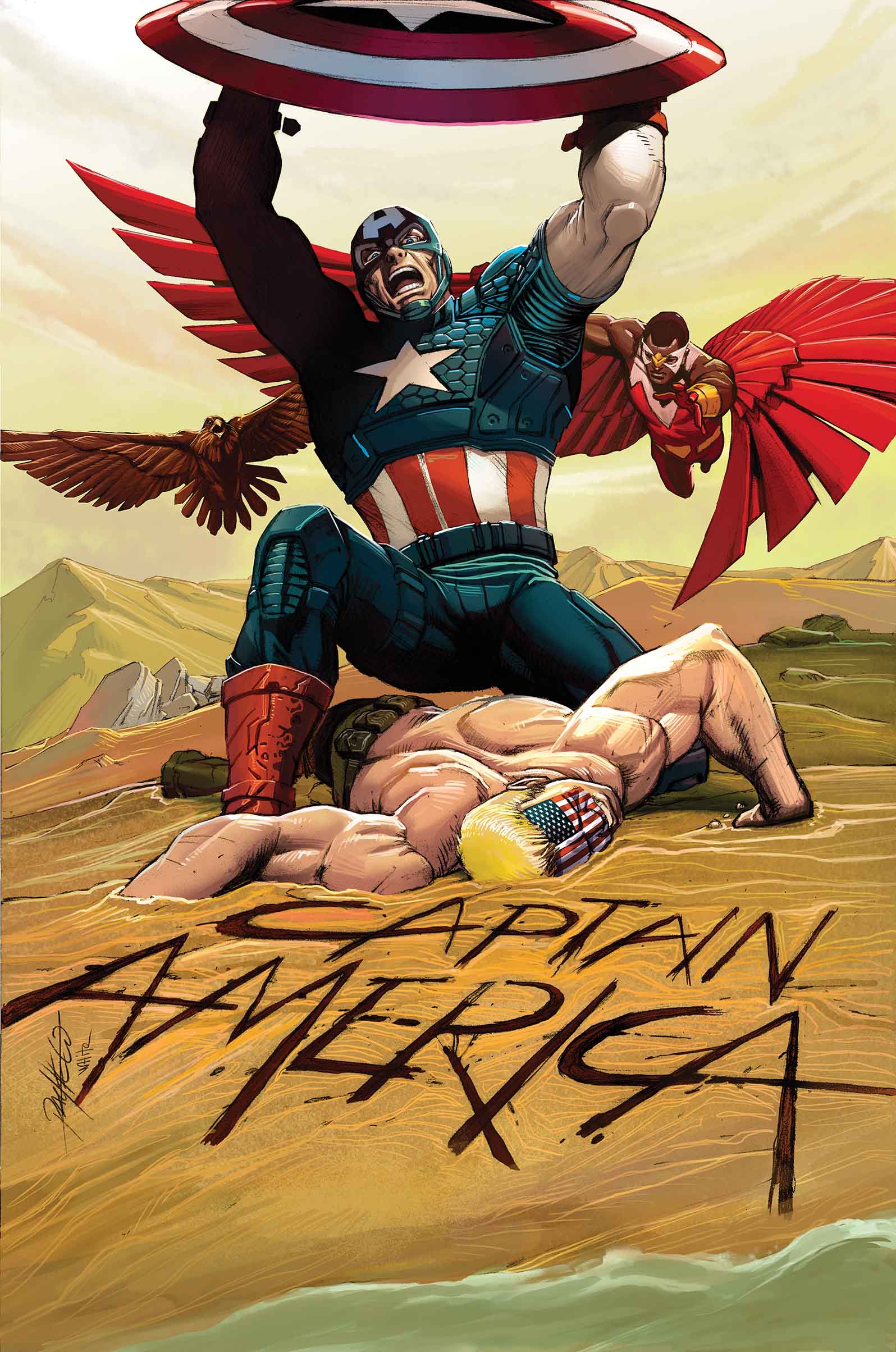
The only area Loose Nuke isn’t a disappointment loose nuke 2is the artwork. Removing John Romita Jr. in favour of Carlos Pacheco and Nick Klein was a good move, returning to something a little brighter and a lot less messy. The pencils look thicker, facial expressions aren’t all one and the same, and there’s great use of shadowing here and there to aid the visual storytelling without drawing explicit attention to them. Nuke does look absolutely ridiculous, as is intended, and Jet Black should probably put some jeans and a jumper on, but for the most part the two artists and their colourists do a great job. The covers to each issue might even be the most memorable part of the book, since a lot of the plot kinda fades into the white noise.

And that is the bigger problem with Loose Nuke at the end of the day: we’ve seen it all before, so it fades in memory a bit. It’s done a little different and the specifics have changed, but as rehashes of old superhero stories go it’s pretty blatant and, more critically, uninteresting. Recycling is par for the course with cape-and-cowl fare, but it feels like we’ve gone a little too far here. Maybe it’s time to throw Cap into the future and see how his 2014 values hold up against the overlords of the Chinese Robot Empire.

loose nuke cover

PUBLISHER: MARVEL COMICS

STORY: 2/5

ARTWORK: 4/5

DIALOGUE: 2/5

OVERALL: 8/15

BEST QUOTE: “That’s the gift of this place, Steve. The unyielding spirit of a free people. Optimism is the American state of being. No matter the calamity, we remain surefooted, confident of tomorrow’s return…it’s why we came here, Steve. Never allow this challenge, this grief, to defeat you, Steve. Get past this and no matter what life throws at you, you’ll overcome it.” – Sarah Rogers

Sex Criminals: One Weird Trick

WARNING: THIS REVIEW CONTAINS MINOR NSFW IMAGERY (which, y’know, is to be expected coz of the title)

A writer’s workshop I attended last week featured the guy running it tell us “every story is a story rewritten”. He was (allegedly) quoting someone famous (Hemingway, maybe?), but Google-fu hasn’t been able to divine the culprit in any permutation of the above quotation or replacing the word “story” with “book”, “fable” or “random cave drawing”.

The crux of this wisdom was the notion that each new story these days takes elements from what has come before and reworks it in a way that can be fresh but is not, per se, entirely original. Star Wars might be a trope codifier for sci-fi fantasy, but the film itself was a rework of the classic 1930s sci-fi serials that would also later be homaged in movies like Flash Gordon. Even something genuinely push-the-envelope as Inception owes much of its DNA to films outside Christopher Nolan’s body of work, though I don’t think any of them could’ve pulled off a stylish mind-boggler in much the same way Nolan did. Also they wouldn’t have had Tom Hardy around.

My point is, stories these days can feel a bit recycled no matter how good they are. Ponder on this, then, as I tell you that Sex Criminals feels like the most truly original indie comic to come out of Image or any other non-Big-Two company in years.

sex criminals 3

In a nutshell, there’s a girl named Suzie. After her father dies and her mother hits the bottle she begins puberty, discovering with her first accidental orgasm that she can somehow freeze time whenever she has the sexy time. Over the years she uses this strange talent, unaware that another bloke called Jonathan, whom she meets at a party, has a similar condition. After the two realise the special things their special places can do, they hit upon the world-beating idea to rob banks together. Because wouldn’t we all?

Now, before those of you who’ve read it go off to draw links between the book and the sex comedies, heist films, Scott Pilgrim-inspired meta-narratives and sexual education posters you’ll no doubt claim inspired the former, let me clarify. It’s rare that I read a book as raptly and attentively as I did Sex Criminals – the last one that truly grabbed me to that extent was Saga – mostly because it’s a breath of fresh air. Some of the usual teen sex tropes are present, though thankfully not as painful to watch as many of the American Pie sequels, and the use of a myth arc to carry along both the strange things Suzie and Jon’s privates can do and those trying to stop them gives the book a surprising and unexpected spine.

In all honesty, the concept initially seemed a bit of a one-trick pony to me. The only way I could see it diversifying the repertoire was sex criminals 4if particular kinds of orgasms (manual, assisted, from intercourse, etc) did different things to time and space, or maybe if an orgasm stretches for so long that the pair of protagonists are skeletons by the time the clocks start running again. But in actuality, Sex Criminals has a really intelligent story that just happens to contain a concept you’d expect as part of a Eurotrip fanfiction. The opening is overly serious (though the narration, quite meta throughout, assures you the sex and jokes are coming soon, promise) and there are bits of a darker undertone popping up here and there to punctuate the long stretches of really excellent comedy. This is a story rather than a string of jokes, so those hoping for a bunch of excuses to experience scenes of characters having sex should probably go watch Hotel Erotica instead.

And because Sex Criminals is a story, the characters are strongly written and their relationship is both believable and really sweet. They’re not together simply because their immodest orgasms break the timey-wimey ball, but because they seem to connect as people, too. Sure, the impetus for their whirlwind 48-hour (or something like that) first date is an insane amount of sex and time-stopping, but as the book goes on we see they could easily have matched up had they not been sexual clockstoppers. It’s a credit to writer Matt Fraction that our protagonists are written as characters rather than a pair of cyphers with sex jokes.

A big theme throughout the book is sexual security; that is, becoming secure in your own self once you hit the dreaded teens and things start happening to your body. Fraction tackles these issues of insecurity head-on with a few fourth-wall-breaking speech bubbles, presumably aimed at younger readers, telling them it’s ok to be changing and becoming an adult. What makes these bits fun rather than preachy is the light way it addresses those issues with truth but stops just short of becoming a sex ed piece. It’s gratifying to see a comic writer face issues of sex that a lot of others seem to shy away from. Maybe we should get some Republicans to check it out.

sex criminals 2

If I have a problem with the story – and given its overall tapestry of nuanced writing and marvellous characterisation, this is fairly minor – it’s the framing device used in medias res during a big bank robbery. Having it at the start works well to establish tension, but the plotting and timeline of later chapters become muddy when it appears at the start of each chapter and disrupts the flow of events from the chapter beforehand. Also, the villains (such as they are) seem reasonably ineffectual and relatively unexplained. I figure we’ll learn more about them later on, and hopefully they’ve got backstories as interesting as their kegel-enthusiast commanding officer.

Art is awesome. Chip Zdarsky does a great job of giving full-lipped illustrations without making it too cartoony, but at the same time carrying a slightly off-beat quirk to character proportions and background work that in some ways adds to the humour level. It very much puts me in mind of Rob Guillory’s work on Chew but with less exaggeration, especially with the funny posters and background details cheekily snuck into panels strategically. Despite the title, there’s not a lot of actual sex and even less full nudity, so Zdarsky straddles (sorry) the line between artistic and pornographic really well. Of particular note is the overlap effect used when time freezes which kinda looks like you’re viewing the world through sparkly fog, as if a rocket launcher detonated Edward Cullen and you’re seeing through his equivalent of pink mist.

Dialogue, mercifully, feels like it’s being spoken by real people. My biggest fear whenever reading teen- or young adult-aimed content is seeing words on page that make me want the protagonists to die on principle, and thankfully Fraction averts that marvellously. Assex criminals 1 mentioned before, the villains aren’t particularly noteworthy, but both Suzie and Jon sound and act like real people. On a meta level, I’ve gotta give Fraction credit for a karaoke sequence meant to use the lyrics to Queen’s “Fat-Bottomed Girls”, but which was prohibited thanks to rights clearance issues. To compensate, Fraction uses in-panel post-it notes on the sequence that explain the lack of lyrics to turn what could’ve been a deleted scene into one of the best meta-jokes in the book. Major kudos, and somehow having the karaoke dance routine going on behind the post-its adds a wonderfully surreal humour value. In this one exception to the rule, the lawyers actually made a comic funnier.

Most might be turned off by the title, some by the story and others by the links to the much-loathed sex comedy genre. Honestly, I cannot recommend Sex Criminals enough. It’s witty, with great heart, excellent metatextual humour and a story I’m quite interested to see progress. It might borrow some things from what’s come before, but it still feels refreshingly original – avoiding the tropes of its forebears while still paying a bit of lip service just makes it better. And if you honestly can’t see the inherent coolness of being able to go all Hiro Nakamura when you rub one out, it’s probably time once again to reassess your standards.

sex criminals cover


PUBLISHER: IMAGE COMICS

STORY: 5/5

ARTWORK: 4.5/5

DIALOGUE: 4.5/5

OVERALL: 14/15

BEST QUOTE: “So, we get a little jumped. And while I’m there on the ground…I see something, right? Porn. Porn in the woods. Which used to be a thing. You’d find porn left to rot out there. So the woods was, like, really slow internet basically. See, I didn’t – my dad – I had no porn, I had no stash, but this…this was mine. All I had to do was not get my ass beat.” – Jonathan

Infinity, Part 3 of 3 (Core Miniseries)

I mentioned during my recap of the best and worst books of 2013 that I believed Infinity would beat the tar out of the other event titles of that year, not least of all the contentious mess that was Age of Ultron. If nothing else, it can firmly take its place as the best event crossover of 2013; if you’re gonna count inter-family titles like Batman’s Night of the Owls or Green Lantern’s Rise of the Third Army, things might get messy.

After reading, I reckon Infinity did indeed kick every shade of ass it could as an event. Is it the best comic story I’ve read? No. Is it the best Marvel I’ve read? No. Is it the best event Marvel’s produced since the pre-2000’s? Quite possibly.

I’ve reviewed the book in two other chunks now, so consider this desert to the main courses as an exploration of why Infinity works as an event, what Marvel (and DC, for that matter) should take away from it, and where each big event since Avengers Disassembled fell down in comparison. Maybe, with this constructive criticism onboard, event comics can become something to look forward to with more regularity than with reflux.

At the end of the day, an event title should usually have six ingredients to really hit the mark as something other than a big, loud infinity 3blemish on the ass cheeks of the superhero comics genre. Keep in mind this doesn’t apply to every event ever made, and it’s perfectly fine to have a crossover that’s not as cerebral or intelligent as something like Infinity. You wanna have a big mash-up of heroes kicking the crap out of each other just because? Go ahead. Just make sure it’s advertised that way, and be prepared for me to slap a great big 1-star rating upon it on Goodreads.

Also keep in mind these steps are for the big blockbuster events like Fear Itself, Civil War and House of M rather than littler ones. If it’s touted as a gamechanger, features every character Marvel ever held the rights to and is written by at least one A-list staff writer, chances are it falls into this category.

.

1 – A TANGIBLE THREAT

The most necessary thing an event needs is an enemy. Whether the Skrulls are threatening to replace the population with slightly greener doppelgangers, or the director of SHIELD turns out to have really been a crocodile all along, an event needs a clear andinfinity 5 discernible threat for the heroes to focus on. Hell, it can be themselves if it fits the story (which, sadly, it did not for Avengers vs. X-Men). Whatever the case, the enemy needs to be present, understandable and a viable threat. They also, for the bigger events, need to be a big enough enemy to justify some Avenger assemblingInfinity got great use out of Thanos and the Builders, and whatever its failings Fear Itself did have those Asgardian bastard gods hitting people with superpowered hammers.

The nature of superheroes – i.e., the characters being a direct response to something nasty, such as crime or being the victim of pater familias – necessitates there’s a villain threatening them, the world, their goldfish, etc. Event titles, featuring every vaguely-marketable superhero a company owns, need a particularly potent enemy to get this particular band together. Which leads me to…

.

2 – VISIBLE STAKES

There has to be a believable goal for both sides. Obviously the heroes want to stop the villains, but for the villain this could be infinity 7something more interesting than “destroy Earth and all the puny humans”. Granted, Infinity fell victim a little to this with both the Builders and Thanos, but there were reasons behind both; Thanos was actually looking for his son and wanted to give the Inhumans what for when they tried to hide the boy on Earth, and the Builders needed to trim our home from their garden of multiversal plants. “Destroy Earth” is acceptable as long as there’s a reason; doing it just because, as with the Worthy in Fear Itself or the Skrulls in Secret Invasion just feels tired and uninteresting.

Conversely, look at some stuff that didn’t involve that old chestnut; Siege (and its preceding year of misery, Dark Reign) had a villain more intent on securing the world because of his misguided idea that he was the only man to properly control it. House of M‘s villain, for lack of a better word, was just crazy and didn’t mean to do all the crazy things she did in her craziness. To stretch my credibility as a seasoned and well-balanced individual somewhat, even Avengers vs. X-Men relied on an enemy more intent on kicking ass than kicking Earth. Oh God, I just said something vaguely slightly a little bit positive about AvX; someone take me behind the shed and have me shot.

Stakes get us invested in the story, and the more varied or interesting they are the better we connect with the heroes’ plight. Make it more personal, something deeper the way House of M did, and it’s the cherry on the croissant.

.

3 – CONSISTENT CHARACTERISATION

Comic companies employ an army of writers, superhero comics more so than others. Ok, not an army, but at least several SEAL teams’ worth.

Point is, there’s a bunch of varied talent and style in any given arm of a comic’s narrative offerings. For all their assembling and infinity 2Avenging, most of Marvel’s characters have distinctly different personalities in the hands of several distinctly different writers, each making great dishes with different flavours. For instance, Captain America’s gone through a few incarnations in the last little while; Ed Brubaker makes him a sad relic of an age gone by, Rick Remender turns him into a mashup of Buck Rogers and Dominic Santiago, and Cullen Bunn…well, the less said of Cullen Bunn, the better.

In order for a big crossover to work, characters need to have some kind of consistency. If there’s a particular flavour of story running in each character or team’s ongoing series, you’re best off striving to match (or at least attempt to) with that tone. One of the drawbacks of, say, Age of Ultron was the apparent abandonment of anything that had happened to Spider-Man – Superior or otherwise – but seemed to be somewhat within present canon. Avengers vs. X-Men also seemed not to care terribly much about Tony Stark’s recent-at-the-time character efforts in The Invincible Iron Man, ditching his newer, more positive outlook on the world and solving terrorism in favour of building superweapons to kill intergalactic forces of nature (because plot).

Infinity kept things consistent. Captain Marvel reads and speaks as if her words came from the pen of Kelly Sue DeConnick herself. Captain America seems world-weary after his recent harrowing adventure in Dimension Z. Spider-Man…well, we’re still not sure about him. But he’s got his black duds on, so there’s still some Superior in there a bit, right?

Congruency between big events and smaller ongoings is crucial, especially for longer-term readers who are invested in the character as well as the giant multiplayer mashup they feature in. Last thing we need is another Civil War fiasco.

.

4 – NO RELIANCE ON “COMIC BOOK DEATH”

I CANNOT STRESS THIS ENOUGH. I’ve lost count of the number of times I’ve railed against this trope being used either as an infinity 6emotional hinge in the story or the closing chapters to the narrative, with the most egregious (and oft-referenced) being Thor’s death concluding Fear Itself. Lesser examples would also include Bucky Barnes’ death earlier in that same book, or Professor X in Avengers vs. X-Men. Relying on the death, threatened or actual, of an established, branded, marketable and famous character in order to raise tension is a wasted effort.

Look at Infinity; Jonathan Hickman had introduced a number of his own characters throughout his preceding Avengers run, and got great mileage from many C- and D-list superheroes who could have easily been killed in Infinity and would’ve raised the emotional stakes if they had. The reality is that death of heroes we know will be back whenever their next movie rolls around to snag new readers falls utterly flat, and relying on it (especially as a conclusion) is falling utterly flat onto a minefield of nail-throwing proximity charges. So, in other words, really of the not good variety.

.

5 – A SATISFYING ENDING

Now, when I say “satisfying”, that does not necessarily mean the ending has to wrap everything up in a neat little bow and answer every question begging. Some of the best events – particularly Siege and, to a lesser extent, House of M – wrap up the main plot but leave enough threads for further storytelling in either single character ongoings or in a infinity 1future event down the line. What stops an ending from being “satisfying” is a significant enough lack of closure. Obviously one can never have a conclusive end to anything superhero-flavoured, since one needs to be able to read more of a cash-cow character the following month, but as long as the event’s main thrust is dealt with and at least some of the B-plots addressed, if not ended, you’ve got a winner on your hands.

Avengers vs. X-Men did not have a satisfying ending. Sure, the Phoenix was vanquished and the Fabulous Five mutants who got possessed by it returned (more or less) to their original selves, but the conclusion came way the hell out of nowhere and ignored several of the more interesting plot threads the book brought up. Some leeway can be given in some cases – such as Cyclops killing Professor X, an act that very much haunts him through the subsequent Uncanny X-Men run – but plots like Namor’s destruction of Wakanda, Hope’s real place in the Marvel mythos following her use against the Phoenix, and the animosity built up between the event’s titular teams are just left dangling for later.

An event needs to feel like a story in and of itself. It’s perfectly fine for it to be part of an ongoing series of events, such as the run Brian Bendis started with Avengers Disassembled, but they should also standalone as a complete story (I can tell you right now this is something DC’s recent Trinity War fails spectacularly at achieving, but I’ll get to that in a later review). Infinity has an ending, the twin A-plots of the Builders and Thanos are respectively concluded as far as the book is concerned, and threads are left for either Jonathan Hickman or another writer to continue in a different direction within the status quo the event leaves us with. Satisfaction doesn’t have to mean total conclusion, although that can certainly help. Just make sure no-one falls victim to the old Tethercat Principle.

.

6 – HONEST ADVERTISING

This one’s less a requirement and more a preference, but market your event properly. Going to the big guns of saying “THIS EVENT WILL FOREVER CHANGE THE FACE OF EVERYTHING YOU KNOW OMG WTF” is just going to turn seasoned readers like me off avengers infinity posterany investment we might have in the title. Fear Itself both succeeds and fails at this aspect; HEROES FALL, GODS DIE was certainly a tagline it lived up to, but on the other hand HEROES FALL, GODS DIE was a tagline it lived up to with way the wrong kind of gusto.

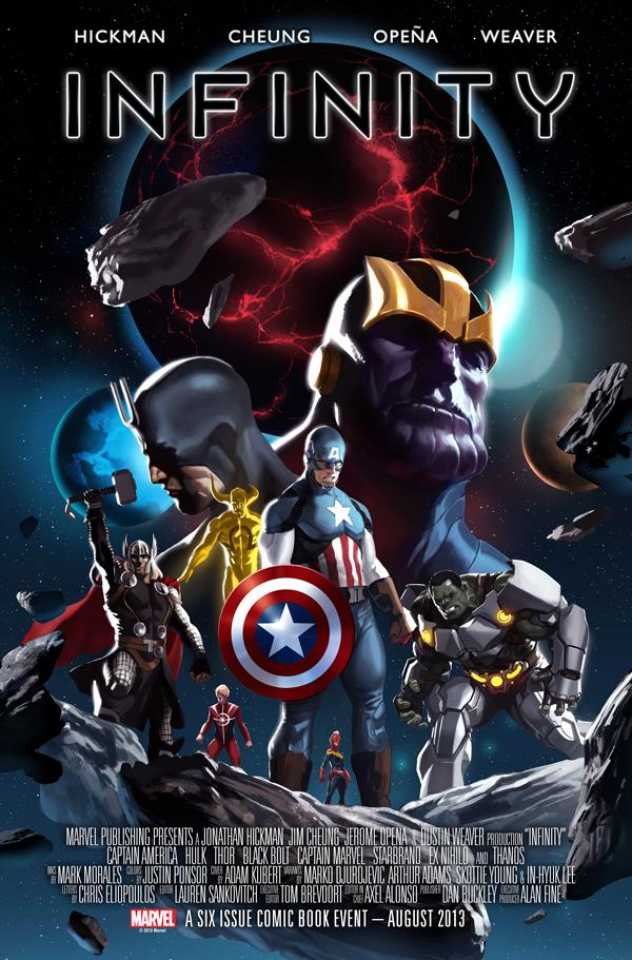
I mentioned the image to the left in the second part of my Infinity review, and I was pleased to see the actual book fit the tone of the movie-esque marketing material. It felt like a big film with a lot of moving parts, featuring twin driving plots, a slew of famous faces and giant stake-raising battles. It lives up to the way it was marketed. Avengers vs. X-Men, for better or worse, was touted as a beat-em-up style story between its two main teams, and certainly adhered to that with, again, the wrong kind of gusto.

Whatever you do, don’t sell your event to me as the biggest change to ever occur in the history of anything ever. Coz then we’ll know you’re just full of it.

.

This is, of course, in no way a definitive guide on how a comic book superhero event should be handled by writers and those associated. It’s merely a guideline, tapping into elements of events I liked as contrasted to elements I didn’t. No event is perfect, including Infinity, but damn it all if it didn’t work as an event better than any I’ve read released in the last decade. It also feels like a story borne out of actual inspiration and the desire to, y’know, tell a story, rather than just seeing how many inches can be added to the official Marvel Money Pile (patent pending).

At the end of the (very long) day, I heartily recommend Infinity. It’s a good story, a good superhero yarn, a good space opera and a good event title. And I know most of my regular audience are probably saying “Jeez, couldn’t you just have said that at the start and not drawn this trilogy of mediocre reviews out over several weeks?”

Well, I could’ve, but haven’t I enlightened you just a little tiny bit?

infinity cover 2

PUBLISHER: MARVEL COMICS

STORY: 4.5/5

ARTWORK: 4/5

DIALOGUE: 4/5

OVERALL: 12.5/15

BEST QUOTE: “Well…first there was nothing, then there was everything. Then the Good Lord saw fit to bring me into the world to kick the asses of those who need it most. So get ready, ’cause this day or the next, it’s coming.” – Captain Marvel

Infinity, Part 2 of 3 (Avengers)

This is what we came to see.

avengers infinity posterEarly in Infinity‘s promotional run, the movie poster image above did the rounds for the book. Promises and inferences were made about the story’s game-changing nature, the linking of threads from all of Jonathan Hickman’s previous Avengers work, and a climactic showdown with the alien enemies known as the Builders whilst longtime baddie Thanos makes a power play for Earth in the background. We were offered something big, from a writer I know is capable of giving us something big, then bigger on top of that.

You know what? Infinity – and its vanilla Avengers component – delivers. It is the 30-minutes-or-less pizza guy who not only gives you the greatest slice of meatlovers you’ve had in your life, but also hands you a spare garlic bread and some of those chocolate-filled mudcake pudding things for good measure. And now I’ve made myself hungry.

In a nutshell, the main thrust of Infinity deals with Captain America doing some Avenger assembling and heading off into deep space to spearhead the Builders before they come to Earth and blow us all avengers infinity 2up with the bureaucratic airs one might expect of a Vogon Constructor Fleet. An armada of starships large enough to rival anything Star Trek: Deep Space Nine could put on screen amasses and takes the fight to the Builders.

That’s it. That’s the story. But dammit if it isn’t entertaining.

Ok, maybe I’m not being entirely fair; this is a Jonathan Hickman book, so of course it’s not as simplistic as the above summation might indicate. There’s metaphysical contemplation of life and death, mostly from resident pontificator-cum-Avenger Ex Nihilo. There are enough continuity-driven appearances by Marvel’s space-faring species that you’d almost think Hickman’s read every intergalactic comic penned in the past half-century. There’s witty and depressing banter amongst characters where appropriate that feels like actual spoken dialogue.

And there are space battles. Dear God, there are space battles.

avengers infinity 4

It’s actually kinda hard, reading in the collected edition, to distinguish between which chapters were Avengers issues and which were Infinity-branded, as there aren’t any indicators to either effect (New Avengers is easier to delineate due to its Earth-bound story). For the purposes of this review just assume I’m talking about all the Infinity stuff that doesn’t relate to Thanos (see here for the rest of that). If the Mad Titan himself felt incongruous to the story, the remaining two thirds fit so well together it reinforces my notion that maybe two events would’ve done better justice to Hickman’s story than just one.

Taking the space opera portions of Infinity on their own, you need to come into it with a reader’s mind galvanised either by paying attention or switching off. What I mean is that you can read about Cap Rogers in the 21st Century and his Blake’s 7 team of adventurers with either an eye for the finer details, the grander tapestry being woven by Hickman and all the neat little references to previous cosmic Marvel tales, or you can read it with an almost Michael Bay sense of avengers infinity 1“WHOOOO I GET TO WATCH SH*T EXPLODE!!” Far be it from me to recommend the latter in almost any other case, and I certainly mean no disrespect to Hickman when I compare him to the disastrous architect behind Transformers‘s downfall, but this really is a tale you can take in two different tellings. Myself, I always strive to be as pretentious as possible when attributing a finer eye to mediums usually designated as “low-brow”, so I read Infinity as an intricate parade of moving parts that just happen to take place during a space battle and came out significantly pleased with the overall result. It also made me really want to watch Star Wars again.

As an event title, the space chapters of Infinity fulfil my criteria masterfully. There’s a clear threat necessitating the Avengers call their entire ensemble to the task, the prolific cast each get a chance to avengers infinity 3shine in their own little moments, and to jump ahead in my usual review structure a few portions, the dialogue is great. The sense of joy at victory and weary resignation following defeat are all palpable in the characters’ words and actions, which really contributes (especially towards the end) to the overall Pyrrhic Victory sense the book strives to achieve. I won’t say whether or not that particular ending is in store for you, though if you honestly believe Infinity ends with Earth destroyed you’ve clearly never read a superhero event. I will, though, say Infinity‘s conclusion left me satisfied, which is still more than Fear Itself can claim to have done (and unlike that shambolic excuse for an event, the conclusion didn’t rely on a major character death or two to get readers invested, which can only be a point in its favour while I keep throwing bits of burning newspaper at those who thought the death of Thor was a great way to cap that stupid affair off).

Art’s good, if a little schizophrenic. Like Avengers vs. X-Men before it, the rotating team of artists aren’t always congruous to each other’s styles, and at times the stark difference in portrayal of characters can be a little jarring going from chapter to chapter. The bulk of it is the full-lipped stuff I’d expect of a major reader-drawing event title (thank God Filipe Andrade wasn’t onboard for this), and for the most part is serviceable, flashy and big. I’d love to get technical about it, but seriously, the space battles look freakin’ sweet. You’d owe it to yourself to check out Infinity on that basis alone, which is a visual recommendation I rarely give without irony.

If I’ve got a gripe with the story, though, it’s that as an event it’s almost entirely inaccessible to newbies unless you go in with the Michael Bay mindset. Disregarding the foreshadowing provided by Hickman’s books leading up to this, the amount of referencing to other Marvel stories (going as far back as the 60s) is insane. Now, I’ve read a ton of Marvel across several eras’ worth of history, and even with my (not really) vast and (totally not) encyclopedic knowledge of the canon I was having trouble following some of the early stuff involving races with apparent grudges and history with each other getting into an intergalactic pissing contest. I also wasn’t quite sure how Captain America had managed to ingratiate himself as well as he did with this apparent space council of continuity, therefore having to rely on the old ‘it’s a thing, don’t question it’ mentality when presented by unexplained elements in superhero comics. Maybe he brainwashed the council to allow humans onboard off-page, or one of the council members saw his costume and really liked the colour scheme.

All things considered, Infinity works really well as an event title, as a story in its own right and as a continuation of Hickman’s Avengers opus. Whether you’re a fan of complex storytelling, deep character pathos and gorgeous artwork, or if you just want to see pretty spaceships blow up, you can’t ask for much more than that.

avengers infinity cover

Scores and best quote given in INFINITY: CORE MINISERIES review