Final Crisis

Before I sink into what will probably be a novel-length review, a quick word on some housekeeping


– From now on, Retro-Reviews are only going to refer to any material I review from anytime before the year 2000. I used it mostly as a signifier for the reviews I made on Facebook back in 2010 (as some of you may have seen in the half dozen old posts that all went up the other night) but I think that might confuse new readers; Scott Pilgrim isn’t exactly retro, is it?


– For the next two weeks I’ll predominantly be doing reviews of slightly older works, and by that I mean from 2011 and backwards. Until Batman Incorporated vol. 1 is out on April 11 there’s not an awful lot for me to talk about that’s up and coming and interesting to me.


– According to Yahoo, my “Batman: The Black Mirror” review is number 1 on the search page at the moment! Whoooo! If you haven’t read it already, go read it now. Then go read the book itself. Seriously. It’s really good.

Ok, now that’s all over with, let’s get into it. Just a bit of a warning, this is going to be long.

Final Crisis. Also known as the end of the Crisis trilogy, the Identity trilogy, and one of the most divisive pieces of comic book literature ever published.

Grant Morrison had been writing for Batman since 2006, and in the lead-up towards his work on Batman RIP he was announced as the writer of DC’s 2008 massive crossover event. The anticipation that built towards Final Crisis was tremendous; while it didn’t end up being as successful as the landmark 52 maxiseries before it, a weekly serial named Countdown to Final Crisis set up 52 weeks of lead-in towards the story (despite the fact a lot of it was retconned out afterwards, the promotional advertising was extensive and touched on almost every convention and internet site even remotely linked to comic books, and the eventual release of the first issue saw initial sales figures at over 100,000 purchases – an exceptional effort for a comic book. Issue 1 was ranked second the week it was released, only falling behind the second issue of Marvel’s 2008 event Secret Invasion. After comparing the two, I can definitely see why they lost to Marvel that week.

As I stated in my Batman RIP review, you could write entire essays on Final Crisis. The story is constructed almost solely out of Morrison’s trademark non-linear narrative and hallucinogen-inspired fantasy trip that only makes sense in a tangential, End of Evangelion kind of way, and while it certainly worked in some corners of his Batman run as a deep psychological probe into Batman’s very motivation for being and the stresses he’s under it does tend to falter a bit when such a psychological framework encompasses an entire universe of characters.

As its barest, minimum level, Final Crisis deals with the rise of Darkseid and his ilk as they take over the world, fitting with the promotional tagline that Final Crisis is “The Day Evil Won”. Every A-lister in the DCU is involved in some capacity as they attempt to halt Darkseid’s advance and consequently screwing-up of the Multiverse, and the Earth soon falls victim to the followers of Darkseid’s “anti-life” equation that encourages people to submit to his rule. This story also marked the triumphant return of Barry Allen, dead for the better part of two decades and last seen in a heroic sacrifice at the climax of Crisis on Infinite Earths, as well as the apparent demise of Batman after over half a century of crimefighting.

Now I’ve spoken about comic book death and crossover events before, and I tend to be fairly cynical on both those topics. The former problem lies in the inability to create sufficient suspense when you know one of the universe’s big three is in the crosshairs, no matter how much publicity is attached to it, and the latter problem deals with the frequency of such events that both undermine the concept of a massive crossover and dilute the impact of the former problem even further.

With Allen’s resurrection and Bruce’s death, both of these problems are averted.

While it is clear that the narrative is the kind of thing you need to A) read altogether as a trade and B) read at least twice through, it feels big. Colossal, even. Everyone is involved, from the heavy hitters to the C-list fodder. The stakes are high. Lives are lost. The game is irrevocably changed afterwards. Once you know what the hell is going on, you can see the grand enormity of both Darkseid’s assault and the lingering effect it has on the DCU at large.

On a deeper level, in relation to the two above character moments, Allen’s return from death was effective and – I imagine for long-time readers – quite shocking. In these days of comics when resurrection tools or alien lifegiving machines practically come free with the Sunday Telegraph it was quite a feat that Morrison accomplished in bringing back the original Flash in a way that was believable and hard-hitting to the audience. The fact that it was permanent just made it all the more awesome, because as far as I can recall hearing from fans at the time, no-one expected it to happen. Keeping someone – an A-lister, even – dead for that amount of time before bringing them back is exactly the kind of character death plot device that writers would do well to use more often if they’re looking to create suspense and anticipation. I believe Marvel have tried it with both Scarlet Witch and Jean Grey in their upcoming Avengers V X-Men event, but honestly, who couldn’t see them both coming back some day?

Batman’s death was equally effective in my mind; being relatively new to comics and unfamiliar with the flexible physics of comic book death, as well as having read Morrison’s RIP run and being well-aware that Bruce Wayne’s days were numbered, I was in exactly the right foreboding, watching-a-train-wreck mood that a reader should be in when they know a big death is coming and it’s been made clear that it’s going to stick (not that it did, but at the time I didn’t know that for certain). When Darkseid’s Omega beams struck Batman right in the noggin, I remember being shocked by the double-page spread that depicted it right after his triumph defeat of the god of all evil.

The shock turned into tears when this happened.

Yep, tears. I cried. I yelled. I felt as if I’d just been given a shiny new flamethrower only for it to explode in my hands and leave me with stubs instead of forearms.

Looking back, despite the fact I know the true meanings behind it, I still hold up this panel as one of the most effective comic book pages I’ve ever seen. To the reader at the time, Batman hasn’t been vaporised or sent to another dimension. His body is there. It’s charred. It’s lifeless. It’s deader than Las Ketchup’s music career.

As far as the audience can tell at the time, Batman is dead in Superman’s arms.

While it’s true that he ended up returning a couple of years later, the image is still effective. It’s so striking they even used a variant of it for the collected edition’s cover. That’s how you punch a reader in the gut.

On a related note, they did kill Martian Manhunter in the story’s opening, but to me this felt far too quick and undermined by all the story that followed. He certainly wasn’t mourned as much as Bruce was, so I can’t help but feel J’onn’s death was hastily added as a favour from Geoff Johns so that he could be used as a plot device once Blackest Night rolled around.

As I said, every A-lister has their part to play in the endgame. Green Lantern brings the universe’s emerald power to bear against the main baddie. Superman travels through layers of metaphysics and psychologically-charged alien dimensions to find the weapon that will save the world. The two Flashes – Allen and West – team up to thwart Darkseid and rally support for a final strike. Wonder Woman…get’s possessed almost immediately and wears an S&M mask. Unfortunate, but like I said – they’ve all got a part to play (no matter how ridiculous).

If there’s one thing Grant Morrison does not do in his writing, it’s give a precede; the story opens with the bare minimum of explanation before the sky goes red, a God is murdered, an old guy gets kidnapped and our favourite Martian is spiked through the heart. Events proceed faster than a Tokyo bullet train and there is very little in the way of expositional dialogue until the very end; the reader is either left to work things out mostly for themselves or, if they’re new to the DC Universe, have absolutely no friggin’ clue as to what the blue-faced hell is going on.

A large portion of fan backlash against Final Crisis revolved around how awful it was reading the story in bite-size chunks each month, a good deal of which was rescinded when the same fans read it all in one go. This is something I cannot stress highly enough to someone wanting to venture forth and read this seminal work; do it in one go. Don’t read bits and pieces here and there, or the story will be lost in a miasma of tangential references and obscure imagery that only the most devout DC readers will pick up on a first reading. This is especially true during the two-part Superman Beyond interlude; I’ve read that thing at least 4 times and I still have trouble figuring out what the red-nailed hell is going on.

Speaking of my reading of it, I absolutely hated Final Crisis when I first experienced it. I mostly stuck to it to find the conclusion to Batman’s death arc, and to be honest the only thing that made me read Issue 7’s conclusion was the tiny hope that maybe Bruce would turn out to be alive somehow – a hope that was indeed validated. But the fact remains that trekking through Final Crisis in single-issue form was like navigating a Shanghai markets and all I can speak is German. I had no idea what the green-nippled hell was going on.

Coloured hells aside, I did look favourably upon Final Crisis shortly after the softcover release one evening when I’d had one too many bourbons and was listening to Jeff Wayne’s musical rendition of The War of the Worlds. I found the musical themes matched the book surprisingly well, especially during the Superman Beyond chapter, so if you take nothing else away from this review then take this; read this book in its entirety when you’re slightly drunk and listening to Jeff Wayne. Seriously. It makes all the difference.

I mentioned that the story has layers, and it most certainly does; superficially it’s layered with the veritable plethora of characters starring within its pages, each contributing to both their own subplots and the arc of the story as a whole. Getting a bit deeper, the story seems like a remarkable use of the graphic medium through its heavy use of symbolism and connected prose that, as stated previously, does little to inform the viewers for the majority of the story. While in almost any comic this latter fact would be a death sentence, it blends so well with the rich tapestry of images and characters that for some of the time I found I was putting the plot to one side and focusing more on the artwork than anything else. Somehow having only parts of the story explained allowed it to be read in a way that’s unlike any other comic I’ve encountered, with the exception of all of Morrison’s Batman stories after The Black Glove.

Furthermore, the layers themselves represent dozens of literary aspects that are either well fleshed-out by story’s end or still touched on in a satisfying way. Final Crisis is many stories all encapsulated in one overarching narrative; it’s metaphysical journey into the heart of the human spirit. It’s a story about the return of love and the death of hope. It’s a story about perseverance in the face of overwhelming odds. It’s justice, betrayal, evil, resurrection, despair and emotion. It spans the gamut not only of graphic novel narrative, but of literary content in general.

There are several moments within the story where the dialogue feels grandiose but not to the point of being too unwieldy, and it strikes a good balance between the dark forebodey-ness of contemporary comics and the larger-than-life well-loved cliches of Golden and Silver Age stories. Wonder Woman proclaiming “The armies of Libra have arrived!”, “I’ll do what I can to plug the hole in forever!” being shouted by Superman as the bad guys close in, and other similar parts of dialogue give it a kind of Gothic-pop feel that meshes the two types of sentencing together quite well, which is only enhanced by the visuals.

Speaking of the visuals, the art is at once marvelous and slightly schizophrenic; J.G. Jones began as the principal illustrator, but deadline problems and personal issues meant the art had to be double-handed by others, most notably future Green Lantern artist Doug Mahnke who drew the entirety of the final issue himself. Jones’ art is wonderfully textured and full-lipped, strongly evoking the styles of Tony Daniel and Ivan Reis, however the villains portrayed within his pages – with the exception of Darkseid, who’s creepy no matter who’s drawing him – all seemed a little bland in terms of faces and costuming detail. Conversely, Mahnke nails the villains quite well – especially Mandrakk, who has a suitably Gothic appeal with all the in-depth facial lining and grotesquely-proportioned body in both Supes Beyond and the final issue – but makes the normal faces – particularly the human ones – appear alien and slightly deformed. The Obama-esque Superman at the end looked more like a mannequin than anything else, and the principal Superman seemed to be trying to channel a slightly androgynous look that didn’t mesh well with that friggin’ annoying curl on his forehead.

On the whole though, the artwork is still well handled and as engaging as I would now expect a blockbuster event’s artwork to be. It stands head-and-shoulders over events like Secret Invasion art-wise, but it doesn’t quite reach the remarkable standards of works like Blackest Night and Siege.

Speaking of Secret Invasion, at the start I mentioned it’s no surprising that it beat Final Crisis 1 to first place the week of release. I don’t say that in a nasty way, because as I’ve established I ended up quite liking Batman’s swan song and Superman’s “use American Idol to save the world” bit at the end. At the same time, though, I can definitely see why this won’t appeal to everyone. Grant Morrison can be an acquired taste at the best of times, and this work is like his usual gigs multiplied by ten. If you’re not a hardcore DC buff or someone deeply ingrained in interpretation of semiotics and obscure symbolism, this may not be the book for you on a first reading.

If you can get past the lack of major exposition, the bipolar changes in artwork and the mind-screwy nature of the middle chapters, it’s a story that is far from being the best but is most definitely memorable. It’s the kind of book I still see people writing and talking about on forums years later, whether detrimental or affirmative, and the events in its pages affected – and, depending on the New 52’s continuity, may continue to affect – the entire DC universe in ways not seen since the very first Crisis.

I’ll borrow a Yahtzee Croshaw methodology in this instance – you have to try it for the utter uniqueness alone.

STORY: 4/5
ARTWORK: 3/5
DIALOGUE: 4/5


OVERALL: 11/15


BEST QUOTE: I. Am. The. New. God. All is one in Darkseid. This mighty body is my church. When I command your surrender, I speak with three billion voices. When I make a fist to crush your resistance, it is with three billion hands. When I stare into your eyes and shatter your dreams, and break your heart, it is with six billion eyes! Nothing like Darkseid has ever come among you. Nothing will again. I will take you to a hell without exit or end, and there I will murder your souls!” – Darkseid

Facebook Review – Blackest Night: Black Lantern Corps Vol. 2

ORIGINALLY PUBLISHED SEPTEMBER 19, 2010
THE FLASH
I knew before going in that I was going to enjoy this section for three central reasons:
1. It’s about the Flash.
2. It’s written by Geoff Johns.
3. It’s not JSA or Wonder Woman.
I was most certainly pleased to find my assumption correct – I did really like this one (mind you, it’s difficult for me to find a Geoff Johns story I don’t like anyway). From the awesome subplot of the Rogues to the substantial screen time taken by Blue Lantern Flash, this section was great from beginning to end.
The story switches between two narratives in particular; Blue Lantern Flash is kicking ass and taking names, as well as dealing with his Black Lantern-ized grandson from the future, whilst Captain Cold and the Rogues are utilizing their gadgets to no end in an attempt to stem the flow of former Rogues rising from the dead. The two plots don’t really intersect, but I think it works well for each of their flows. They work better separately.
I’ve only really got one major gripe with his, and that is that the Rogues should’ve had their own miniseries in Blackest Night. I really enjoyed their sections of the story, but felt that at points it was a little rushed. I’d’ve liked to see a bit more development from Cold, or some more evil squickiness from Boomerang as he feeds fresh bodies to his zombie father. I think Johns could’ve easily extended their subplot into a full-blown story, but I was still happy with what we got in the end anyway.
This story, as well as The Flash: Rebirth, has really showcased that Johns knows what the hell he’s doing. The characterization of Barry Allen is spot on, and to the untrained eye it seems like he’s been writing the Flash for years before now. As with Green Lantern, it’s really awesome when a writer connects so well with their writing subject that they both enhance and yet keep the same elements that make the character great in the first place.
8/10
JUSTICE SOCIETY OF AMERICA
There is one very clear and defining reason that I didn’t like this section – I had no idea what the fuck was going on.
Seeing as I’ve never read any Alan Scott, previous JSA, Power Girl, etc, I expected that, as with Titans, I’d have to just read and pick it up as I go along. I had read bits and pieces of this one a while back, when it was first released, but had never read it from start to finish.
Once I did this, however, I was sorely disappointed. There is little to no explanation of the current characters (although the deceased ones are each given their own opening monologues on their lives and deaths as superheroes) and it feels like a lot of them are just mashed in there for the hell of it. It’s effectively one big fight scene, with a few random interludes of characterization, and it really detracted a lot from the emotional experience that Blackest Night is. Apart from Jessie Quick’s thing with her father (which made her look either incredibly stupid or just plain suicidal) and Power Girl’s tears over Superman-2, it felt like there was really little emotion running through the story, or at least not as much as there should’ve been.
Plus the doomsday weapon that they were building that was basically a light bomb to kill the nearby Black Lanterns…WTF? You mean, if it kills all of them there then they couldn’t perhaps rush it to Coast City, the epicentre of the Black Lantern onslaught, and just detonate it there? Or even just somewhere with a few more Blacks nearby? Blowing up their only dues ex machine to take down zombie Superman seemed like it could’ve worked more to their advantage if they’d moved or built it elsewhere.
I was highly confused with a lot of the current characters and what they were actually doing, seeing as there was little to no explanation (unlike Titans). For someone who doesn’t read JSA it was quite harrowing to try and grasp the continuity of it all in the space of the three issues when they didn’t really give me an opportunity to do that.
Wasn’t too impressed with this one, and I wish they could’ve done more with it.
3/10
WONDER WOMAN
Surprisingly, I actually enjoyed this one.
The story seems like standard Blackest Night fare, with Wonder Woman kicking the crap out of Black Lantern Maxwell Lord (who has some hilarious lines, especially involving his severed head) in the first issue, but when it bridges into the second the story quickly shifts tones as the mighty Amazon becomes a Black Lantern herself, with much of the second issue spent kicking Mera’s ass, ripping out Wonder Girl’s hard and slicing the crap out of Black Lantern Donna Troy with her axe.
OR IS IT?
The twist at the end of the second issue, leading directly into Wonder Woman’s deputization as a Star Sapphire, seemed a little contrived, and, in my opinion, could’ve done without. I would’ve loved it if Wonder Woman had in fact killed Wonder Girl and almost killed Mera  (though no-one gives a shit about Donna Troy) because it would’ve added dimensions to the character that I think were begun in Infinite Crisis, making her a much more readable character for me (I personally don’t like her stories on the whole). I would’ve read a Wonder Woman story where she deals with the ramifications of killing and maiming her friends, and ends up becoming a leather-clad dominatrix whose lasso of truth turns into a fiery whip of death whilst she prowls the night looking for men –
Sorry, that kinda got away from me a bit.
While making it all just a dream was a bit of a letdown, the story itself is still very well told. The shift from normal to Black Lantern to Star Sapphire is believable and works well for the character. I particularly enjoyed her opening monologue to part 3 where she comments on how surreal it is to wear an emotion the same way you might wear a piece of clothing, which is something I hadn’t thought of before. It helps when it’s written by Greg Rucka, the mastermind behind Batwoman: Elegy.
Also, the cover for Issue 3 is FRIGGIN’ HOT. Seriously, I don’t like Wonder Woman all that much but DAMN. That cover by Greg Horn is fantasmical.
7/10

Facebook Review – Blackest Night: Black Lantern Corps Vol. 1

ORIGINALLY PUBLISHED SEPTEMBER 6, 2010
For the purposes of this review, and for the follow-up next week of Volume 2, I’ll be reviewing each of the smaller stories within on their own merits. Volume 1 contains the three-part Blackest Night miniseries’ for Batman, Superman and Titans.
BATMAN
I want you to keep a picture of something in your mind when you read this section – Batman, Robin and Red Robin, with flamethrowers, fighting zombies.
Just let that settle while I get into the banal stuff.
The story in this miniseries is pretty standard for Blackest Night fare: Black Lanterns are invading, some old characters we know are resurrected – in this case, Dick Grayson’s and Tim Drake’s parents respectively – and our Gothamites have to save the day once again. The status quo is upset, however, with the inclusion of Deadman, who’s basically a benevolent ghost that possesses people at will.
This is not a Batman story that read for Batman, but more for Deadman. His quips every now and then, particularly after possessing some hapless character, give a lot of sarcastic edge to the story, against the always-annoying Damian and starting-to-get-on-my-nerves Dick.
Plus it has Red Robin, which is always cool.
Did I mention the flamethrowers?
It’s not a humungous story in terms of either Batman or Blackest Night, but it was certainly enjoyable than my next piece to review.
6.5/10
SUPERMAN
Oh. My. Freaking. God.
Someone needs to depower Superman. Now.
I really tried to put aside my prejudices against Superman and his Krytopian Mary Sues, and enjoy this is as more of a Blackest Night story, but alas I found I could not. Supes is still too damn powerful. Superboy is an annoying, angsty bitch. Supergirl is still only there for fanservice, and the occasional eye-beam. Krypto the motherfucking Superdog is still one of the worst comic-related inventions since bat nipples.
I didn’t like this, if you couldn’t tell already.
As with Batman it’s a fairly standard BN story, with Superman and Co fighting off a few revived inhabitants of Smallville. Amongst this is a fight between our Superman and Superman of Earth-2 (I think – I wasn’t quite clear on that), which had some lovely visuals but was far too predictable. They did touch on the New Krypton story a bit with that cutaway to Supergirl and her mother(?) but otherwise mostly stayed on Earth.
This felt pointless, from start to finish. We already know Supes is gonna kick the Black Lanterns’ asses and experience little to no setbacks. We already know that New Krypton is going to be decimated by the Blacks. We already know that nothing really substantial is going to happen here, and that the characters aren’t going to be able to stop the black rings seeing as they don’t have an indigo and other colour Lantern present.
I really found few redeeming factors in this story, with a notable one being Superdog burning down a farm just to get at the Black Lantern terrorizing Ma Kent. As much as I hate Superdog, I have to admit that was pretty cool.
Other than that though, completely superfluous to the story.
2/10
TITANS
Out of the four segments in these two volumes that are from series’ I don’t read (being Superman, Titans, JSA and Wonder Woman) this was the one I enjoyed the most. If the aim, in part, of these stories was to get you to read the actual series after Blackest Night, the Titans one certainly fulfilled that task.
I found the Titans section to be absolutely fantastic from start to finish. I’d never read a Titans book before, and had no idea what to expect apart from maybe a bit of teen angst and some token appearances by Cyborg, who for me seems to be the team’s second mascot (beside Robin).
Of course I got both of those things, but what I also got as an engrossing and engaging story that made it really easy for me to understand what was going on. I wasn’t going “WTF?” with the bits relating to Don and Hank Hall, or with Beast Boy having to face down Black Lantern Terra whilst ruminating about his past relationship with her. I found the plot, besides the Black Lantern elements I already knew about, to be thoroughly enjoyable and easily accessible for newbies to the book.
I also figured it was a pretty bold move to kill off Holly Granger, the current Hawk, as she seemed to be a rather well-established character. After doing some research and discovering that she was, in fact, around since 2003, and was a fairly major character in Titans, I’m doubly as pleased that the BN story managed to include such a radical twist to it. I always like it when they kill off a major character unexpectedly – sure, they revive a few years later, but it’s still awesome to see this twist pulled off well.
After the mediocre and downright appalling sections of Batman and Superman respectively, the Titans section was a refreshing change and a great way to end the book. Definitely the best out of the first three.
8/10


Facebook Review – The Scott Pilgrim series

ORIGINALLY PUBLISHED AUGUST 15, 2010
SPOILERS ABOUND
As with Fray highlighting my distaste for third-party comics, my review this week highlights my unwillingness to read anything that isn’t in colour. Walking into Kings Comics in Sydney to the Batman section I always steer clear of the copious volumes of Batman: Black and White that are on the shelf in favour of some full-textured pastel palaver. I guess it mostly stems from the fact that if I’m going to pay $30 or more for a hardcover I expect it to be the fullest visual experience it can be – and yes, I know that a lot of black and white comics contain compelling stories and whatnot, but I still prefer full-colour stuff on the whole.
The Scott Pilgrim series, however, has made me re-evaluate my stance on black-and-white comic books. For starters it is significantly cheaper – each one only cost me $10US, which equates to something like $14AUD or whatever – and while the artwork is substantially black and white, apart from a few pages at the start of Volume 4, it’s carried off in such a way that I really didn’t care that there was a distinct lack of shading and texturing. The story itself was so engrossing that the monochrome artwork took a backseat through my reading experience. Not to say that the artwork isn’t great and awesome and geeky and harkens back to the Nintendo era – which it totally does, on all counts – but the story is what kept me engrossed the most.
Written by obvious genius Bryan Lee O’Malley, the series takes place in Canada where a young, slack-tart dude (the eponymous Scott Pilgrim) lays around the house with his gay roommate, having no job, no money, no apartmently possessions and an underage quasi-girlfriend named Knives Chau (which really should’ve been a clue – as lampshaded in the book, who would willingly date a girl named KNIVES?). Scott’s sedentary and lackadaisical existence is thrown for a loop when he meets Ramona Flowers, an America Ninjagirl who works for amazon.ca and has the ability to travel through his mind to reach her postage destinations. In order for the two to date Scott must defeat her seven evil exes, get a job, overcome his own laid-back lifestyle, find a place to live and embark on a mystical journey to understand the power of love and the importance of having your own source of income.
If this sounds even remotely interesting so far would it sound better if I said it also takes place in a partial-game-world that harkens back to River City Ransom and a slew of old Nintendo titles, complete with additional “lives”, kick-ass swords that appear out of nowhere and enemies exploding into coins and fluffy bunnies? If you’re still not enticed by now then either I’m a poor reviewer (which is entirely possible) or you’re someone with the kind of personal taste that thinks Stephenie Meyer is a great writer (that’s right – any of you who were hoping I’d review the Twilight graphic novel can take a hike).
Character-wise, the inhabitants of Scott’s Canada game world are hilarious and yet surprisingly well fleshed out. Of particular note are Scott’s frequently-drunk gay roommate Wallace Wells, his caustic, stubborn drunk bandmate Stephen Stills and his loud and foul-mouthed, sometimes drunk (noticing a pattern?) former-ex-turned-other-bandmate Kim Pine. I found myself really liking each of the protagonists – and indeed, even some of the antagonists such as samurai-ninja Roxy Richter – because they’re delivered in a way that keeps them grounded in reality whilst still giving them an edge of fantasy in the game world. In particular I found myself relating a lot to Scott himself, right down to his troubled relationship with a broken bird who has a tendency to break away from meaningful social relationships in order to avoid getting hurt (mind you, his ending was way better than mine in that area).
Despite his layabout nature Scott is a characteryou can’t help but love anyway, especially when he’s put up against the comments his friends make regarding his unreliability and his “safe” and “cutely idiotic” nature. As the driving force of the story Scott manages to carry the plot forward extremely well, and there are few – if any – moments where it dips because of his actions. The character’s ability to make even the most mundane of occurrences in the books – such as a shopping trip or a sojourn to a local bar – hilariously funny speaks volumes on O’Malley’s excellent writing.
A minor gripe I had was with Volume 3 – focussing on Scott having to fight Ramona’s third evil ex, who has partnered up with Scott’s own ex-girlfriend, it just felt like it dragged on a little. Don’t get me wrong, reading the story from start to finish made it a small con in hindsight (and after looking at the release schedule, it kinda makes me glad that I came into it after the final book was released), but if someone were reading these one by one over a longer period of time it may make the reader a little disinterested to pick up the fourth one if it’ll be more of the same. I can reassure you all, however, that the series as an entirety is excellent, and that the problems in book 3 really are superfluous when you read the wholestory.
I’m psyched to see the movie tomorrow night, after all the good reviews I’d been hearing, and I’m hoping it’ll be an adaptation worthy of the praise and acclaim that has been heaped onto the graphic novels like sunscreen on a fat guy in the summertime (don’t think too hard about that analogy – I sure as hell didn’t).
9.5/10

Facebook Review – Batwoman: Elegy

ORIGINALLY PUBLISHED AUGUST 24, 2010
Apologies for the lateness. Last couple of days I’ve been kinda busy.
 SPOILERS ABOUND.
Sunday in the Comics with Christopher – Batwoman: Elegy
Something that I probably should’ve mentioned in my first review is that I love hardcovers. Really, really love hardcovers. Not just because spending the extra money on a book of refined art and witty dialogue in a harder and less-damageable format makes me feel fancy (which it does) but because having a hardcover to read, as opposed to a trade paperback, just feels much better in my hands. The pages are easier to turn, the cover is easier to open without bending and damaging it, and I get a sense that a hardcover can sometimes deliver far more story-wise to the reader than some trades can. Given the extra money being paid, one would expect that a hardcover might contain more bang for your buck, as it were, when giving you the story it contains.
Batwoman’s first graphic novel, Elegy, certainly achieves this goal.
Penned by Greg Rucka and containing some of the most beautiful comic book art I’ve ever seen by J.H. Williams III, Elegy acts first as an adventure story and then a hybridized resolution to the adventure story alongside an origin tale. In reality the book contains two stories – being Elegy and Go – but reading them in this format I prefer to think of them as one big tale that bleeds together seamlessly, which it certainly does.
Elegy follows Kate Kane as she begins her journey as Batwoman in earnest. Following on from one of her past adventures where she was almost sacrificed by a bunch of whacky crime cultists (which, while understandable enough through the book’s prologue, left me scratching my head a little and wondering if this was indeed a legitimate Bat-verse story) Kane doggedly pursues the new High Madam of Crime in Gotham, being a woman who is so big a fruitcake that she believes she is Alice Liddell from the eponymous Lewis Carroll story. Of course, Kane eventually saves Gotham and stops Alice in her tracks, which seems standard enough.
What is not standard, however, is both the manner of Alice’s defeat and the revelation she imparts to Kate before her demise. Let me tell you, it’s massive. It’s so massive I literally went back over the couple of pages before it and read the last passage again, to make sure I hadn’t died or started a microsleep complete with lucid dream. It was a twist worthy of a Geoff Johns or a Grant Morrison story, and after going back and reading it again with this fact in mind it puts a whole new dynamic on both Batwoman as a character and on the interactions she has with Alice.
Another non-standard feature is Kate’s origin story, interwoven with the resolution of the main Elegy storyline. Having a superhero with a truly militaristic upbringing certainly alters the “normal man can change the world” dynamic that Batman has, and while on paper that may seem a little jarring, given the history of almost all of the Bat family coming from relatively mundane beginnings (with the exception of people like Cassandra Cain), but in practice the origin is executed beautifully. It was so immersive for me, in fact, that even though I knew it was coming I still felt quite sad when Kate’s mother was killed near the beginning. Not enough to cry (seeing as the only comic that has ever made me cry is the New X-Men issue where Beast gets the crap beaten out of him by Beak) but still to feel real sorrow for this character. That kind of immersion in a storyline, eliciting that kind of sympathy, always scores high points from me.
I experienced disappointment that this was the only Batwoman story out currently – and was indeed led to believe that her current feature in Detective Comics was now superseded by Batman returning to the title – but was quickly elated by the news that we’ve got a strictly Batwoman comic coming up. I really hope it upholds the epic awesomeness that Elegy embodies.
9/10
As an aside to my readers, can anyone recommend a bad comic for me to review?

Facebook Review – Joss Whedon’s "Fray"

ORIGINALLY PUBLISHED AUGUST 8, 2010


SPOILERS ABOUND. BEWARE.

It’s not been often that I’ve been attracted to Dark Horse stuff. As a rule I tend to stick to DC and Marvel in particular, but on the odd occasion sometimes I branch out and venture into unknown slightly-less-prominent territory (Scott Pilgrim is another example of this, which I will review later. That series is pure liquid awesome). The reason for this is I tend to prefer things that I can talk about a bit more with people, as well as the fact that I’ve been hurt by lesser-known comics before (Jeremiah Harm comes particularly to mind here).

During Comic-Con, however, I was pointed towards Joss Whedon’s “Fray” by my good friend and fellow con-man (as in follower at the con, not an actual con man) Damian. He promised surprising twists, ingenious plot and characterisations, and some good tying in towards the Buffy the Vampire Slayer universe.

And you know what? He was absolutely right on all those counts.

Fray, set hundreds of years in the future and following the first Slayer to arise pretty much since Buffy and the Potentials did their thang, is a futuristic look at what Buffy would’ve been had she been born a few centuries later, sported multicoloured hair and was a complete and utter slacker/expert thief for a twisted mutant fish dude (who is NOT a freaky fish guy). The main character of Melaka Fray presents most of the action, although there are several portions where we follow the Native-American-tattoo-wannabe vampire Icarus and his boss – who I will not name for reasons of massive spoilers, and it being a truly epic twist – as well as the demon quasi-Watcher Urkonn.

The twists in this book are PHENOMENAL. Seriously. There’s a shitload I did not see coming in this story – in particular the identity of Icarus’s boss and a revelation right near the end that causes the death of a major character – in amongst the fairly stock-standard plot twists of “yay, I am the chosen one” mixed with “yay, people I know are dying left right and center”. Special mention does go to a minor character who dies halfway through the book, which was a bit unexpected and very sad (particularly when it comes back to haunt Fray at the end of the story).

A few minor gripes: Fray’s sister Erin was kind of a useless character. I feel that as a sibling antagonist she was underused, and as a sibling antagonist who works for the cops I found her doubly as underused. She didn’t really seem to drive Fray as far forward as I would’ve liked, and it would’ve been nice if her reconciliation with Fray had been a bit longer and a bit more genuine. Granted, the situation under which they make up is a bit more severe than your usual “disparate siblings come back together” thing, but I still would’ve liked a little more done with that.

Another problem I have is with Icarus’s death which – SPOILERS – involves Erin dropping a car on his head, right before he’s set to have an epic showdown with Fray in the penultimate chapter. While I understand that Whedon wanted to possibly subvert the whole epic showdown trope with this act, I felt it really gave a big sense of anticlimax to Icarus’s final fate. Not that he was an incredibly awesome character or anything, but the story had spent a fair portion fleshing him out as not just a standard vamp (or Lurk, as they are referred to in this story). A bit more resolution other than Fray’s useless sister turning his brain into motor oil would’ve been a bit better.

Now as I said, I’m wary of Dark Horse and more “indie” comics in general (yes, I know Dark Horse is not technically indie, but you know what I mean. Besides, I tend to translate indie as “anything that isn’t DC or Marvel”) but I found Fray to be a generally refreshing and truly engaging read (just ask any of my uni friends, I’ve been rabbiting on about it to them for ages since I’ve read it) that really worked well at being both a standalone and a piece that contributes to the overall Buffyverse. The artwork by Moline and Owens was pretty good too, striking a nice balance between classic four-colour palette art and contemporary realistic colouring.

Reading this book gave me new hope that maybe more comics outside of the big two are worth giving a look – and while most of you might think it’s a narrow view of me to only read majority-wise from DC and Marvel, it’s a fair argument. But it’s what I enjoy, and at the end of the day what I enjoy above all else is a good comic book.

Fray certainly fits that category.

9/10

Batman: R.I.P.

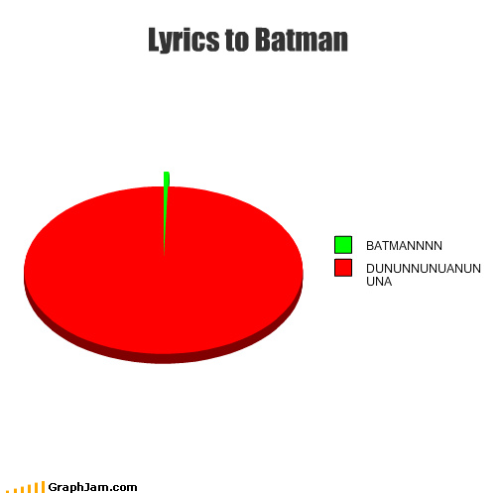
Those of you who’ve known me since I first got into comics know that I’ve had a love-hate relationship with Grant Morrison’s writing, and by that I mean I hated it initially for killing of Batman and being as cohesive and understandable as a faded clothing receipt written in Sanskrit, but then loved the crap out of it when I actually read the story from start to finish and found it to be deep, provocative and out-of-the-ordinary. So the hate now occupies a significantly smaller portion than the love, which if it was on a pie chart might look something like this. Just imagine the “na na na” is the love bit.

I was hoping to be reviewing the remainder of Flashpoint by now but, to be perfectly honest, the Wonder Woman story is moving far too slowly for me to be invested at the moment, and since University is limiting my comic book reading time I’d much rather read something enjoyable, like the amazingnesses that are The Sandman and The Walking Dead, both of which I’ll retro-review once I’ve read a bit more of them.

I’ve been wanting to solidly review all of Morrison’s Batman run for a good while now, but I decided to take a leaf out of George Lucas’s book and start in the middle. The year is 2008; Final Crisis looms on the horizon, and before it becomes plagued by last-minute artist changes and deadline pushbacks we’re told by Chaos Magician Morrison that he plans to kill Batman in the eponymously-named title as well as within the pages of what is purported to be the last Crisis ever. This news makes international headlines, and anticipation for the story’s conclusion is high.

2008 was also the year I first got into comic books, having seen the apex of filmmaking that is The Dark Knight and being entranced by Batman’s hitherto-unknown-to-me awesomeness. Since this was back in the days where I didn’t have a weekly-paying job I did tend to…ahem…appropriate comics through slightly electronic means, but in my defense I did end up buying almost all of those comics in real form a couple of years later when I started working at my current job. I read a ton of the old stuff – Hush, Under the Hood, Gotham Underground, The Killing Joke, etc – and also touched on Morrison’s run as well, seeing as he was the current writer at the time.

I had three issues of RIP when I got into comics, and to say they made no sense to me was an understatement. I vaguely recall Messenger-ing a friend and vitriolically tearing apart Morrison’s writing and incomprehensibility for a good while (if you, my Messenger friend, are reading this, then I apologise for talking your ear off like that. Especially since you didn’t like comic books at the time). Comparing it to other stories I’d read – predominantly Hush – I found it to be an incredibly shittastic story. Having said that, I was eagerly awaiting the conclusion of the arc to witness how exactly they were going to kill Batman. Just ask any of the friends I went onto Schoolies with – although you probably can’t, because I killed them all – and they’d tell you that the first chance I got when the final issue came out I raided an internet cafe in Port Macquarie and downloaded that shit faster than a starving wolf eating a child.

So I’m four paragraphs in now and I’ve not really talked about the book proper, so let’s dive in; for the last few in-universe months, Batman has been plagued by attacks coming from an ominously named person/organisation/firefighter’s charity called The Black Glove. The story opens with members of the Glove gathering together – presumably for some kind of firefighter’s ball – and promising to kill ol’ Bats in the most horrifically gory and psychologically tortuous way possible. The main guy in charge, one Doctor Simon Hurt, seems to look a little familiar, but that’ll be addressed later on.

Meanwhile Bats is busy test-driving a new Batmobile and getting some after-mission fun times with Jezebel Jet (is the name not a clue?) who has had his true identity revealed to her in one of the rare cases of Bruce opening up to another human being. Seriously, Peter Parker could take lessons here.

It doesn’t take long from there for the Black Glove to start their assault, rendering Bruce unconscious through some post-hynoptic suggestions involving something called Zur-En-Arrh, kidnapping Alfred and siccing a platoon of ridiculously-clad villains against Robin, Nightwing and anyone even remotely connected to the whole Batman operation.

Then Bruce gets shot up on military-grade heroin, meets a negro ghost, is aided by a tiny alien named Bat-Mite that only he can see, puts on a multicoloured Bat-outfit that makes him look like a Mard Gras rapist with a baseball bat, gets buried alive, knifes out one of his own teeth and jumps face-first into a helicopter.

It’s much better than it sounds. I promise.

The story here, for lack of a better term, is fuck-crazy. Events move on at a breakneck pace once the Glove make their move, and all the layers and multiple-meanings of dialogue and imagery in the story are hard to follow at first but gradually build towards a spectacular climax, and a subsequent re-read shows a shitload of foreshadowing throughout almost every page. If you’ve not read the preceding volumes – Batman & Son and Batman: The Black Glove – then it won’t make as much sense, especially during the middle portion where Bruce goes – pardon the pun – absolutely Bat-shit crazy as the Batman of Zur-En-Arrh. Hell, even if you have read them they probably won’t make a lot of sense on first readthrough.

The artwork here is outstanding; if there’s one thing Tony Daniel can do, it’s draw. If there’s one thing he can’t do, it’s write – see Life After Death or Eye Of The Beholder – so it’s good to see him only doing the former here. Daniel executes a masterstroke with the art, giving deep texturing and layers to every piece of visual text here, no matter how ancillary. The slightly trippy sequences with Batman in the purple getup are also illustrated surprisingly well, and to me they added a sinister quality to the bright colours usually associated with Golden and Silver Age comics that I thought were meant to be slightly burlesqued here.

The dialogue does get let down a little, but not because it’s overwrought – except for an opening scene between Tim and Alfred where he works out Damian is Bruce’s son – but because it’s not necessarily informative. While I’m one of the first advocates for works like Christopher Nolan’s, where not everything is spelled out for the audience in exposition-heavy dialogue, there is a limit in my mind as to how much you can skimp on explaining stuff just enough for the audience to work it out on their own. It doesn’t get in the way for me too much now, but for a first-time reader – especially if they haven’t read the other books in the series – it’ll just leave them scratching their head and more likely to go off and read something less engaging, like Cry for Justice or anything written by Christie Golden.

As for the death itself, I’m glad they didn’t go with what happens at the end of RIP as the big twist ending, since it was a scenario Bats has probably been part of a few times, and if that was the way he was to go out then it would’ve sucked. The actual death in Final Crisis had much more of a punch to me, so if you do plan on reading Morrison’s Batman run then make sure you pick up Final Crisis as well, or just read the relevant few pages right there in the bookstore. Or wait for my review of it one day, because I could write entire goddamn essays on Final Crisis.

I’ll say this again when I review them, but go check out Son and Black Glove before you dive into RIP. If you’re so determined to go into this one regardless, be advised it assumes you’re already onboard and there’s not much in the way of explanation. But if the upside of that is getting to see Batman dress up in red and purple to go beat up thugs with a Red Sox bat without any appropriate context, then I think that’s awesome enough to get by on its own.

STORY: 4.5/5
ARTWORK: 5/5
DIALOGUE: 4/5


OVERALL: 13.5/15

Flashpoint – The World of Flashpoint featuring SUPERMAN

PROJECT SUPERMAN
Scott Snyder


“My name is Kal. Today, I must be a Superman.”

With these words closes the first – and at this point, only – Superman story I’ve ever really liked.

For those who know me, I’ll let that sink in for a minute.

For those of you new to this blog or me in general, my opinion of Superman is analogous to the feeling that right-thinking people have about reality television – boring, overhyped and profoundly uninteresting. Granted, I did enjoy Christopher Reeve’s take on the character in the old movies, but comic-wise Superman has been the complete anti-me in terms of what I’m into as a reader. Batman has ambiguous morals at times and is a genuinely flawed character. Iron Man deals with interpersonal problems and a very bad drinking habit. Hell, even good old embodiment-of-patriotism Captain America has shit he had to handle when his sidekick comes back as a Russian sleeper agent (it’s better than it sounds).

Superman, by comparison, is the most lawful good paragon of virtue you’re likely to meet, is nigh-invincible apart from his infamous Achilles heel kryptonite, and has generally, in my mind, featured in lackluster stories that are generally something in the theme of “big baddie threatens Metropolis, Superman saves the day”. Actually, that’s not strictly true – New Krypton was “big Kryptonian baddies threaten Metropolis, Superman saves the day”. I think. I never actually read that one.

So far every Superman comic I’ve read has left me wanting a lot more than what I got, and the very strange bits where Mon-El takes over after Final Crisis felt equally bland. But Project Superman, the Flashpoint tie-in written by Batman genius Scott Snyder, is really, genuinely, good.


For the most part the story doesn’t even feature Superman at all, and while normally I’d scoff that this is by no means a bad thing it actually works well for the story. As with the Deadman tie-in there’s a very good sense of progression and escalation, with the action focusing mainly on superhuman-gone-wrong Subject Zero – who by the end of it is so chock-full of powers and anime hair I was pretty sure he was channeling Seymour from Final Fantasy X – from his humble beginnings as a test volunteer to the climactic finish where he murders Lois Lane and gets his ass royally handed to him by a slightly anorexic Supes. Snyder paints Zero as a sympathetic and psychotic protagonist, whose gradual descent into madness does not leave you with the feeling that he’s a straight-out villain – indeed, were it not for the neglect of General Lane, it’s quite probably Zero and Superman could’ve gone into crimefighting together, if they’d maybe found a way to curb Zero’s growing psychosis early on. Now that’s a comic I’d read.

As for the the big S himself, he’s projected here not as a towering figure of jingoistic patriotism and invulnerable valour, but rather as a skinny pre-teen alien kid who’s genuinely frightened and confused at all the military and scientific shenanigans that Lane and his ilk are putting him through. There are tiny scenes peppered throughout that made me interally go “Awww,” in sympathy, like when he steals General Lane’s baseball, or when Krypto gets machine-gunned, or when he heat-visions a picture of Lois onto his cell wall…to say Snyder made him a sympathetic character is a gross, immense understatement.

And that’s what surprised me about this story – the level of sympathy each character gets, with the definite exception of Lionel Luthor (seriously, I would not leave your kids with him if I were you. They’ll get sacrificed faster than a Kuriboh in a YuGiOh duel). For a three-issue arc the story is tight and punchy, the main characters are all reasonably fleshed out and given genuinely tragic motivations – Subject Zero most of all – and there is a definite crescendo towards the final battle between Zero and Supes.

The artwork, by and large, is quite well-drawn and coloured, and the dialogue doesn’t appear two-dimensional or vestigial. Superman not saying a word until issue 3 just gives him more of a sense of childlike vulnerability, until he finds his voice and verbally – as well as physically – beats down Zero with his own pseudo-philosophical trappings. The dialogue doesn’t quite hit the stride that The Black Mirror does, but it still fits with the characters it’s written for. All of these elements roll together into one great tie-in that really contributes well to the Flashpoint universe.

So yes, I liked this Superman story. However, on the whole, this story is not a proper Superman story.

There’s a distinction, for me, between liking a character in Flashpoint and liking them in any other tie-in. A prime example for me would be Wonder Woman; I kinda liked her a bit in her Blackest Night tie-in, and that might’ve led to me reading some more of her stuff if I was into the direction she took afterwards (I’ve heard mixed reviews about the Odyssey arc, which I may or may not read one day). If I end up liking her in Flashpoint, however, my liking would be contained to that one arc. There’s nothing else along that line with her in it, just like there’s nothing else featuring Deathstroke as a pirate or Deadman as a smarmy prick. If I like one of those stories, I can’t explore the mythos further because that’s all there is, no matter how enjoyable the arc was or how much I want to read more.

In a story like Project Superman, this is especially true. If there was a book about this on its own, I’d snatch it up way quick and read that shit like it was my last book before execution. The problem I have is that this is all there is besides the main title, and as much as I enjoyed this tie-in I know that the regular ongoing Superman title is vastly different all-around. As great as it was, Project Superman hasn’t made me want to jump head-first into a bunch of Superman comics the way that something like Fear Itself made me want to dive into Daredevil, because I know it’ll be different, and I know what that difference is like.

It’s unfortunate, because I quite enjoy Scott Snyder’s stories, and if he did an ongoing Superman title I’d be almost certain to read it. Hell, I’ll be checking out Grant Morrison’s Action Comics run in August when it comes out in trade, simply because he’s the one writing it. If Snyder had written the Blackest Night Superman tie-in – which I distinctly remember being appallingly awful – then maybe that would have spurred me to check out the series proper. Right now, though, I’ll stick with what I’ve got here, and what I’ve got is a highly enjoyable, emotionally riveting and genuinely inventive story with some very well-written characters and some equally good dialogue.

STORY: 5/5
ARTWORK: 4/5
DIALOGUE: 4/5


OVERALL: 13/15


THE WORLD OF FLASHPOINT
Rex Ogle


One of the great things the reboot of Battlestar Galactica did really well is to show views from the trenches; it wasn’t just about the A-list characters like Adama and Rosling fighting the evil Cylon menace, it featured the dock workers, the labourers, the random redshirt pilots that were always well-characterised right before they took a Raider to the Viper. Part of what expanded the world of the story and the characters within it was a broader lens in some episodes that highlighted how the world itself – or, in this case, the Fleet itself – was doing in amongst all the chaos.

This is an aspect that World of Flashpoint pulls off quite well. The story follows wicca enthusiast Traci 13, shortly after the war begins and she fails to save her mother and brothers from the Atlantean sinking of Paris, as she travels to globe to try and garner support for a strike against her distressed father and his band of villain cameos before he launches a satellite attack that will most likely crack the planet in two. Along the way she meets several heroes from the real universe that are redone in some very interesting ways, including a hilarious Paul Hogan-esque version of Guy Gardner and a friendly Gotham priest whose identity I won’t spoil, but was definitely another “Aww” moment for me.

From the get-go the story is quick to introduce both its protagonist and premise in a bit of neat exposition from Traci 13, before she starts her whirlwind walk of a war-torn world to gather supporters as the battle rages across all four corners of the globe. As she progresses Traci discovers that she doesn’t need support, that the power was within her all along, and this leads to a final Luke vs. Vader fight for the fate of the world.

The trench-view of the story is its primary strength; the focus is not just on Traci but on the people she meets, and their one or two-page bits that all contribute to a kind of mosaic of the world of the Flashpoint universe. It really gives you a feel for the turmoil, despair and courageous strength of will that some of the second stringers have in this dystopic nightmare, and by the end of it there’s a real sense of engaging with Traci’s motivation and the final realisation of her real power. While said realisation is a little cliche, and the very end a bit predictable and Disney-esque, the narrative is still quite absorbing and different to anything I’ve read of Flashpoint so far. It’s the people, rather than the heroes, that are the focus here.

The artwork is deeply textured and little bit muted; while there’s certainly colour on display it’s not bright and shiny, but it’s not too dim that it’s dark and gritty. It’s nothing too enthralling, but it’s not bad either.

The dialogue shines in this piece; Traci’s internal monologuing is alright, but the parts spoken by the various random inhabitants are all quite varied and interesting, particularly with the Buddhist Guy Gardner who owns a peaceful bar or the tough-as-nails Nat Irons and her struggle against the enemy. As I mentioned previously the characters are quite engaging, and the short bites of dialogue each character delivers helps you both relate to and engage with them really well.

I’m not sure if Traci 13 exists in the regular DCU – I’m pretty sure she does, since there’s a bit where she kinda remembers her old life with her father – but if she does I’d be interested to read some of her stuff. If she’s anything like her Flashpoint counterpart then she’s got a lot of girl balls, and that’s something you don’t see in a lot of female comic characters anymore. One can only hope she didn’t fall victim to the submissive retcons Catwoman and Power Girl received recently.

STORY: 4.5/5
ARTWORK: 3/5
DIALOGUE: 5/5


OVERALL: 12.5/15


BOOSTER GOLD – TURBULENCE
Dan Jurgens


While I’ve never read a full-on Booster Gold story, I did experience a bit of him during Return of Bruce Wayne when he assisted Hal Jordan, Superman and Rip Hunter in the timeline search for Batman. He seemed kind of ok; bright gold and blue, assisted by the probot from the Descent games, courageous and handsome and kind of what Han Solo might’ve been if he was a superhero.

Checking out his Flashpoint crossover – being the only character, besides Barry Allen, who is not affected by the timeline change – it soon became apparent that the Han Solo comparison was quite apt. If they’d ever made a movie of this guy, it should’ve starred Harrison Ford during his Indiana Jones days. That’s a movie I’d watch.

The plot follows Booster dealing with the universal retcons as best he can while also contending with Doomsday, former Superman killer and raging ball of bone-breaking. Along the way he meets a young lass named Alex who can steal people’s powers by accident – kinda like Peter Petrelli with bigger boobs – and they both go off to stop rampant General Adam, never having taken the mantle of Captain Atom and instead controlling Doomsday via a helmet, from using the giant abomination of science to wipe out the entire world.

Having someone else from the old DCU continuity involved was an interesting idea, but I don’t think it was utilised as well as it could’ve been. The focus seems to be more on the battle with Doomsday rather than Booster’s displacement in time, which is something the Flash explored in the first couple of issues of the main title, and the eleventh hour degradation of memory right before Alex bites the dust came a bit too late. Plus, I’m still not quite sure how he ended up at Vanishing Point while Barry re-ran the timeline. Presumably that’d be explained during the new run.

What is most awesome, however, is the way Alex – for all intents and purposes a noob to the superhero game – spectacularly forces Doomsday to basically rip his own guts out using the control helmet. It was grueling, felt slow – in a good way – and was the main highlight for me in this story. It’s a pity she dies before Booster can take her to his universe, but she went out like a champ. The resolution involving her and the chalkboard at the end was also a nice little touch.

The artwork is bright and shiny, the complete opposite to World of Flashpoint’s above, and the best illustration for me came from the brief appearance of the Flash near the end. The rest of the time it was good, but still nothing special. Doomsday was well drawn, though. Looks like what Baraka from Mortal Kombat might resemble if he took up steroids.

The dialogue is what reminds me most of Han Solo, with Booster letting off verbal quips somewhere between Hal Jordan and Deadpool. His real fear when Doomsday first re-emerges is believable, and his early bits of banter with Rip Hunter and the other chick were kinda funny. Mostly, though, his interactions with Alex work well, almost as if he were a scoundrel courting a Princess Leia that can also fly and shoot lasers.

Pretty solid effort, but a little action-y in places.

STORY: 3.5/5
ARTWORK: 3/5
DIALOGUE: 4.5/5


OVERALL: 11/15


THE CANTERBURY CRICKET – THE SCOUNDREL’S TALE
Mike Carlin


To be honest, I’m not sure why this one exists. It’s a one-shot that feels unnecessary, adds almost nothing to the overall universe except a Kafka ripoff, and is more of a recounting than an actual story in itself. That being said, the idea of a man-sized cricket talking in a British accent is kind of entertaining, in a YuGiOh Abridged Bakura kind of way.

Some dudes rescue a dude who’s a big bug, the big bug has a story about himself, other big bugs and how he once killed the love of his life to get away from a maniac Amazon guy, and then a green lady gets burnt to a crisp. Oh, and there’s a rhyming demon involved too.

It’s not quite on Secret Seven’s level in terms of incomprehensibility, but it’s there in terms of adding little to the world. The story is over way too fast to become invested in anyone’s character, especially when none of them besides Etrigan are the least bit familiar to me, and the main character of the Cricket – who has virtually been extracted unaltered from The Metamorphosis – doesn’t strike me as a likable character even after his change into the virtuous crickety cricket. Not that I have a problem reading a story where the main character is a bad guy or an asshole, but this guy is just annoying. And far too brief.

The artwork’s kinda murky, and flits absently between dark and gritty shades against bright and happy bits inside the Cricket’s flashbacks. Nothing special.

The dialogue is well done in parts, and Etrigan’s rhymes – while being a bit out of place in this backdrop of war – keep with the theme of the original character and are kind of funny. Green lady Jinny has some good bits too, but her abrupt death kinda diminishes her character a little.

It’s definitely not the best I’ve read from Flashpoint, but not the worst either. Probably second-worst.

STORY: 2/5
ARTWORK: 2/5
DIALOGUE: 4/5


OVERALL: 8/15

Flashpoint – The World of Flashpoint featuring BATMAN

BATMAN: KNIGHT OF VENGEANCE
Brian Azzarello


First up on the Flashpoint reading list, and definitely an enticing offering.

The short, snacky three-issue arcs built around each character in these books (but not so much the 1-issues for Reverse-Flash and so on) means that the story has to be punchy and informative, since this is really the only glimpse you get on these different characters outside of the flagship book. Azzarello manages to pull this off quite nicely, giving you a story that features plenty of the Bat characters we know and love as well as a redefinition of Batman’s oldest nemesis that, while I already knew what the twist was, is still probably one of the biggest WHAM moments in Batman history.

Unfortunately, while the story itself is quite engaging and the characters are well-rounded for a three-issue story, the dialogue suffers a little from there being almost none of it. Jim Gordon doesn’t seem that different from his regular universe counterpart, and as such his dialogue comes across as a little two-dimensional in terms of the “virtuous cop” paradigm. Thomas Wayne’s constant murmuring in place of Bruce’s “hh”-ing is also a bit annoying, since whenever I try to hear it in my mind it sounds like the sound one makes when sleepwalking. Personally, that wouldn’t really intimidate me, but at least he makes up for it by slamming a machete into Killer Croc’s skull and snapping a Joker victim’s neck. Those were some pretty intense moments, that definitely set him apart from Bruce’s MO.

As well as the dialogue, the art is also a bit sub-par. The covers to the issues are very well done and richly detailed, but the artwork of the story itself feels a bit plain and single-layered. While this is in no means a trick unused in good comics before (The Black Mirror and Batman: Year One spring to mind) it’s none done in the gritty, slightly retro way that it’s utilised as in contemporary works. Batman’s costume mostly looks like a large grey blob with a bit of red on it, far from Andy Kubert and Sandra Hope’s great illustrations in the main title, and Jim Gordon looks like he’s wearing a clump of steel wool instead of hair. Plus the Joker looks uncannily like a character from The Raggy Dolls.

STORY: 5/5
ARTWORK: 2.5/5
DIALOGUE: 3/5


OVERALL: 10.5/15


DEADMAN AND THE FLYING GRAYSONS
J.T. Krul


I love Deadman, I really do. I got into him in a big way with his appearances in Blackest Night, and his fate in Brightest Day – especially in light of his relationship with Dove – left me a bit misty-eyed.

Having said that, I’m so glad his Flashpoint version isn’t around constantly because if he was he would warrant a harpoon to the ear with every sentence that comes out of his mouth.

Yes, “jerk” must be Boston Brand’s middle name in this tie-in, because he speaks and acts like Naomi Campbell minus the phone attack. He does provide a good contrast against Dick and his Grayson family, but every line of dialogue he had – until the last few pages of the third issue – made me want to flamethrower his head off.

There’s a good sense of escalation with this story; the protagonists start out in an almost-idyllic lifestyle as part of a traveling circus – with the “almost” part being because, you know, there’s a way going on between the Ama-Scones and the Longpanteans – and by the end those who are left standing are embroiled in a fierce street battle for Doctor Fate’s helmet. The progression feels natural, and like with the Batman story the characters are quite engaging and interesting. Plus Kent Nelson, despite only having about five lines of dialogue, absolutely steals the show here. His line right before an Amazon gets wasted by Shark was particularly noteworthy.

With all that above praise, however, the story doesn’t feel particularly groundbreaking or new in terms of separating from the main universe’s timeline. Dick’s family still dies, Deadman kicks the bucket and becomes a ghostly apparition who resorts to body hijacking. While the specifics of the events are a bit different, the overall impact is still the same – apart from Dick’s decision to become the new Doctor Fate, which I would’ve liked to see explored a little further either in Flashpoint or the DCU proper.

Don’t get me wrong, it’s not bad, it’s just a bit plain. It feels like a slightly different rehash of the original characters’ origin stories with a big war plonked in the middle. The dialogue has a few good moments, like the Shark moment above, but aside from that it’s pretty basic. The story loses a few points because of a truly cringeworthy flashback involving Dick and his father trying to make a jump, though.

The artwork, on the other hand, is the most salient feature for me. The vintage-look covers for each issue strongly evoke a classic approach that is contrasted neatly with the contemporary darkness of the story, and the illustrations in the actual story is richly layered and textured. The bright colours feel a little dulled compared to the main title, but I choose to interpret it as being the fancy vibrancy of a happy mood (in this case, Dick being with his family at a circus) being filtered through a dark cloud of the upcoming tragedies that befall the protagonists.

I think I’ve been studying Critical Discourse Theory a bit too long.

STORY: 3.5/5
ARTWORK: 4.5/5
DIALOGUE: 2.5/5


OVERALL: 10.5/15


DEATHSTROKE AND THE CURSE OF THE RAVAGER
Jimmy Palmiotti


Despite what some contemporary critics may think (I’m looking at you, Mr Croshaw), pirates are cool. Despite what a few Batman and Robin readers may think, Deathstroke is cool. So putting the two cool elements together should result in a nice cocktail of cool, right?

Right.

See what I did there? You totally thought I’d say wrong, didn’t you? Shows what you know.

While my previous experience with Jimmy Palmiotti’s writing (Mortal Kombat vs. DC Universe) is akin to reading the Ingredients panel on a packet of biscuits with half the words replaced by onomatopoeia and bone-breaking sounds, I found this offering to be really, really interesting by comparison. Deathstroke is presented not as an assassin for hire but as a scurvy pirate lad in control of the titular Ravager, a vast and powerful pirate ship that spends half its time raiding other ships and the other half of its time getting attacked by Aquaman. The crew is comprised of a ragtag bunch of misfit villains who pillage and plunder like they’re taking orders from Long John Silver’s cousin.

Plus, there’s a really hot purple-haired chick who can make explosions appear randomly. Coz, you know, that’s the most salient element right there.

I’ve not read an awful lot of Deathstroke compared to others of Batman’s rogues gallery, but what I have read paints him as a morally questionable gun-for-hire with a badass eyepatch and an even more badass sword that was the only viable weapon – besides batarangs – in MKvDCU. Seeing him redone as a pirate against the canvas of the Atlantean-Amazon war gave him a dimension that makes a lot of sense to me, which is further aided by a somewhat sympathetic storyline involving his quest to find his missing daughter who – in defiance of a million other villainous fathers – he actually cares about. Aww, so he really does have a heart. In this timeline at least.

I actually figured the ending would be something of a foregone conclusion, since Deathstroke seems to be killed by Ocean Master halfway through the main title, but when this bit turned up at the end of the first issue of this tie-in and followed him after it happens, showing that he did not actually die from that trident strike, it gave the rest of the story a very interesting remainder, where the foregone conclusion was thrown under a bus. I quite like it when a prequel or tie-in manages to pull of something like that believably, especially in a story like this where a character’s death can be quite final given that it’s effectively a parallel universe. Tell you what, though, he’s got a mighty ungrateful crew when he revives later in the second issue – makes me wonder if the policy he uses to recruit crewmates out of prisons is one that he’s unilaterally taken for everyone on the Ravager. God help us if he hits Arkham Asylum.

The artwork kicks a lot of ass, and as always I found Aquaman’s militaristic crimson getup to be one of the visual highlights for me. The grizzled sea-captain-from-Simpsons look suits Deathstroke to a tee, and the menagerie of freaks and malcontents he calls his crew adds a visual variety to the standard array of redshirts one would usually find in such a story. Complementing this is some very good dialogue for Deathstroke himself, although it seems as if every other villain in the story, with the exception of Aquaman, is ripped straight out of a Saturday morning cartoon. Warlord in particular has a bad case of the “You will never succeed! Mwahahaha!” mindset that I’d hoped serious comic book villains had distanced themselves from, but I suppose I shouldn’t complain too much because in spite of that I still very much enjoyed the title.

I suppose this could act as a natural evolution for the real Deathstroke – because, you know, there’s not much else you can do after a failed attempt to body-jack Robin – and I know I wouldn’t mind seeing an ongoing series relating to superhuman pirates. I suppose, though, that’d end up being a little too much like a villain-centric group book, like a polar opposite to the Justice League on the open sea.

But you know, I’d still read it anyway.

STORY: 4/5
ARTWORK: 4/5
DIALOGUE: 3/5


OVERALL: 11/15

SECRET SEVEN
Peter Milligan


I tried reading Secret Six once. It was during the Batman RIP storyline, where they had a very brief tie-in. It seemed like an interesting concept; at a time before I was aware of things like Dark Avengers or the Thunderbolts, a villain team-up sounded kinda interesting. Reading the actual story, however, I was underwhelmed. The dialogue felt almost identical to the villains in the Deathstroke story above, and nothing really happened that contributed to the overall RIP arc at all.

Plus there was a guy on the cover who looked like Batman in a mustard outfit, which just looked hideous. Surely Gotham City has fashion police?

Reading the first issue I had a lot of problems. For one thing, I had absolutely no clue what was going on, other than the fact that Secret Seven were heroes and apparently they committed suicide, but some guy who can change his body might’ve been responsible, but he just saw a woman who died two years ago, and then he gets captured by aliens, and they all look like they were drawn with a box of crayolas…

ARGH!

The story only gets more convoluted as it progresses, and there’s very little in the way of actual plot. It seems like a quest by the main character – a slightly unbalanced “changing man” named Shade – to reunite the Secret Seven, only that falls by the wayside when he starts banging some blonde Jekyll-and-Hyde character named June Moone, then it turns out he killed some people, then biker-chick Zatanna turns up, then Shade gets thrown into a madness dimension…

GRR-ARGH!

I really couldn’t find the story here. At all. Well, there were snatches here and there, but it came and went far too fast to catch onto anything. The alien plot at the start doesn’t do much to establish who Shade is and what the overall premise of his endeavour is, and the eleventh hour appearance of fellow Seveners Zatanna, Mindwarp and Raven only added more convolution to a plot that was already chock-full of it. Plus the ending very much had a feeling of “rocks fall, everybody dies” about it. Or, in Shade’s case, “rocks fall, end up in a strange meta dimension that doesn’t explain shit”.

The artwork is mediocre at best, and the first issue in particular has a real problem with too much retro-style artwork that doesn’t mesh well with what little story there is, particularly during Shade’s brief visit to the alien spaceship. The later art got a bit better – probably because different artists were involved – but it was still generally lackluster and overloaded with unnecessary colouring. Plus, the part where Enchantress uses her orange magics to find Shade looks uncannily like she’s about to give a giant magical penis a handjob.

Plus the dialogue’s sucky; apart from not knowing what the hell is going on, it’s kind of two-dimensional and doesn’t flesh out the characters much. The lines each character delivers gives them one, and only one, big defining character trait – Shade is crazy, Enchantress is a lunatic, Amethyst is a child in the body of a hot teenager.

Wait, what?

I wonder if the story of Shade will be followed in the real DCU later on, since the story seems to deliberately leave him in limbo and ends with an ominous question mark that maybe he’ll emerge later. Personally, I’d be a bit intrigued to follow his story, but I won’t be queuing up to get it autographed.

STORY: 1/5
ARTWORK: 2/5
DIALOGUE: 1.5/5


OVERALL: 4.5/15

Flashpoint

WARNING: MAJOR SPOILERS ARE INCLUDED IN THIS REVIEW

Yes, I know, it was out in October last year. Yes, I know, it was highly controversial as the vehicle for DC’s company-wide soft reboot “The New 52”. Yes, I know, the Joker’s a woman.

Wait, what?

With the release this week of the World of Flashpoint collected editions featuring Batman, Superman and Wonder Woman, and with the upcoming editions next week featuring The Flash and Green Lantern, I figured I’d give them a review similar to the way I did Black Lantern Corps on Facebook two years ago. I was initially hesitant to touch them, especially the ones involving Supes and his ilk, but then I took a look at the writers involved: Scott Snyder. Brian Azzarello. Dan Abnett. James Robinson (hopefully out of his Cry for Justice funk).

Only thing missing is a tie-in with Grant Morrison.

So before we dive into the spin-offs, let’s take a look at the mothership title. Released as five single issues across 2011, Flashpoint was DC’s big yearly event that eventually led to The New 52. This wasn’t made known until about halfway through the story, and coupled with the fact that the final issue was the only single-issue release DC had in the last week of August it made anticipation for Flashpoint to be one of the biggest and most game-changing crossover events since Crisis on Infinite Earths.

So does it live up to the expectation of being a super-fun-chocolate-time awesome event? Well, sort of.

Geoff Johns as the lead writer put my mind at ease before I dived into it, since he can generally be relied upon for excellent storytelling that is at once action-packed without becoming overwhelming and at the same time deeply interpersonal and thought-provoking. His arcs on the regular Flash comic leading up to this have all foreshadowed the book’s events rather well, and his varied interpretations of parallel universe DC superheroes makes for an intriguing digression from their established personas.

The story follows Barry Allen – current head of the Flash family – waking up one evening to discover the world around him has drastically changed; Superman has never existed in the public eye, Batman’s a murderer, Wonder Woman and Aquaman are at war (it’s actually a lot cooler than it sounds on that front), and the Justice League never formed. The revelation that this is in fact the real world, rather than a parallel universe that Barry has stumbled into, creates the impetus for Barry to find a way to repair the timeline and get back to the world he knows.

From the get-go the storytelling is tight and fast-paced, and the limited brevity of a five-issue crossover is no wasted. Nearly everything is there that needs to be there for the story to work properly, and every major character (particularly and especially Batman) is written in a way that is at once different and similar to their regular universe counterparts. The story did get a little bogged down during the heroes’ stay at SHAZAM’s house, and the kids themselves seemed a little out of place in the main tapestry of the story. This is also the biggest point where the dialogue falls flattest for me; the SHAZAM kids dialogue is clunky and childish (I know that’s because their kids, but there have been plenty of other times when children’s dialogue in comics has been better – Kid Flash in Rebirth springs to mind), and Billy Batson puts me in mind of a Phantom Menace-era Jake Lloyd when he delivers his lines.

As well as that, Element Woman shits me to tears. She had a few funny lines here and there that made me giggle (particularly “I love your uniform! It’s so…red!” to the Flash) but on the whole she felt as out of place as the SHAZAM kids. Her fluffy dialogue (except for her slightly serious moment when she agrees to aid the Flash against Aquaman and Wonder Woman) was like a layer of melted marshmallow stuck inside a McDonald’s quarter pounder – very unnecessary. I was quietly hoping she’s kark it in the final battle, but no such luck.

Speaking of the final battle, that was pretty well executed too. The highlights for me were the inclusion of Grifter and the resistance movement (led by an un-Supes-domesticated Lois Lane) and an absolutely killer last-minute appearance by Reverse-Flash that worked quite well with the story’s final revelation about what caused the Flashpoint world. While the discovery that Reverse-Flash has become a paradox outside the timeline was a little strange – and delivered in a slightly Saturday-morning-cartoon-villain way – it ended up, in my mind, creating a scenario similar to the way that Doctor Who keeps bringing the Master back; he’s an anomaly, outside the regular rules of the game, and despite the fact that he gets spectacularly offed by Flashpoint Batman (“Doctor’s advice” indeed) I don’t think this is the last we’ve seen of him, and not just because comic book death means bugger all these days. So I’d be interested to see if Francis Manapul explores that in his current Flash run.

Also, that final scene between Barry and real-universe Bruce Wayne made me a little misty-eyed. Johns really knows how to tuck at your heartstrings.

I haven’t talked a lot about the art, because there’s only one word for it: AWESOME. Andy Kubert is in top form, with art better than his previous efforts on Whatever Happened to the Caped Crusader?, and Sandra Hope’s inking gives the colour a vibrancy that is juxtaposed well by the bleakness of the story’s content. Plus, Batman with red eyes is exceptionally cool.

Before I conclude this review, I want to talk about a character I was most surprised by – Cyborg. Until now I’d only thought of him as the token black teammate of the Teen Titans, but I found his Flashpoint persona quiet engaging as a hero to rally behind. I’ve heard that he continues similarly to that in the new Justice League reboot, which I’ll be checking out in May, so I think it’s definitely an interesting direction for the character. I’d definitely like to see how he holds his own against A-listers like Batman and Green Lantern.

A final note for those new to comics, or hoping to get into The New 52 through this book – don’t. While it does open the door towards the rebooted world, it’s also the conclusion of an arc three years in the making for Barry Allen. It may intrigue you, but it’s also highly possible that new fans may be a bit put off by most of the arc references that are peppered throughout. I’m not saying it’d be impossible for neophytes to read, but it won’t be as rewarding as if you’d read the books preceding.

A solid effort indeed.

STORY: 4/5
ARTWORK: 5/5
DIALOGUE: 3/5


OVERALL: 12/15