MIND MGMT: The Manager

Everyone remember LOST? What a great show that was. Coherent narrative, simple and relatable characters, and a supremely satisfying and well-explained ending. I loved LOST, and I loved the fact that it didn’t push envelopes or challenge its audience in any way.

In a similar vein, I’m really liking MIND MGMT. It’s got a similar streamlined structure with characters that are instant classics and a narrative that, while at times a bit predictable, is absorbing and safe while providing a lot of comfortable familiarity.

If only.

I’m the first one to admit that I generally prefer complex, overly-complicated stories when compared to bog-standard, audience appeasement pieces with limited characters and a plot that could be completely outlined on a piece of toilet paper. I can get into schlock-fests like The Expendables and Armageddon every so often, but if my mind-cogs aren’t stimulated by something with at least six analytical reference books’ worth of subtext then I feel like it’s a wasted effort on my part. If there’s one thing MIND MGMT provides in spades, it’s stimulation – for better or worse.

In a present-day setting where there are as many psychically-gifted individuals as there are abortion-hating Republicans, a young writer living a Bohemian lifestyle abroad ends up discovering the existence of MIND MGMT, an organisation dedicated to “recruiting” (read: kidnapping) those with extrasensory talents and putting them on the government payroll. This shady conglomerate of ESP’ers are used as hitmen, data entry operators and creative visual artists (no, seriously) by the United States, for the main purpose of…something nebulous. Our young writer protagonist is recruited by a guy who knows here from…somewhere, and wants her to help him bring down MIND MGMT because…he really wants to bring them down. Oh, and there are two Croup and Vandermar-esque psychic hitmen after them both because…uh, they really want to kill them.

While I’m damn sure I’m going to recommend MIND MGMT, it needs to come with an overweight asterisk and a reader’s guideline attached: do not read this if you’re expecting easy answers, or any answers at all for that matter. There’s plenty that is followed up on (such as some of the nebulous actions of the agency, which begin to paint a literal and figurative picture of a government conspiracy that’s waaaaaay over on the amoral side of the scales) but there’s a whole lot that isn’t, with the narrative barrelling along without pausing for resolution and taking audience understanding as read. Granted, some of that can be forgiven because this is Volume 1 of a multi-part story, but there’s a lot that can’t. The true nature behind Meru, the writer protagonist, and the dude helping her is kinda explained but not entirely, and the motivations of the two hitmen after them are also summarily left mostly to reader imagination to fill in the blanks. While that’s not necessarily a bad thing for a story, merely raising the enigmatic elements and making me wait impatiently for the next volume to give me more half-answers, it’s very much a love-it-or-hate-it kind of deal.

Similarly attached to the polarizing story is the artwork, hand-drawn by writer Matt Kindt. Remember a few weeks ago in my Thor review when I mentioned loving artists who illustrate rather than straight-out CGI their comics? Well, there are times when this kind of artistic freedom can result in visuals that get a little too into themselves. For example, the pages themselves are done in a kind of crayon-cum-Picasso style that at times more resembles a primary schoolkid’s attempt at art than any actual illustration. On top of that, there’s a distinct lack of big visual codifiers for most of the characters to be distinguished against each other – part of where a series like The Walking Dead excels in delineating different characters, without the useful superhero aid of different coloured costumes, is through little facial and clothing details that tell us immediately who we’re looking at without going to great extremes (for example, a scar and some freckles distinctly tell us Andrea is talking, rather than her carbon-copy facial doppelganger in the Alexandria Safe Zone who’s a completely different character).

MIND MGMT has a problem where, especially in the opening chapter during a riot in Zanzibar, character distinction is difficult. We can always tell who Meru and her partner Henry Lyme are because they’re visually separate from everyone else, but a lot of the other characters get lost in the shuffle when we’re not sure if the person stalking our heroes down an alley is the corporate hitman sent to dispatch them or the blind, fruit-loving hobo who just wants to show them his banana skin collection. While it will certainly be off-putting to some readers, I didn’t mind the art on the whole. As with the story, it’s a take-it-or-leave-it kind of thing.

Dialogue is…well, it’s not bad, and it’s certainly got quite a few lines that made me laugh out loud (an instant gold star for almost any comic book), but there’s something about it that’s a little janky. I can’t really explain it better than that – not that I’m exactly known for my crystal-clear explanations of things when comic books are involved – and it’s certainly not a giant mark against it compared to the artwork, but I feel a little disconnected reading dialogue from characters whom we’re not 100% solid on yet. Characterisation flits around a little too, and there’s far too much exposition in the latter half of the book when part of the agency’s backstory is crammed down Meru’s gullet. So it’s not bad, but not standout either. As with the artwork, it’s a kiss-it-or-kill-it kind of gig.

Wait, that last one didn’t work. You can’t kiss dialogue.

At the end of the day, MIND MGMT: The Manager is an exercise in weirdness that’s sometimes hard to read and even harder to summarise, but has enough intrigue built into that I’ll come back for seconds. I’m sorry if my elucidations are haphazard or lacking in this review, but it’s that kind of story. Unfortunately, no-one can be told what MIND MGMT is – you have to see it for yourself.

STORY: 4/5

ARTWORK: 3.5/5

DIALOGUE: 3.5/5

OVERALL: 11/15

BEST QUOTE: “The good thing about walking into a trap is…well, not much. You know it’s a trap, I guess.” – The Narrator

All-New X-Men: Here to Stay

I’ll be the first to admit that, quite frequently, superhero books can get far too “comicky”. You know, those unconsciously-agreed-upon tropes that fit under the umbrella of being far too out there, far too camp or just far too far towards the furthest faryness. To say a work is “over the top” is one thing, but to say it’s too comicky is like “over the top and up to 11”.

I like a good overpowered narrative as much as the next slacker, and I’ll admit I take no small amount of lazy joy from occasionally just reading overblown, “we must save the world or reality is doooooooomed!” stories. Guilty pleasures like Green Lantern: New Guardians and Avengers: X-Sanction, with stories devoid of cerebral content and more in line with something like Mortal Kombat rather than BioShock Infinite, are aplenty on my shelf alongside the thought-provoking opuses of Grant Morrison and Rick Remender. Comicky stories start becoming stupid, however, when the teaspoon shallow plot and over-the-top fantastical elements are combined with an honest attempt at grounded, cerebral storytelling, which gives us an end result of a book trying way too hard to fit in with the big boys at the dinner table while still wearing a bib and half their mashed carrot on their face.

Simply put, some stupid stories work as stupid stories, but when a stupid story tries to be smart it ends up failing. Unfortunately, Brian Bendis’ All-New X-Men is one such story.

As one of the few current plotlines stupid enough to remember that Avengers vs. X-Men was a thing, All-New X-Men is an attempt to create a story somewhere between Heroes and Doctor Who with the merest hint of Looper. After Charles Xavier’s untimely death at the hands of Scott Summers – now wearing the “villain” t-shirt so prominently he could almost use it as his national flag – erstwhile X-Man Beast goes back in time to retrieve the original five X-Men from the 1960s. His goal is to bring them to the present to see the horrors inflicted by their future selves in an attempt to right their wayward paths later down the track. Returning to present-day-ville with young versions of Cyclops, Jean Grey, Angel, Iceman and Beast, the stakes are then raised when the current Cyclops decides it’s a great time to start his own mutant school in direct competition with the good guys’ and attempts to woo his underaged former comrades to his side.

Let me just state that I don’t dislike this story simply because Bendis wrote it. As a popular target of internet rage artists across the world, hating a story because it was written by the guy is like assuming everything Michael Bay directs will suck simply because he directs it. Yes, Bendis has given us this and Bay has given us Transformers, but don’t forget we also got Dark Avengers and Armageddon from them, respectively.

That said, the story is ridiculous. Plain and simple. It’s an interesting concept that gets completely mishandled by the time we reach Here to Stay, the second volume in the series, by having a bunch of concurrent plotlines that just seem to pile on the stupidity in bigger layers until we end up with the following all happening at once:

1. Beast is wrestling first with a terminal illness (that gets seemingly cured in an incredibly anticlimactic way) and then with his guilt over bringing these poor kids from the future, all the while believing Cyclops is responsible for killing Xavier despite the fact he was possessed at the time because he “didn’t fight hard enough”.

2. Kitty Pryde teaches the old X-Men how to use their new abilities, and forms a BFF relationship with young Jean Grey.

3. Mystique, Sabretooth and some scantily-clad prostitute are attempting to rob a bank and do something that involves pinching 1960s Cyclops from the grasp of the good guys.

4. The Avengers are pissed that the X-Men came back from the past.

5. Past-Angel is having trouble dealing with the present day and his contemporary self, and undergoes something of a panic attack.

6. The X-Men must save the world from present-Cyclops or reality is dooooooooooomed!

And those are just the ones I can remember in this plain yet overhyped trainwreck. There’s far too much going on and there’s so little time devoted to any one plotline that is all becomes a huge jumble of insubstantiality. The character-building moments are incredibly schmaltzy, especially whenever Jean and Kitty have another chat about boys and mind control, the action scenes look like they’re ripped straight out of a bad Looney Tunes episode, and almost every previously well-established character seems to have become more watered down than the wreck of the Titanic. Wolverine is undoubtedly the worst offender; far from being the gradually-level-headed schoolmaster he was during Wolverine and the X-Men, he’s presented here as a two-dimensional berserker who’s only a SNIKT and a “bub” away from becoming the star of a Frank Miller miniseries.

Dialogue is pathetic, even by Bendis standards. Actually, hang on, Bendis is usually fantastic with dialogue. Previous works like Daredevil and Dark Avengers made great use of realistic dialogue juxtaposed with the fantasy of being a superhero comic – meaning we get super-technobabble alongside banter regarding baseball teams – which worked really well as both a method of relatability to the characters – since their problems aren’t always so far removed from our own – and as a means of giving them depth. Here, all we get are overblown pulp lines probably snatched wholesale from a Flash Gordon comic, which almost always literally boils down to things along the lines of “We must save the world  or reality is dooooooooomed!” Add to that Beast’s little diatribe to past-Angel about why he thinks Cyclops in particular is responsible for Xavier’s death (which comes as an incredibly poor justification for Beast’s person-pinching actions), and you’ve got an experience that sounds like it was scripted by a five-year-old smashing their X-Men figurines together while making sound effects and forcing plastic Wolverine and Cyclops to make out.

Artwork’s the only place that scores points here, since Stuart Immonen can usually do no wrong. There is a big problem with most of the female characters being portrayed as either strippers or having full-body curves that’d make Christina Hendricks jealous, and the men’s facial expressions can come across as either vacant or just bloodlusty, but on the whole it’s pretty serviceable. If I must be forced to wade through this written muck at least it’s a bit pretty.

It’s disappointing that I give All-New X-Men: Here to Stay such a low score because the concept sounded fascinating on paper, and as much as people rip on Bendis so often you’d think it should be an Olympic sport I tried to come in with an open mind that had his previous good work sitting in the middle of it. Maybe I feel so let down because expectations were so high, so perhaps a bit of bar-lowering is required. Excuse me for a second.

***

OMG u guyz All Nu Xmen is teh sh*t! Soooooo good ai? Wulvarine is cool SNIKT BUB luv his claws.

***

That’s how uncultured fans speak, right?

all new xmen here to stay

STORY: 2/5

ARTWORK: 3.5/5

DIALOGUE: 1/5

OVERALL: 6.5/15

BEST QUOTE: “Gut him, teach.” – Quentin Quire

Saga, Volume 2

WARNING: THIS REVIEW CONTAINS SOME VERY NSFW IMAGERY

Imagine seeing a movie for the first time that completely knocks you off your feet. It’s the kind of story that speaks to you on so many levels, touches so many of the bases you identify with that you can’t help but feel a singularly satisfying experience that you don’t find anywhere else in quite the same way. It transcends simple enjoyment or a “best ever” list, and holds a special place in your heart.

So much so that when a sequel’s announced you’re equal parts excited and trepidatious; on the one hand, “Yay, there’s more of my favourite movie coming! With the same cast and director and everything! It’s going to kick ass!”, while on the other, “Oh god, they’re going to wring a ham-fisted sequel out of something I find singularly special! It’s going to suck!”

Then, after waiting a few years to sit down for a couple of hours and see what will either be another landmark narrative moment or the awkward squawking of a beloved intellectual property being rigorously tortured on-screen, you finally see it – and against all odds, the movie kicks so much supreme ass that you’re positive it’s as good and special as, if not more than, the work that preceded it. It’s beyond the impossible, but it’s happened. An exemplar of work now has a matching sibling of equal caliber.

If it weren’t already obvious from the title, Saga‘s become this for me.

After last year’s award-winning (at least on this website) entry, I was similarly excited and apprehensive that Volume 2 would live up to the expectations set by its maiden debut book. It went beyond thinking lightning could strike twice and moved into “winning the lottery on two different Powerballs in the same week” territory – not exactly impossible, but you’d have a better chance of the American government purchasing Julian Assange a beach house in Maui.

Thankfully it avoided the pitfall that franchises like The Matrix and Die Hard have fallen prey to, and kicked more ass than a robotic boot magnetically attracted to donkeys. The story picks up not long after Volume 1’s conclusion, where Hazel and her merry band of parental misfits come across father Marko’s own parents on the rocketship they grew in a forest. Following that we’ve got a similar fantasy-cum-sci-fi tone as the first book, now peppered with oddities such as security guards with talking face crotches, a one-eyed Mills and Boon author who lives in a lighthouse guarded by a baby seal in overalls, and a generous helping of unwanted GST. No, not a Goods and Savings Tax, but rather a Giant-Scrotum’d Troll.

Did you think I was kidding?

Troll bollocks aside, the story’s got a lot to offer intellectually. The endless cycle of generational war faced by the inhabitants of Wreath and Landfall – or, particularly, the reasons behind it – are directly called into question. There’s quite a bit of introspection regarding what makes a good parent in this interstellar backdrop of a hellhole. The reader is challenged to decide, is a battle fought on ideological grounds something worth actively supporting, or is our agency so far removed from the idealistic heart of the conflict that we can grow so dispassionate as to not care one way or the other if millions get slaughtered in the name of hollow “peace”?

More importantly though, there’s a troll with a giant scrotum.

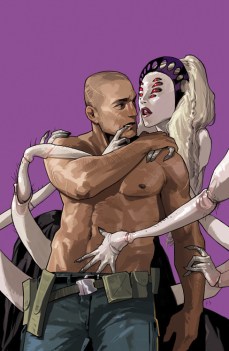
If I have an issue with the story – and believe me, it’s so minor it almost doesn’t bear scrutinising – it’s that some characters end up a bit out of focus. Prince Robot IV – snarky android anti-villain of the first volume, presented here without a need to go to the bathroom – only shows up towards the end, and aside from a brief interlude where he dreams about killing whorehouse security guards with deceased spider-girlfriend The Stalk there’s also little of The Will in this one compared to Volume 1. Part of what amped up the tension in Volume 1 was seeing these two separate entities about to collide with both their intended targets – our fugitive heroes – and each other. It was a bit missed here, though that tension did return in an absolute masterstroke at Volume 2’s conclusion.

The art by Fiona Staples is in fine form as always, and several steps above the work presented in Volume 1. I remember being a bit annoyed that some of the battle scenes and blood sprays could get a bit visually confusing, and Staples seemed to have nipped that problem in the bud with Volume 2. While bits and pieces can be slightly off-putting (like the oft-mentioned troll genitalia) it all comes together in the end, giving us realistic facial expressions and fantastically-imagined creatures given shape on the page. Also, whenever I see The Stalk I’m not sure if I should feel disgusted or oddly curious – I guess that’s a good thing?

Dialogue is flawless. Brian K. Vaughan has an uncanny knack for just the right amount of swearing, neutrality and thoughtful dialogue with lovey-doveyness inserted in just the right places. There’s some great banter between the two big new pairs of protagonist interactions – being Marko and his mother, and Alana with Marko’s father – and the character dynamics as a whole are kept fairly stable and consistent. As one of the few comics that can literally make me laugh out loud every other sentence but be able snap back to dead seriousness when needed, Saga gets a bit fat gold star at the bottom of that particular report card.

If you’re not aboard the Saga train, get on now. It’s accessible, unburdened (at least for now) of years of snarled continuity and copious back issues, with a narrative and characters you can truly engage with despite the fantastic deep space setting. It’s got humour, violence, sex, swearing, heartwarming moments and a cute kid in yellow-horned jim-jams.

Also, troll scrotum.

STORY: 5/5

ARTWORK: 4.5/5

DIALOGUE: 5/5

OVERALL: 14.5/15

BEST QUOTE: “Yeah, yeah, so my mom and dad used to have sex. What, like your parents just WILLED you into existence…” – Hazel

Thor, God of Thunder: The God Butcher

Of all the superintelligent, super-strong and super-muscularly-enhanced supermen I’ve super-reviewed in my super-column, one of the superest of the super ones I’ve super-neglected up until now is Super-Thor. No, wait, he’s just Thor. Sorry, I was super-overloaded there.

The God of Thunder, the Odinson, the Norse Avenger, or for those of you more familiar with the films, the Guy with the Tremendously Sexy Biceps. The closest I’ve come to checking him out (his character, not his muscles, mind) is when I reviewed the book that killed him. That doesn’t really bode well, does it?

In all honesty, Thor’s a character I like in small doses, and in particular sets of circumstances. As a bruiser Avenger he’s pretty neat, as a decrier of Tony Stark’s douchebaggery he’s pretty cool, and whenever he and Captain America get together it seems that the Lawful-Good-Patriotism-O-Meter goes off the freakin’ charts. As a solo character, though, he can be quite hit-and-miss – you can go from something awesome like J. Michael Straczynski’s Thor omnibus, with lots of character development and a fast-moving and engaging plot, straight into something mediocre like Kieron Gillen’s Siege Aftermath, mostly dealing with the blokes Thor hangs out with on weekends, or even into the terminably awful like Stan Lee’s ill-advised backup story in Lateverian Prometheus, which should never be viewed by human eyeballs. It seems he’s a superhero that some writers don’t always know what to super-do with.

So can Jason Aaron, sterling writer of the actually-pretty-good X-Men: Schism and Wolverine and the X-Men, bring something new to the table that falls on the Straczynski side of the Good-Thor-Bad-Thor spectrum? Or will he doom the God of Thunder to the eternal damnation that writers like Stan Lee inflict upon him?

Thor is a young, untrained Norse deity hanging out on pre-millennial Earth when a dead god suddenly washes up on his shore. In the present, Thor is the Avenger we know and love and is investigating the disappearances of several major figures of worship across the galaxy, only to discover they’ve all been murdered brutally by the eponymous God Butcher. And in the future, several thousand years after all other Norse mythological figures have kicked the bucket, Thor wears a badass eyepatch and fights off the God Butcher’s black dingo minions as the last King of Asgard.

The story shifts between the three perspectives, tying a narrative across millennia in a simple and effective way that’s never disorientating. It’s easy to follow the story but the layers are still pretty dense, giving a depth of narrative across three different time periods that few other works can match. Plus, there’s something kind of awesome in seeing one-eyed piratesque Thor in the distant future kick the crap out of black dingo-looking dudes with a hammer and a metal arm that’d make the Winter Soldier jealous.

The character focus is front and center, fleshing out the hulking viking divinity with some greatly grounded moments that occasionally make you forget you’re reading about someone almost on the same level, superpower-wise, as post-crucifixion Jesus. While the cast of supporting characters is minimal, with the occasional appearance of Iron Man really being the only thread connecting this story to the larger Avengers-verse, what we get from the Blonde Bicep himself is more than enough to compensate. Anyone looking for ways to make absurdly powerful superheroes a bit more realistic and mired in the actual (lookin’ at you, Superman) could gain a lot from following some of the cues The God Butcher lays down.

The artwork by Esad Ribic is nothing short of breathtaking. Being a fan of those who take the time to really illustrate the page rather than just draw and CGI it (in the vein of names like Alex Ross, who paints every single page of every single comic he’s involved in from scratch) it’s refreshing to see an artist give us a beautiful, layered and toned piece of work that oozes with lots of TLC. All three Thor incarnations look great, the villain looks creepy as all get-out, the carnage is visceral, the alien vistas are gorgeous, and not an inch of the visuals feels wasted. There is an odd habit that sees Thor have his mouth open in an ‘O’ rather frequently, but rather than marking down the artwork I’ll just chalk that up to an appeal to the “homoerotic fanfiction writing” demographic that Marvel seem to be catering to.

Dialogue is good, with some pretty awesome and laugh-out-loud lines, but some characters seem to shift a bit too far in their personalities sometimes. A good example of this is the archivist Thor meets in some kind of deep space library, who alternates between “cool old guy” and “admonishing old guy who hates Thor”. Since this is coming from the writer of standout dialogue work from books like X-Men: Schism, it’s a little disappointing that characterisations flit about like an autistic hummingbird a little too often. It’s not a major strike against the book, but a point of contention nonetheless.

On the whole, though, The God Butcher kicks ass literally and figuratively. It puts me in mind of Stracyznski’s Thor magnum opus, giving us a protagonist we can relate to, a villain with pathos and proper motivation, some truly excellent artwork and a myth arc that looks set to be both epic in scale and methodical in execution. It’s pretty clear Jason Aaron has mapped out a lot of what’s to come already, which leaves me waiting with bated breath for the part of the story where Thor decides to lose his eye in order to become the biggest Norse pirate badass since Erik the Red.

thor god butcher

STORY: 5/5

ARTWORK: 5/5

DIALOGUE: 3.5/5

OVERALL: 13.5/15

BEST QUOTE: “Now if you’ll excuse me. There is always someone somewhere in need of smiting with a very large hammer. And Thor is always happy to oblige.” – Thor

Captain Marvel Double Bill: “In Pursuit of Flight” & “Down”

It seems like each week I’ve got a new reason to say that Marvel beat DC in the relaunch game.

First it was by having their previous canon actually mean more than a handkerchief full of whale bile, then it was the streamlining and consistency of their premier super-team into less of a miasma of metahumanity and more an easily-digestible team of movie stars and random yahoos. Now, it’s their depiction of feminism – in and out of universe. DC copped a lot of flak for having only one female writer at the time of their reboot (and not a very good one at that) and a bunch of superheroines depicted as having had balloons and silicone implants for parents. On the flip-side, Marvel is kicking lots of ass with lots of ass-kicking women, some of whom are even written by the somewhat larger feminine talent pool they currently possess.

If there’s one book that has concretely proven that a lady superhero doesn’t have to be awesome by shedding all but a square inch of fabric from their person, it’s Captain Marvel. Written by Kelly Sue DeConnick and backed by some of the weirdest art I’ve seen since Neil Gaiman’s Sandman, Carol Danvers – probably the youngest Air Force Colonel in the history of America’s military – is struggling to adjust to her new status as the fully-clothed, fully-powered and fully-feminist hero Captain Marvel. It seems she’s got some some alien tomfoolery going on in her brain that gives her the blessing of superpowers but the suckiness of impending amnesia and possible cancer. So, while dealing with this mixed bag of superheroic traits, she travels back in time to fight with an all-girl squad of soldiers in the middle of World War II, meets her past self and does battle with a childhood hero of hers, battles a robot made of sunken airplanes and air-tackles some kind of bird-lady by jumping off a flying motorcycle.

And they say superhero comics are unoriginal these days.

In a nutshell, this is a book for people wanting something different from garden-variety superhero fare. It’s like a mashup of Buffy the Vampire SlayerBack to the Future and Heroes, and takes a few of the life-on-the-street aspects that Hawkeye put to good use. Carol is a really well fleshed out character, with struggles, conflicts and dialogue that are at once believable and at the same time engaging with readers. She’s not a plastic bimbo with a fetish for barely-covering superheroine stripper outfits, nor is she an testosterone-poisoned man-lady with nothing but an insatiable bloodlust and barely-contained lesbian subtext. The new Captain Marvel is smart, funny and kickass as well as still being pretty sexy (if you seriously don’t find something hot about the all-encompassing blue and red suit she wears, you need to reassess your standards). Most importantly, she’s not there as eye candy for less-than-discerning male readers. She’s there to tell a story, not to be ogled at with digitally-enhanced curves and legs that wouldn’t look out of place on a Bond girl.

The story itself does a great job of escalation, peppered with nice character moments; taking the two books as parts of a whole, there’s a distinct direction towards something big. Little bits and pieces of a myth arc are dropped, and by the end of the second book it’s apparent that we’re working towards a tremendous pay-off. All the little disparities the book has seem to fit nicely together, even if they go from one extreme (World War II girl scouts) to the other (Megatron’s bastard child made of airplanes). It’s a solid, satisfying read.

The artwork is the only major thing that brings the story down. Emma Rios and Dexter Soy are certainly not esoteric illustrators, which isn’t necessarily a bad thing, but problems start to crop up when the characters’ skins look as green as a Skrull and the physical proportions take on some weird dimensions for both boys and girls (see the image above for an example). While I’m all for seeing different, more abstract art on a page compared to the chiselled abs and paintbox colours of most other superhero books, this one gets a little too abstract. It can kinda throw you out of the story when great, human dialogue is juxtaposed against almost hyper-animesque visuals, but if you can knuckle through it then the ultimate rewards the story gives you are worth it.

While underappreciated and, to my mind, far too under-exposed, Captain Marvel’s first two books are solid efforts with engaging, unique stories, some cracking wit in the dialogue and art that can be off-putting but is worth getting through. It also decisively proves that a female superhero doesn’t have to show off her ass in order to kick some.

STORY: 5/5

ARTWORK: 2.5/5

DIALOGUE: 5/5

OVERALL: 12.5/15

BEST QUOTE: “Now, if you’ll excuse me, I need to go punch a dinosaur.” – Captain Marvel

WELCOME

The Writer’s Multiverse – a free, easily-accessible hub of creativity, social commentary, opinionating and storytelling.


The purpose here is to provide both readers and writers with an outlet for their creative minds; read some of the best storytelling ever to hit the internet, or add some of your own to expand our plethora of gifted writers. Fiction, reviews, comments, poems, recipes, ruminations – all of it can go right here. This little spot here. No, not there, that’s where the cat sleeps.


The only thing we don’t take on is fan-fiction – sorry, but for copyrighting purposes we don’t want to infringe or annoy any published authors out there.


It’s still early days right now, but if you want to get involved I can be contacted at

chris.comerford33@gmail.com


Thanks for checking us out – new content every week, so stay tuned!

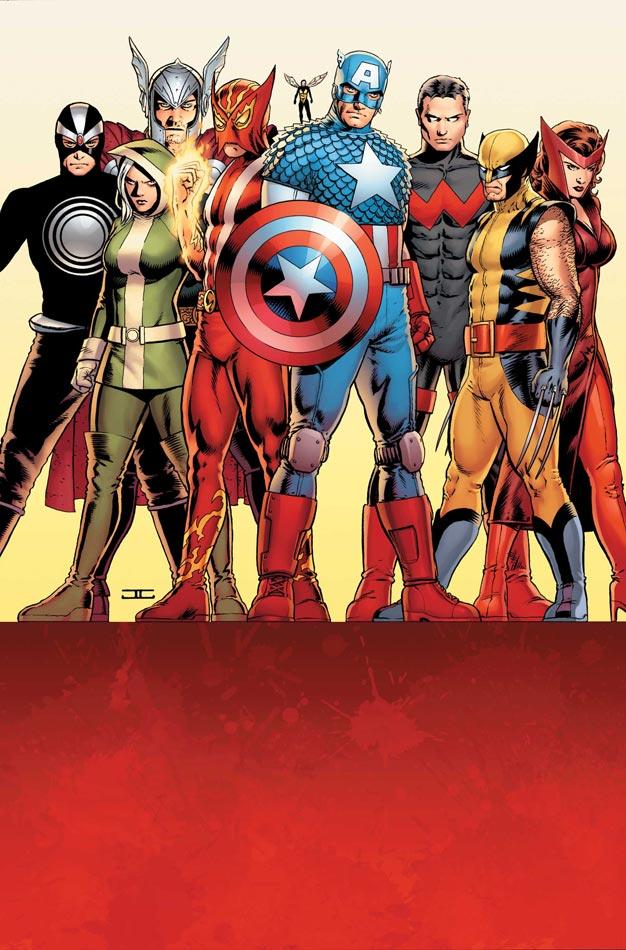
[MARVEL NOW] Uncanny Avengers: The Red Shadow

Those of you who were with me during the dark, prehistoric era of 2012, when the world was careening towards an apocalypse as anti-climactic as the end of the Twilight saga, will remember I reviewed the first issue of a series called Uncanny Avengers. Heralded as the flagship title in Marvel’s NOW relaunch, it was a promising beginning to what was hopefully a far better-handled rebooting effort than anything DC could conjure.

The series sold itself in the title as being an X-Men (hence the Uncanny) and Avengers title (hence the…Avengers). In the wake of Avengers vs. X-Men‘s disappointing conclusion, a new team of superheroes sourced from New York’s longtime saviours and those weirdo outcast people living in San Fran comes together to defend us from baddies. Their first villain – a retooled Red Skull clone who has implanted himself with the psychically-overpowered brain of the X-Men’s former leader, Charles Xavier.

I’ll get this out of the way right now – those of you gunning for a great gateway entry to Marvel, like Hickman’s Avengers title, shouldn’t get your hopes up here. Rick Remender is giving us a series built upon quite a bit of prior continuity, not to mention the massive story he told pre-relaunch in Uncanny X-Force. Those of you not firmly entrenched in the continuity may be left scratching your head through a lot of this book, and thus would probably be better served reading Hawkeye instead.

Those of you still here after that will be pleased to know Remender isn’t mishandling the reins on this one. If he’d been the one to write AvX it’s possible we would’ve gotten a far superior story with actual moral dilemmas, since there’s quite a bit of that presented throughout The Red Shadow. When you get right down to it the story is fairly basic – I mean, who hasn’t worn the “mega villain attacks New York” t-shirt and not made it overdone? – but it’s the characters that are centre stage here. There’s a ton of introspection among all the main headliners, and the plot itself actually gets resolved far quicker than I’d’ve anticipated for a lead-in story like this. In fact, in a rare feat for cape comics, the entire final issue of the book almost exclusively deals with the fallout of the preceding narrative and gives a really satisfying denouement with a great sequel hook into the next volume. It’s everything I ask for in a good character study, not just in comics, and it really brings great efforts like Batman and Robin to mind by having an ending that doesn’t entirely resort to fisticuffs for a resolution.

That being said, there is one major crime The Red Shadow is guilty of: remember that introspective dialogue I mentioned earlier? How there’s a ton of it? I don’t use that word idly. The number of little white boxes that give us present tense descriptions of what the characters are doing gets a bit ridiculous when they make up more than half the lettering of any given issue in this book. I get that there’s not a lot of room for mouthing off against supervillains when you’re mid-flight or swinging an ancient Norse hammer, and it would’ve detracted significantly from the book’s pacing if the heroes stopped mid-battle for a soliloquy every page, but there is far too much of the mind-babbling going on for me to keep that pace anyway. It’s great that Remender really wants us to know what the characters are feeling, that it’s not just a great big outdoor bar brawl, but there’s a point where you really need to just let some images speak for themselves sans dialogue. It’s something he pulled off really well in Uncanny X-Force, so why can’t we see some more of that here?

So the story’s pretty good, the dialogue is fairly snappy (when it’s not in those goddamn little white boxes) and overall it’s an enjoying read. There’s not a lot I can say about the artwork since it’s handled by John Cassaday (responsible for the gorgeousness that is Joss Whedon’s Astonishing X-Men run) and Olivier Coipel (one of the finest Avengers artists in the business), and is thus pretty damn pretty. So go on, read it. It’s pretty good.

Sorry if I seem a little distracted in this shorter review, my reading list appears to have somehow evolved into a metric ton and I’m supposed to be churning through them right now. Though my ton of books is certainly bigger than Remender’s ton of motherloving little white boxes.

STORY: 3.5/5
ARTWORK: 5/5
DIALOGUE: 3.5/5

OVERALL: 12/15

BEST QUOTE: “(about Wolverine) He’s reached “foaming at the mouth”. We’re well past the “make a plan” phase.” – Rogue

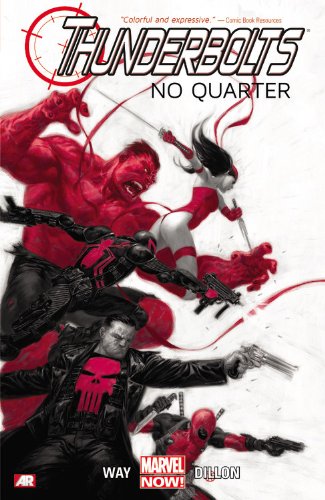
[MARVEL NOW] Thunderbolts: No Quarter

Daniel Way’s new Thunderbolts run is “Colorful and expressive”, according to Comic Book Resources. Remember this quote, I’ll come back to it later.

One of the many, many lacklustre series that Marvel had before their beautiful new relaunch was an ongoing for a character you may have heard of called Deadpool. Written by Daniel Way, the series started off great with the titular anti-hero living up to his nickname “the Merc with a Mouth”. There were jokes, there were meta-jokes, and there were pancakes. Soooooo many pancakes.

Then, as time went on, the series stagnated. The jokes became old. The self-aware humour became stale. The comedy aspect got hyper-violent and incredibly goofy, all to the detriment of one of Marvel’s most beloved antagonist protagonists. The series came to be colloquially identified online as “Way-pool”, after its author’s surname, distinguished almost entirely from every other incarnation of the character by being stupid, irreverent and, in some cases, blatantly offensive. If there are any female readers who’ve managed to get through Way’s latter Deadpool books without feeling your feminism tracts start to ignite, please send me an email because I’m pretty sure you have iron constitution.

So the relaunch comes, and Daniel Way is given the new Thunderbolts book to write. For those not in the know, the Thunderbolts were a team of anti-heroes and outright villains who went around doing odd-jobs like killing baddies and squabbling with each other. I’m not hugely familiar with the team pre-NOW, but I’m willing to bet they never had Deadpool along before this point. If they did, I’m pretty sure Way would’ve been out on his ass for suggesting him as part of the new team.

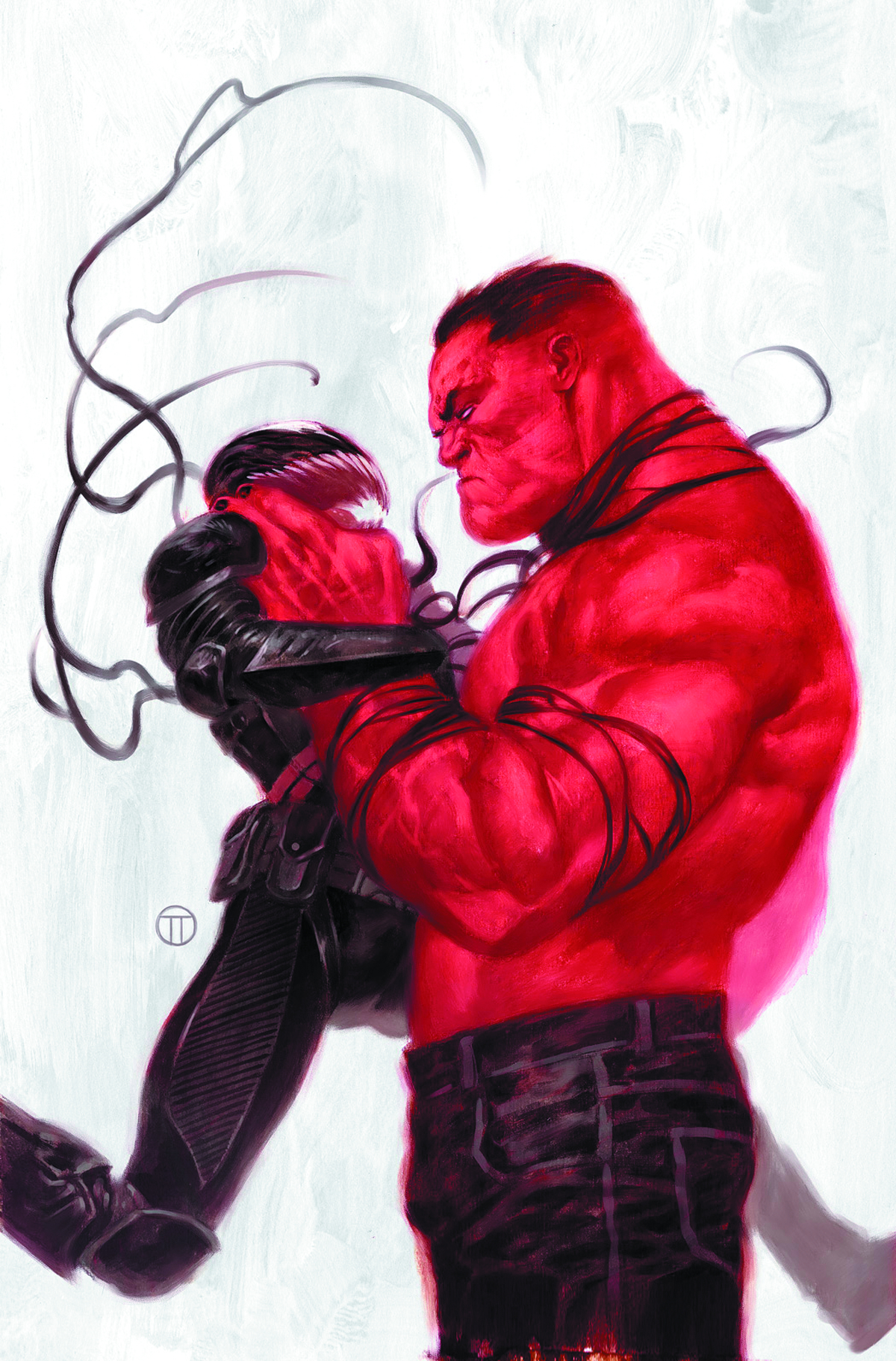
Trying my best to keep an open mind, I dove into Thunderbolts: No Quarter with as little expectation as possible. After all, it was Daniel Way (a writer I can’t stand) doing a team of anti-heroes and supervillains (a story that is far better executed in books like Uncanny X-Force) with his version of Deadpool (who, as we’ve established, is kind of bordering on dad-joke levels of humourlessness) in addition to Red Hulk, Elektra, Venom and the Punisher. That concoction of foul demon seed and whale sperm couldn’t possibly be as bad as all that, right?

Oh, optimism. You are a bitch.

Let’s be blunt – there is no story here. Seriously. The half-assed aspect of “anti-heroes kick ass together” is so paper-thin that half the anti-heroes don’t show up for most of the book, and the ones that do have achingly awkward dialogue that makes them seem as lively and likely to get along as six swordfish in a bucket. Apart from that, there’s some plot about finding a guy who was a former Hulk villain and trying to get him to do something with a computer that isn’t entirely (or even partially) explained until literally five pages before the end. Oh, and the Punisher and Elektra are apparently f**king, and Deadpool has a crush on the latter.

The casualness and unexpected nature with which I dispensed that last tidbit should tell you a lot about the curveballs the story likes to throw at you from absolute thin air. Character motivations, internal plot twists and changes in nature seem to come out of the goddamn ether with absolutely zero expectation, but in the worst way possible. Since when has Deadpool had the hots for Elektra? Why the hell is Venom housebroken enough to work with a team without laying them low to his flying black symbiote spaghetti monster? And just where the hell does General Ross’ moustache go when he turns into Red Hulk? Is the ‘stache retreating into his body what gives him his arms as thick as a pair of copulating dolphins?

This review has seemed a bit muddled and all over the place, right? Well, so’s the damn book. The plot jumps around in medias res for absolutely no bloody reason, and it’s hard to stay invested in protagonists who are about as stable in characterisation and execution as Patrick Bateman suffering from Alzheimer’s. Adding to that the lack of a plot, an incredibly ridiculous midpoint monologue from Deadpool that makes Ctrl+Alt+Del‘s walls of text seem conservative and an ending that is just so pointless it doesn’t even bear giving a spoiler warning for – it concludes with the team having to get into a submarine to go find something, meaning lots and lots of that whole “six degrees of separation” wackiness that only someone as mind-bogglingly untalented as Daniel Way could come up with as a comedic device.

What’d I say at the beginning, that Way’s run is “Colorful and expressive”? I’ll give you the first part – there is certainly a shedload of colour on display, and all of it used to ill effect. Red seems to be the predominant palette, including an incredibly stupid new crimson skull to replace the usually-white one on the Punisher’s chest, and the skin tones of all the non-masked, non-Asian characters seem to switch between Latino and Edward Cullen at the drop of a hat. Steve Dillon doesn’t do a particularly memorable job on art duties here, giving us something serviceable but unremarkable.

The second part of that accolade, “expressive”, gets shot in the kneecaps through some entirely superfluous dialogue throughout. It doesn’t quite reach Tony Daniel levels of awfulness, but on the whole it’s just bland, flat and incredibly two-dimensional. The depth of every character (particularly and most heinously Venom) is about as shallow as a broken teacup, and dialogue is so standard they’d do a better job emoting through interpretive dance. The only real stand-out in this area for me is Deadpool, but, again, for entirely the wrong reasons.

You see, there’s a reason I didn’t like the latter parts of Daniel Way’s Deadpool run – the comedy, besides being flatter than a West German orchestra, got way too American. It started to remind me of really bad sitcoms like The Big Bang Theory and Mike and Molly, where the humour comes from slapstick, angst and plain dialogue. While I enjoy an unsophisticated laugh like everyone else, it doesn’t really work when the players talk to make themselves laugh in order to make you laugh.

Well, Daniel Way is nothing if not consistent – his Deadpool here is as annoying, slapsticky and underdeveloped as it was in his core run. All that wonderful depth and black comedy brought to him in Uncanny X-Force seems to have been conveniently left out, replaced with some truly facepalm-worthy plot about Deapdool wanting to bone Elektra but getting all pouty because the Punisher got there first. It only goes downhill from there.

At the end of the day, No Quarter is an entirely forgettable, entirely superfluous and entirely ridiculous entry into the Marvel NOW canon that should be grateful it’s not currently lying in the sewage outlet pipe beside my apartment block.

STORY: 1/5
ARTWORK: 2.5/5
DIALOGUE: 1/5

OVERALL: 4.5/15

BEST QUOTE: “Who gives a #$&% where pineapples grow?” – Deadpool

Punk Rock Jesus

I am an Unorthodox Christian.

Whilst being christened under the Church of England and attending a public school with some of the most dogmatic Thursday-religion-class teachers I’ve ever suffered through might give me a great springboard towards becoming a forward-thinking, God-loving Christian without additional appellations, it wasn’t meant to be. The boring version is that there were personal issues and crises of faith during and post-High School, and in the end I came to the decision I believed there was a God (made up of only the better parts of his description), that a couple of the things in the Bible were alright, and that there was a Heaven. That was where I drew the line.

The biggest problem I find is that it’s difficult to reconcile the notion of a benevolent, loving, all-encompassing entity who also practices an almost dictatorial way of life that ensures only the best brown-nosers are ensured a place at the top when the Rapture comes. If God really does love each and every one of the delicate little snowflakes living in his planet-sized ant farm, why is he stricter than even the most stringent military procession in terms of how we live and how we die? If we’re meant to be free from the tyranny of sin, why is there a laundry list of protocols that determine what we are and aren’t allowed to do between cradle and grave? Doesn’t the idea of a strict adherence to rules not only defy the notion of free will and love of the world that we have ingrained in us since birth, but also creates a dichotomous entity in the form of our Father who art in Heaven, offering us the good afterlife if we toe the line downstairs?

Obviously the ideas of Christianity, as well as the arguments for and against, are far too vast and complex to be resolved succinctly over the course of a few paragraphs, or indeed within the pages of a book like Punk Rock Jesus. So put all my religious blathering aside for a while, and we’ll get into what you actually came here to read about.

The story, penned by Sean Murphy, is simple in premise but massively layered in execution; in a near-future where reality television is taken to its logical conclusion and becomes probably the most world-encompassing social presence since Facebook, a show company manages to create a clone of Jesus from DNA found on the Shroud of Turin implanted in a teenage virgin. The child is raised on a secret island as part of the “J2” show, which turns out to be the biggest ratings success ever (quoted as having the viewership of 27 Superbowls-worth of gormless social pollutants). Far from being a new Eden, the island and its master, Rick Slate, turn out to have less than savory plans for both the reborn messiah and his virgin mother, and things quickly spiral out of control.

The narrative follows years in the lives of several characters aside from the titular musically-influenced protagonist, showcasing not only the negative effects of both reality TV and the drive for bigger ratings, but also the extremes religion can go to in order to get their point across – both with disastrous results. The Punk Rock part comes in when, as a young adult, Jesus 2.0 joins a band to spread a message condemning the church, proclaiming his status as an atheist and inciting the people to rebel against those responsible for the reality show.

While it’s very easy for any creative or factual work to point at Christianity and label the Church as a bunch of child-molesting, moral-less thugs, it’s difficult to express disdain for their practices in an intelligent, grounded manner that still manages to have an impact without turning into a rambling author tract. Similarly, simply calling the money-hoarding masterminds behind Keeping Up with the Kardashians a load of talentless whores just doesn’t cut it as part of an intelligent and meaningful discourse. Both these points are masterfully executed by Punk Rock Jesus; points for and against both the church and the TV show are pulled off in a fashion that strongly, and intelligently, points out the minor and massive flaws inherent in both concepts. The scary dogma of the former and the hyper-fiscal drive of the latter are presented as their biggest (and, in some cases, most evil) traits, neither being shown as something to aspire to. The character dilemmas while interacting with both institutions also avoid the pitfalls of having a simplistic, one-sided disagreement with either one (that is, the characters don’t dislike either establishment simply because “they’re evil”).

To be succint, Punk Rock Jesus is fantastic. Utterly sublime, from start to finish. The plot is engrossing, the characters are fleshed out and believable in both flaws and strengths (including the truly morally reprehensible antagonist, who’s probably the most evil black-and-white-illustrated comic villain since The Governor), and there’s very little of the book that feels extraneous. The arguments against the church and reality TV, clearly fuelled by Murphy’s own thoughts on both matters, manage to be presented intelligently while still smacking the crap out of their intended targets in a way that satisfies the reader immensely. In addition, if you really don’t see the appeal of the new messiah being a mohawked, anti-establishment punk rocker who leads his fans the way a trigger-happy American General might lead his monkeys into a third-world country, then it’s probably time to reassess your life choices.

The artwork is great, but at times a bit confusing. One of the major problems faced by a black-and-white story is that the visual layers can get confusing if there’s not much definition between them, making important elements fade into the background of associated paletting. It’s not a big complaint, but there were a few moments where people or things I was supposed to notice prominently seemed to blend into the rest of the landscape. It’s also difficult to differentiate characters if they have similar faces and there’s no distinct colour variation in their outfits, which is a similar problem The Walking Dead faced. Again, not a huge issue, but it does throw you out of the reading a little when the awesome big guy character you’re meant to be liking turns out to actually be the evil big guy character who looks like his evil twin brother and is busy throwing another sackful of children into a trash compactor.
Where the artwork falters, though, the dialogue compensates. At times the tone can shift a little too awkwardly into black comedy from the serious roots of the piece, and you might think the inclusion of a punk-rocking Jesus after the opening first half of emotionally-charged world-building is a little incongruous, but overall it blends together beautifully in a way I’d not have thought possible. There’s wit, there’s drama, there’s some really heartwarming moments and there’s more obscenities than an episode of South Park dedicated to fornicating.

I really get the impression that Sean Murphy has been working on this for a long while as a labour of love, something he says as much in the afterword, and it really shows. I’d almost go so far as to call it a comic book equivalent of Inception; it’s a magnum opus, lovingly crafted from the ground up and polished long before it ever hit the media circuit, backed by a story and characters that the creator really seems invested in. Punk Rock Jesus is one of those rare delights where incongruity and social commentary fuse together to create something fantastic, and the end result is a tale that left me thoroughly satisfied.

Now if you’ll excuse me, as an Unorthodox Christian it’s time for my daily prayer to Batman.

STORY: 5/5
ARTWORK: 3.5/5
DIALOGUE: 5/5

OVERALL: 13.5/15

BEST QUOTE: “HELLO AMERICA! The most Christian nation on Earth! The one that God has blessed! This is Jesus Christ, coming to you live from Lower Manhattan, telling you all GO F**K YOURSELF! JESUS HATES YOU!” – Chris.

[MARVEL NOW] Avengers: Avengers World

Hi, DC?

Yeah, this is Marvel. We win.


I imagine this must’ve been a phonecall made somewhere along the line after both companies’ respective rebranding-relaunchy-rebooty things. Seriously, I’ve now checked out roughly half a dozen of Marvel’s new NOW books, and compared to the first half dozen New 52 stories I read it seems that Marvel have a significantly stronger upper hand here.

It may be complete, blind luck that I managed to snag titles that kicked ass all in one go (or the really bad stuff hasn’t been released yet, in which case I’ll gladly bake some humble pie and beg Batman to take me back), but so far Marvel’s new offerings have been awesome. Part of it’s because the writers are top-notch, part of it’s because the company seems to be (at least so far) treating their characters with respect, and a big part of it is because previous continuity still matters a damn. DC Comics might be raking in the big bucks in the comic world right now, but Marvel are kicking ass and taking names to such a degree with storylines and characters at the moment that I wouldn’t be surprised if Disney buys  DC out and fuses the two companies together. You could call it MC – Marvel Comics.

Oh, wait.

So while I may have tipped my hand a bit early with this review, allow me to say that Jonathan Hickman’s new take on the Avengers is frikkin’ sweet. I could just wrap it up there and give no further elucidation, but I wouldn’t be the semi-professional comic critic I pretend to be if I didn’t at least go through the motions a little.

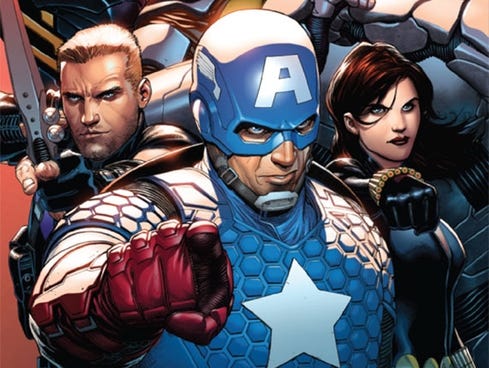
Following a need to reinvent the characters we like, as well as pare down the truly immense roster of members that’s as easy to keep balanced as a truck on a volcano lip, Hickman cuts the team down to the core six from the films – Cap, Iron Man, Thor, Black Widow, Hulk and Hawkeye. After a mission to a terraformed Mars ends with all the heroes bar Cap getting captured by the creepiest evolutionist cult to exist since the Four Horsemen in Uncanny X-Force, the team expands by taking on some former members – like old-hands Wolverine and Spider-Man – and some newbies that most casual and even long-time fans, myself included, wouldn’t know at first blush. I mean, how many of you have heard of Sunspot or Cannonball?

Don’t answer that question.

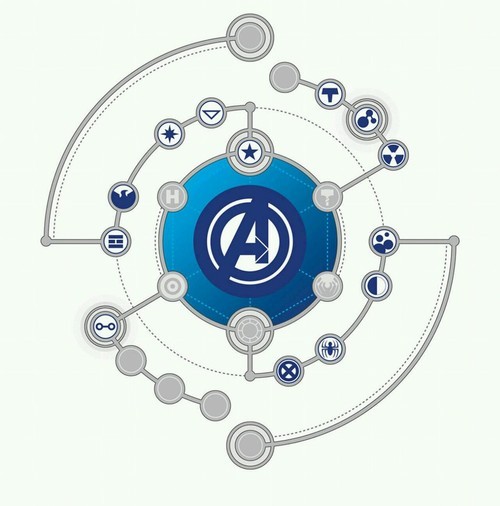
After the initial arc dealing with said cult, the book does one of the most intelligent Avengers moves
I’ve ever read; namely, instead of having six million heroes on the page at once in each issue, it takes key members of the roster and explores them for a while. A handy little diagram, nicknamed the Avengers Machine (pictured right), shows at the beginning of each story which particular members they’ll be focussing on for that issue. On top of that, we get some more in-depth character exploration with one or two of the newbies each time, since we all know by now the deeper motivations of characters like Iron Man and Hulk.

It’s a really unique take on an Avengers title, showing us the underdogs alongside the old guard while still presenting a story that feels fresh and looks awesome. In a clear break from recycled stories by long-time scribes like Brian Bendis and Dan Slott, where a bunch of heroes show up and kick the ass of the threat-of-the-week, Hickman gives us the superhero element alongside ideas of metaphysics, human psychology and creation myths that seem inspired by his indie work on titles like Red Mass for Mars and Pax Romana. The result is a story that, for me, was never boring, kept me engaged and had a great variety of unique qualities to offer as far as superhero stories go.

The artwork looks aged, but that’s not a hit against it; I mean to say it looks like a weathered, towering oak, aged by time but no less imposing. Jerome Opena and Adam Kubert do a great job at giving us the old in a new way, and while there is a clear distinction in palette and shape between the old Avengers and the newer ones it doesn’t get too jarring. There are a few moments where battle scenes can get visually confusing and colours can overlap a little, but overall it looks fantastic.

Plus, they seem to make Captain America look a little more grizzled and a little less cherry-cheeked here, which I kind of like. He looks wearier, has got more stubble than usual and has a bit of a gaunter jawline thing going on. That, combined with his newer costume, really brings him back to the soldier roots that defined him as a character – he ain’t shiny and clean, he’s gritty and ready for a fight. That’s the kind of Cap I haven’t seen since Ed Brubaker’s Winter Soldier, and it was a nice little touch.

Dialogue is pretty good, though I’ve yet to read any that feels specifically Hickman-esque. Right now we seem to be mostly getting character voices derived from who they’ve been for the past seven decades without any real new input from the author, or anything that feels distinctly like a Hickman line, but that’s ok. This is still early days, and I’m hoping that further down the line we’ll start getting characters with some more Hickman bite in their dialogue.

Overall, Avengers World kicks ass and takes names we may not have heard before, and is definitely worth your time. As Avengers stories go it’s a very intelligent read, which might put off someone looking for a good, honest superhero punch-em-up, but if you’re after a slightly denser read then it behooves you to check it out. If nothing else, it’ll make you question just how a character called Sunspot thought it was a good idea to name himself after something that causes cancer.

STORY: 5/5
ARTWORK: 5/5
DIALOGUE: 4/5

OVERALL: 14/15

BEST QUOTE: “Hey…when we get home, remind me to put “get pies” on Jarvis’ to-do list.” – Iron Man